

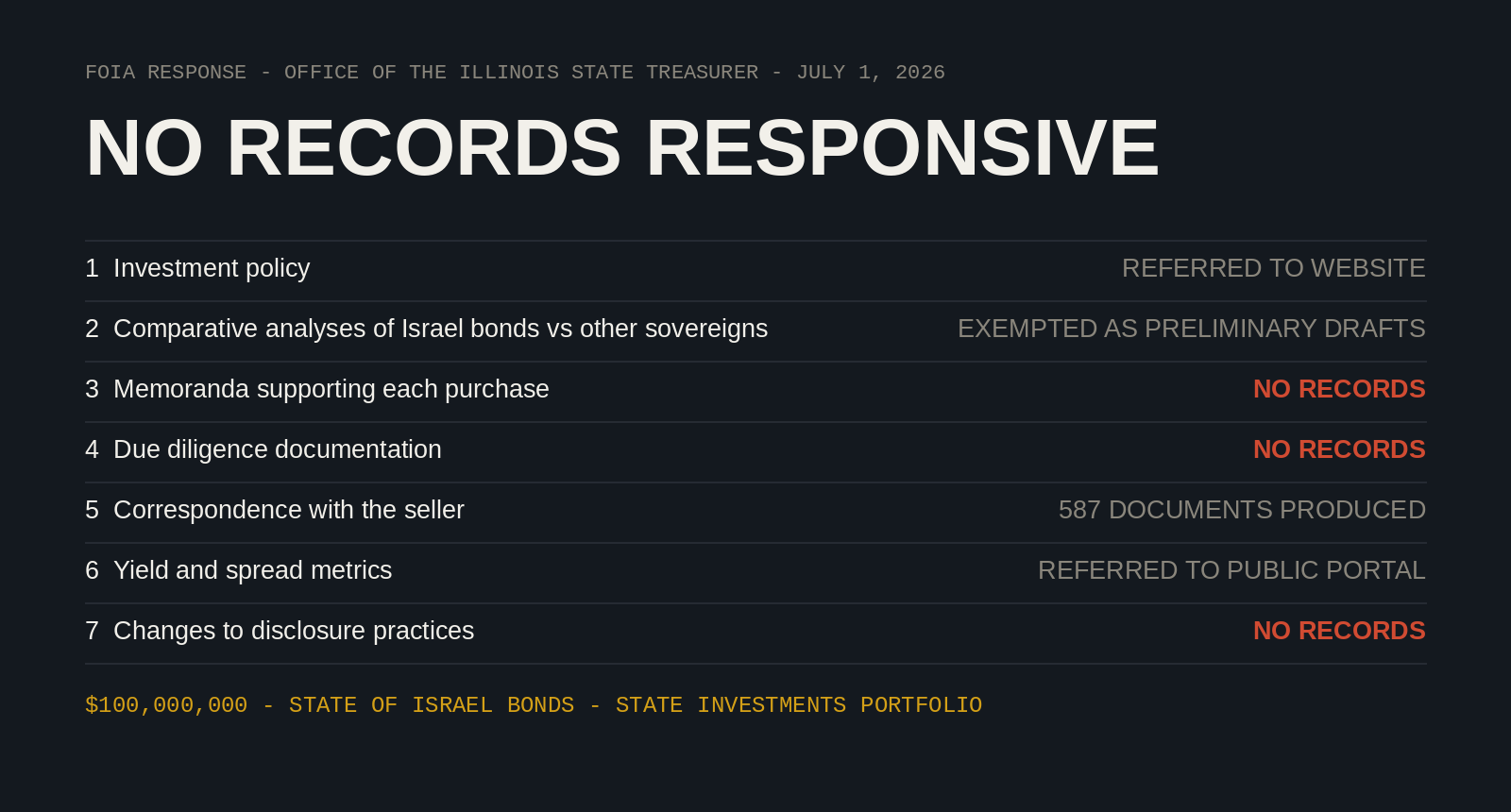
What happened: Illinois built a $100 million State of Israel bond position through repeated purchases of $5 million to $20 million over a decade, most recently at the widest spreads in the record. Why it matters: the office’s signed FOIA determination states that no purchase memoranda and no due diligence documentation exist for the position; the only analytical exchange in three years of produced correspondence is a purchase committed two hours and thirty-three minutes after the seller’s pitch. The state repeatedly lent public money to a foreign government with no written reasoning of its own anywhere in the produced record. What’s pending: a Public Access Counselor review of one determination, and a second records request on the Republic of Poland holding in the same portfolio category.
On February 26, 2025, at 10:47 in the morning, Larry Berman sent an email to the Illinois State Treasurer’s office. Berman is the National Managing Director for Corporate and Institutional Sales at Development Corporation for Israel, the FINRA-member underwriter that sells State of Israel bonds in the United States. His email went to Elizabeth Turner, the office’s Chief Banking Officer. Treasurer Michael Frerichs was copied.
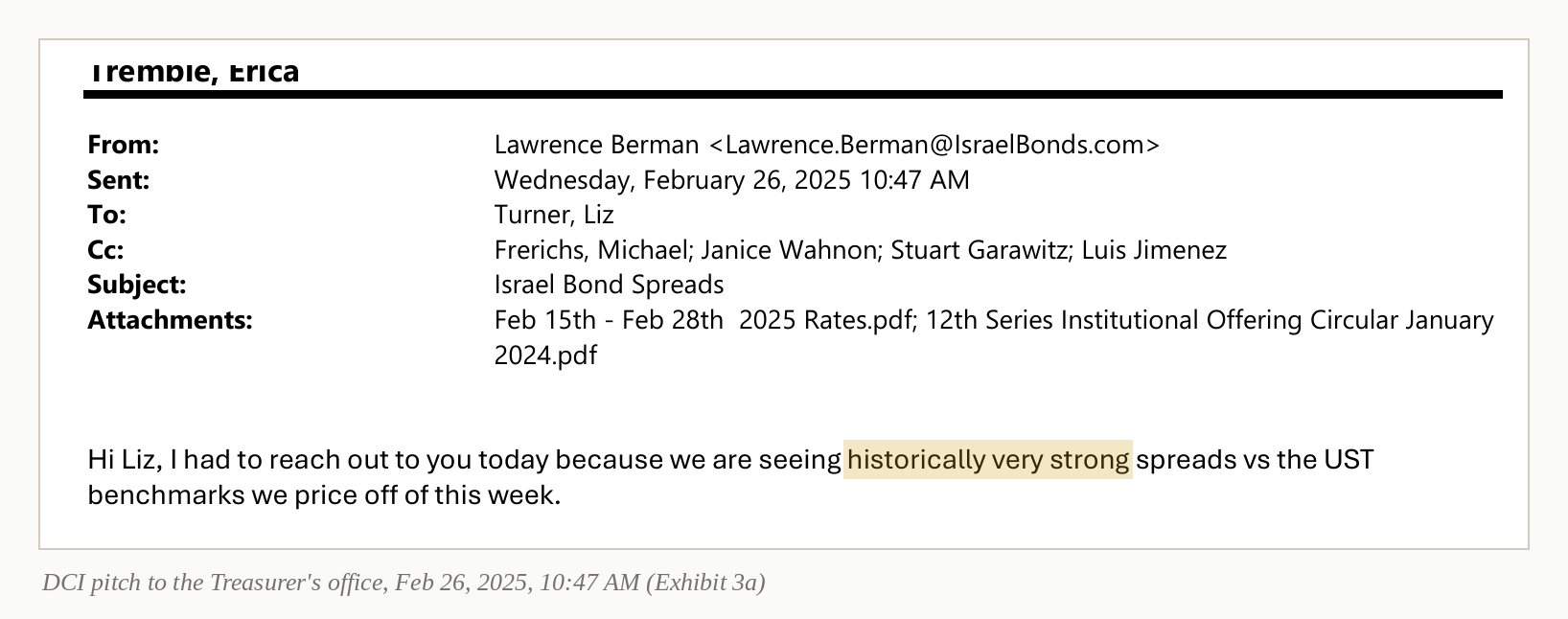
Berman’s pitch was specific. Israel bonds were paying spreads over comparable U.S. Treasuries of 64 basis points at two years, 104 at three, 159 at five, and 172 at ten. He called the spreads “historically very strong” and suggested the office place its order that day or the next. A rate sheet and the current offering circular were attached.
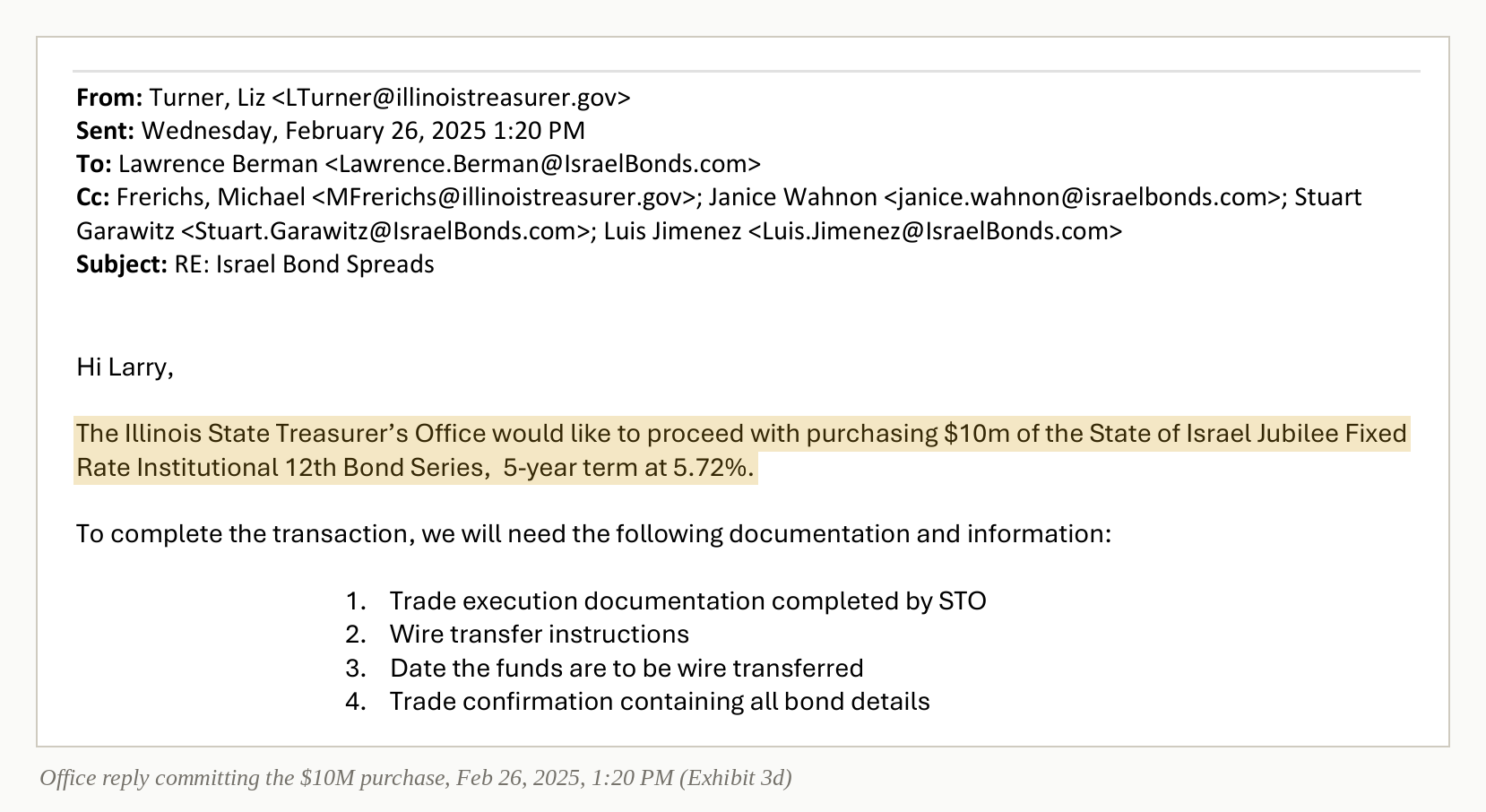
At 1:20 that afternoon, two hours and thirty-three minutes later, Turner replied. The office would proceed with a $10 million purchase of the five-year bond at 5.72 percent. Four questions followed. They concerned the execution documents, the wire instructions, the wire date, and the trade confirmation. The money moved on March 3.
Taken alone, this is an efficient transaction. What gives it weight is its context, and the context is now a matter of public record, because I asked the office for all of it.
On June 11, 2026, I submitted a seven-category request to the Treasurer’s office under the Illinois Freedom of Information Act, covering the office’s State of Israel bond holdings from June 1, 2023 forward. The office responded on July 1 with a signed determination letter (Exhibit 2) and a production of 587 documents. The February 2025 exchange is in the production (Exhibits 3a–3d). It is the only analytical conversation in it. And the categories that would contain the office’s own analysis came back with a specific answer: no records responsive.
The documents cited in this piece are collected at christopher-sweat.com/documents/100m-no-memo. Inline citations link to the files there.
What the office produced
The office handled the request properly. It invoked a lawful extension with statutory citations and responded inside the extended window. It also produced more than the request required. The request excluded routine transactional confirmations from the correspondence category; the office produced them anyway, and those confirmations turned out to be the most informative documents in the file. Nothing in this piece rests on a procedural failure by the office. The findings rest on what the office, following procedure, said it has and does not have.
The seven determinations, from the July 1 letter signed by FOIA Officer Erica Tremble (Exhibit 2):
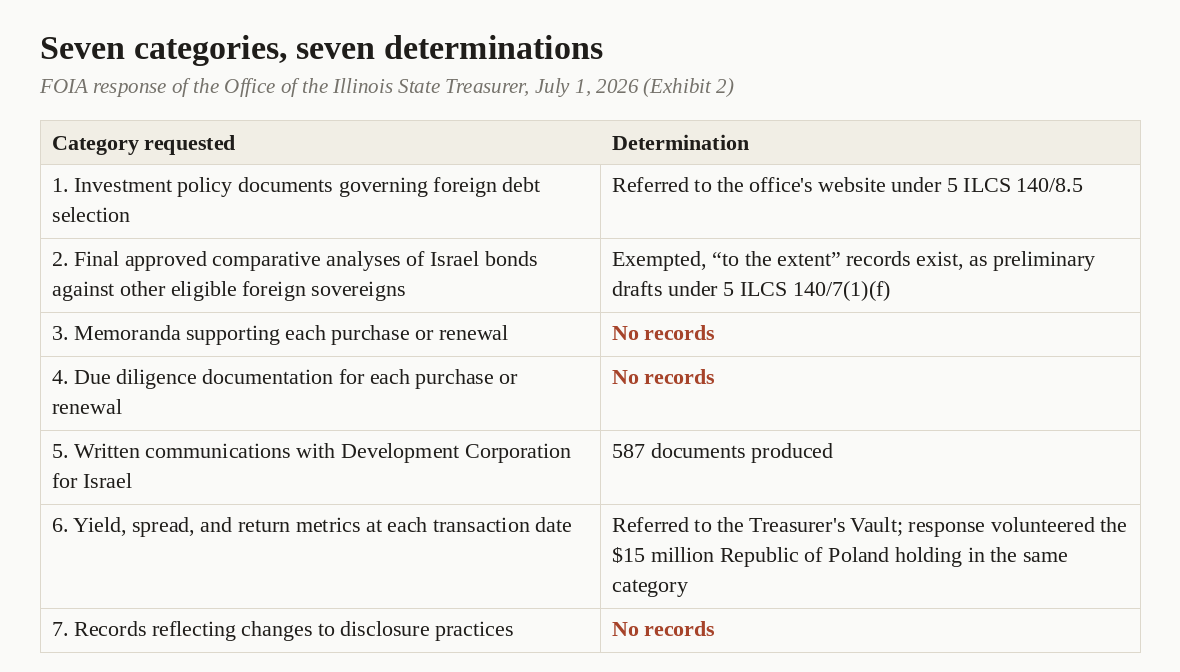
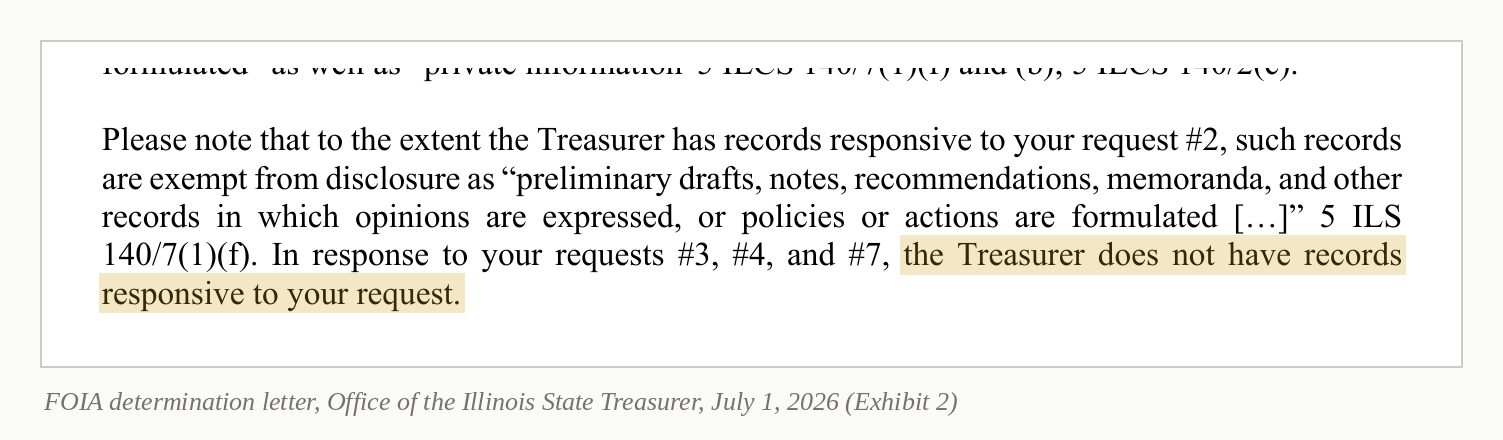
Categories 3 and 4 are the anchor of everything that follows. In the office’s own words, it does not have records responsive to a request for the memoranda supporting each purchase of a $100 million position, and it does not have records responsive to a request for the due diligence documentation connected to those purchases.
Category 2 contains a drafting problem worth stating precisely. The request asked for final approved comparative analyses. The response withholds records, to the extent they exist, as “preliminary drafts, notes, recommendations, memoranda and other records in which opinions are expressed, or policies or actions are formulated.” A final approved analysis is not a preliminary draft. The response supports two readings. Under the first, no final comparative analysis exists, and the exemption is invoked against materials the request did not seek. Under the second, a final analysis exists and is being withheld under an exemption that does not cover it. I have filed a Request for Review with the Public Access Counselor at the Office of the Attorney General asking which reading is correct. That review is pending.
What the file shows
The produced records, joined to the office’s public Vault data, reconstruct the position completely. The two sources reconcile to the dollar in every month where they overlap.
The program is old. Security-level records show State of Israel bonds in the portfolio since at least July 2016, purchased in $10 million blocks at coupons between 1.53 and 3.53 percent, held to maturity, and rolled. The post-October 2023 change is one of scale and price, not of existence.
The current position, from the office’s Computershare interest advice of May 1, 2025 (Exhibit 4), cross-checked against trade confirmations (Exhibits 5a–5f) and the Vault’s security-level data (Exhibit 13a):
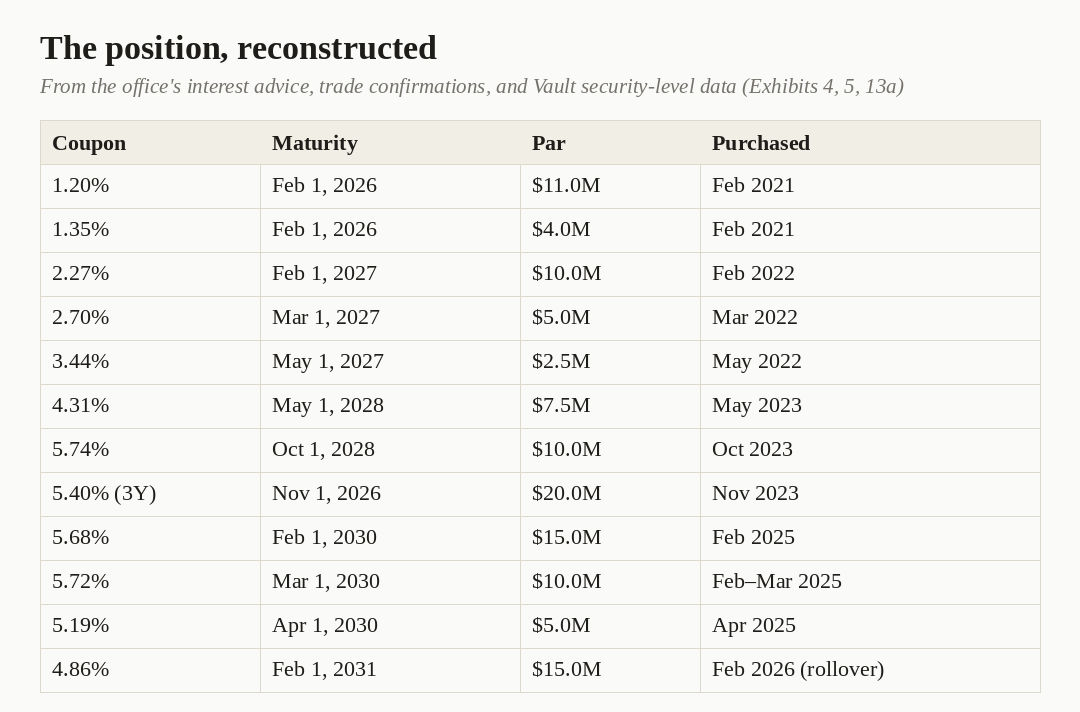
The coupon ladder tells the price story in one column. The state lent to the same sovereign at 1.20 and 1.35 percent in February 2021. It re-lent at 5.68 and 5.72 percent in early 2025. In February 2026 it rolled the maturing 2021 paper into a new five-year at 4.86 percent (Exhibit 6a, Exhibit 6b).
Coupons move with Treasury rates, so the coupon alone conflates two things. The spread over the Treasury curve at each purchase date separates them. The table below uses the official daily par yield curve published by the U.S. Treasury, matched to each bond’s issue date (working values at Exhibit 13b). Two purchases carry a second figure because the seller’s own emails state the spread as priced off DCI’s two-week period benchmarks, which differ from the official close by a few basis points.
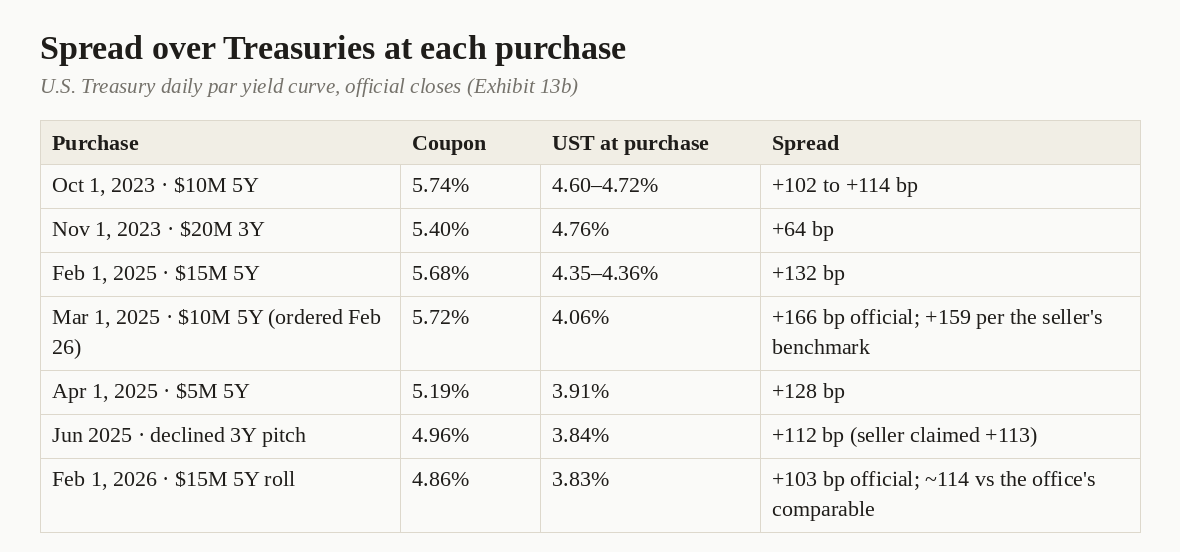
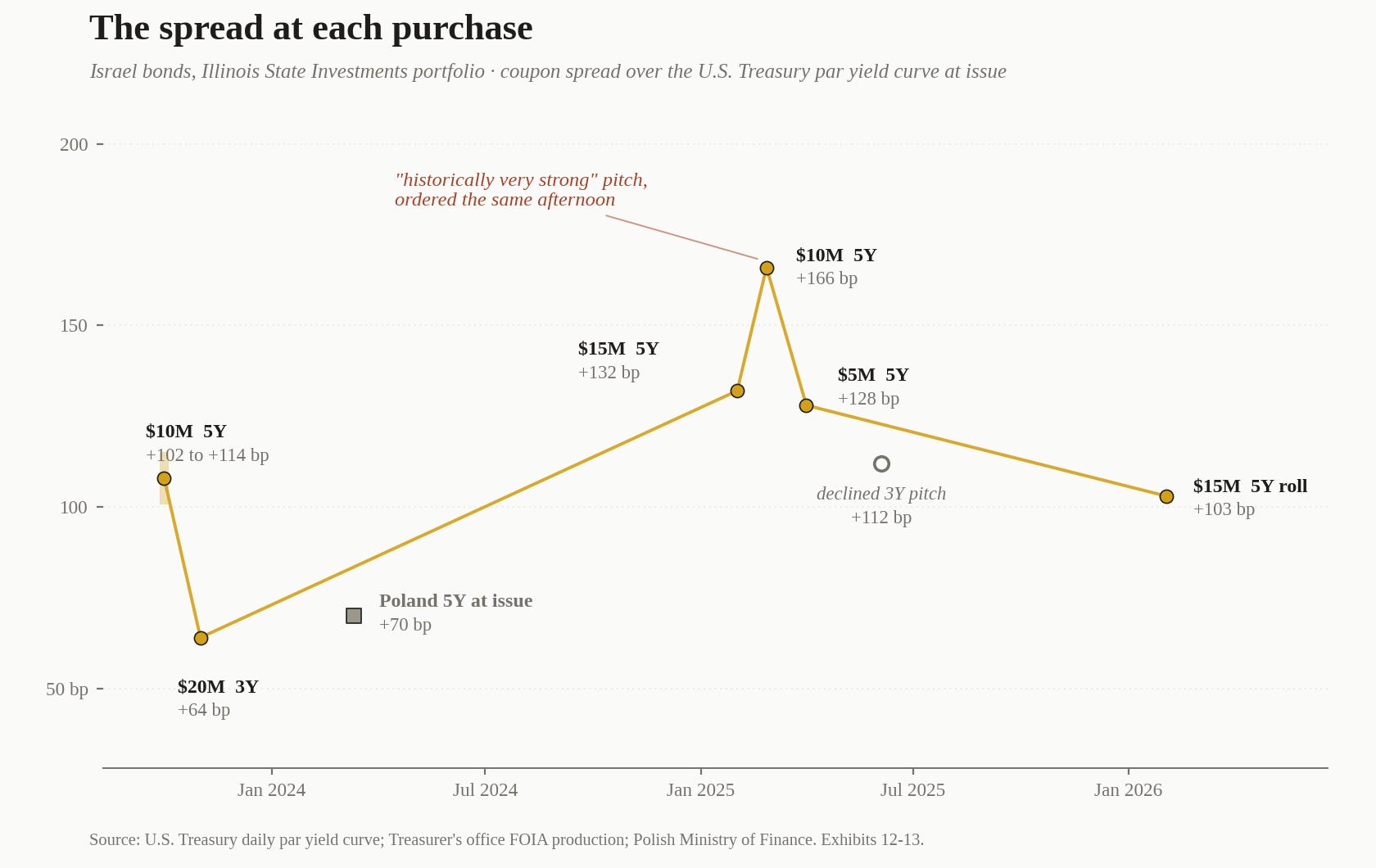
A note on the last row. My earlier pieces carried the office’s characterization of the February 2026 renewal as roughly 114 basis points over a comparable Treasury. Against the official curve on the first business day after issue, the figure is 103. The difference is the choice of benchmark, and the table above states each figure with its method. The refinement bears on the decomposition from the first piece in one direction only: the credit and illiquidity components were sized against the office’s 114, so a renewal spread of 103 leaves the residual excess return at or below zero. The measured figure tightens the original conclusion. The same treatment applies to the seller: Berman’s February 2025 pitch claimed 159 basis points against his period benchmark, and the official close that day makes it 166.
Precision also matters on October 2023. The $10 million bond in the ledger carries an October 1 issue date. October 1 precedes October 7. The record produced cannot resolve when the order was placed relative to the attack, and this piece does not describe that purchase as a response to it. The purchases that unambiguously follow October 7 are the two November 1 trades totaling $20 million. What the record does establish is the tempo of the correspondence in that window: the produced record runs in the single digits per month through September 2023, then 62 documents in October, 57 in November, and 59 in December, nearly all of it the seller’s outbound content.
The record also shows the office declining. In April 2025, Berman wrote to flag that the office had $5 million maturing May 1 and to recommend reinvestment at what he again called stronger-than-usual spreads (Exhibit 7a). The office let the bond mature without a roll. In June 2025, Berman pitched a three-year at 4.96 percent, 113 basis points over his benchmark, a figure the Treasury data confirms almost exactly (Exhibit 7b). No reply appears in the production, and no purchase followed. The office says yes, and the office says no. What the file lacks is documented reasoning behind either answer.
The spread, revisited
My first piece argued that the spread on these bonds is compensation, priced by the market, for sovereign credit risk and for a non-tradable structure, with nothing left over as excess return. The second piece reported the Bank of Israel’s own confirmation that the risk premium had compressed to near its pre-war level. The FOIA production adds a fact the framework could not supply on its own: the position’s largest recent purchase was made at the widest spread in the record, on the seller’s word that the width was strength.
The width was the market’s price on Israel’s credit. Here is the rating history over the holding period, from the agencies’ actions:
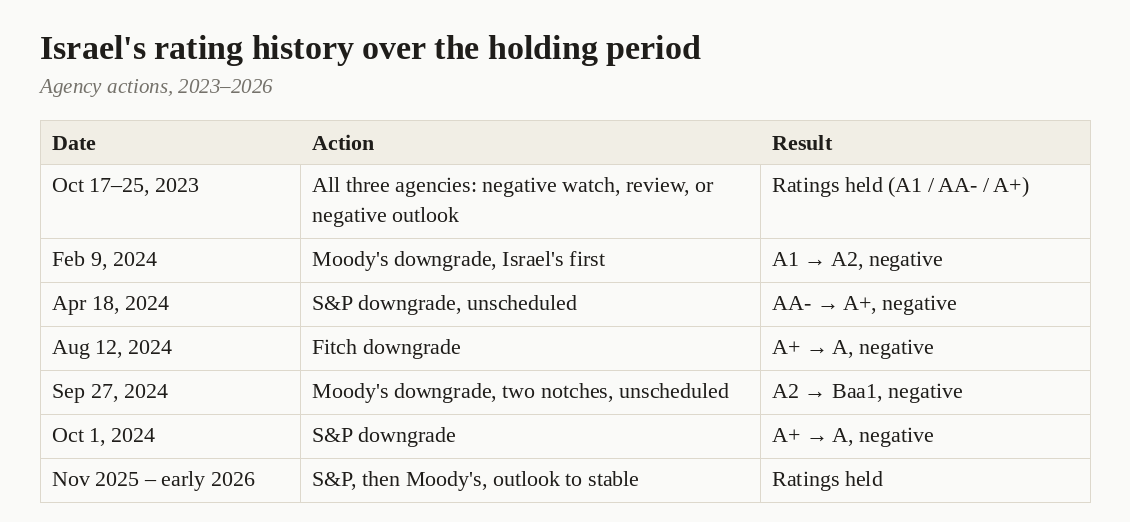
The February 26, 2025 order was placed five months after the last of five downgrades, with all three agencies on negative outlook. The 166-basis-point spread the office bought that day was wide because the market had repriced the sovereign. “Historically very strong spreads” and “historically elevated credit risk” describe the same number from two directions. The seller chose the first description. The produced record contains no document in which anyone at the office weighed the second.
The governing investment policy requires foreign sovereigns to be rated in one of the three highest classifications by at least two standard rating services. At every 2025 purchase, S&P and Fitch stood at A, and Moody’s stood at Baa1, below the line. Two of three agencies satisfied the floor. The purchases were compliant. The margin was zero.
The vocabulary of the production makes the same point at the corpus scale. Across all 587 documents, three years of correspondence between the office and the seller of a nine-figure position, the phrase “due diligence” appears zero times. “Comparative” and “comparison” appear zero times. “Risk assessment” appears zero times. The analytical vocabulary that does appear, spreads, and benchmarks appears in the seller’s rate pitches and in the one February 2025 exchange. The only analysis present in the file is the seller’s.
The Poland position
The comparator was in the portfolio the whole time. The office’s own FOIA response volunteered it: the Foreign Bonds category holds $15 million in Republic of Poland bonds alongside the Israel position.
The Vault identifies the bond. It is the five-year tranche of Poland’s March 11, 2024 dollar benchmark, a $1.5 billion issue carrying a 4.625 percent coupon and maturing March 18, 2029. Poland’s Ministry of Finance published the pricing: 70 basis points over the comparable Treasury, yielding 4.797 percent at issue (Exhibit 12 links). Illinois’s records show the position at a cost of $14,918,400 against $15 million par, a price of 99.456, added to the portfolio in January 2025 (Exhibit 13a).
Set the two holdings side by side. Poland, rated A2, A-, and A-, was bought through a broker at a market price below par, in an instrument priced by a $1.5 billion syndicated book at 70 basis points over Treasuries. Israel, rated Baa1, A, and A at the time, was bought at par at the seller’s posted rate, at 159 to 166 basis points over Treasuries, one month later. Same portfolio category. Same buyer. Same quarter.
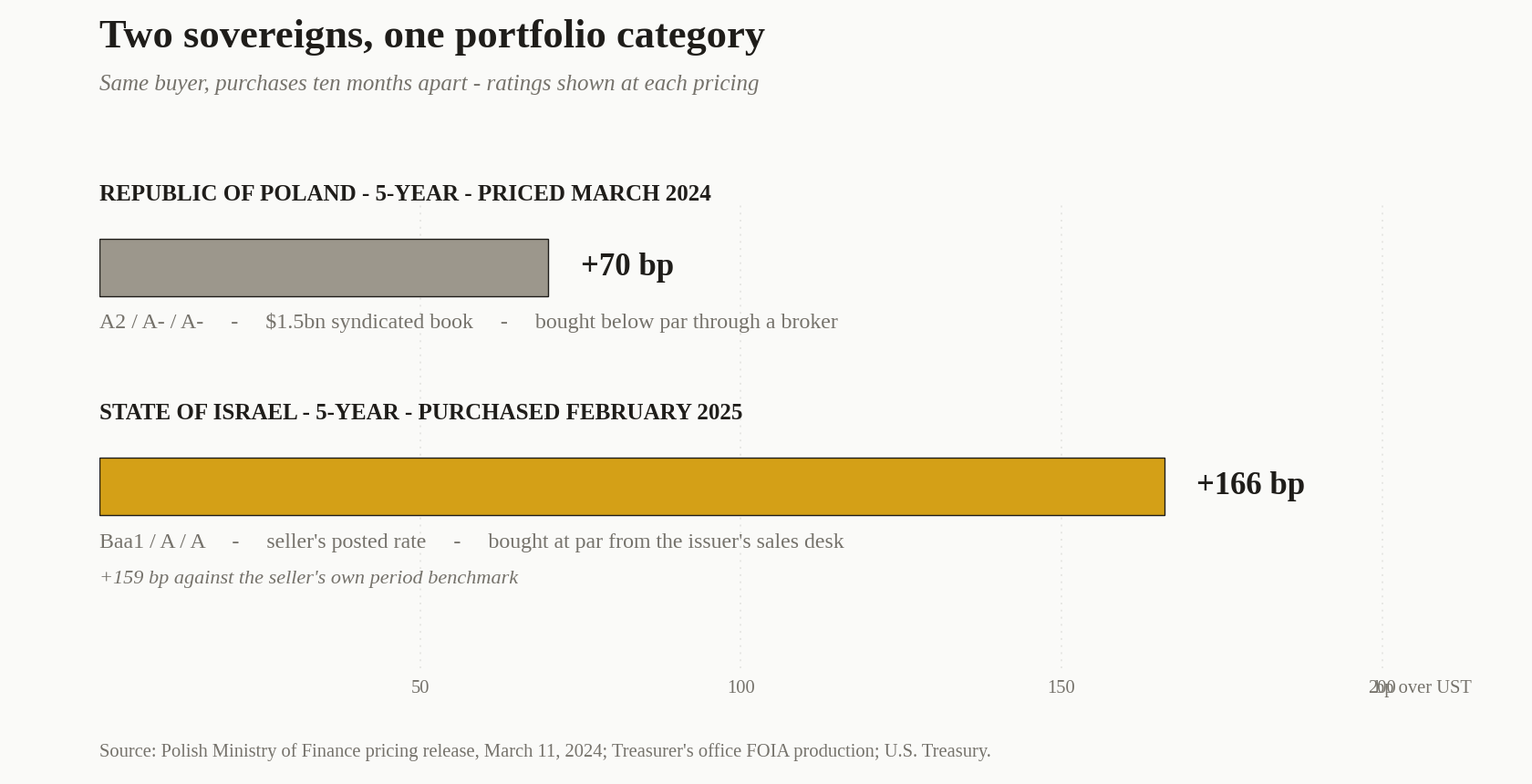
An 89-basis-point difference between two sovereigns in the same allocation is precisely the object of a comparative analysis. The word “Poland” appears nowhere in the three years of produced correspondence. Whether the Poland purchase includes the memoranda and due diligence documentation that the Israel purchase lacks is a question that the same statute can answer, and on July 1, I filed a second FOIA request seeking them. If records exist for Poland and not for Israel, that is a finding. If records exist for neither, the gap is portfolio practice, and the Israel position is its most visible instance. The response is due this month.
Policy versus record
The purchases were lawful. That conclusion is worth stating plainly because it concentrates the weight on the missing documents.
Two versions of the State Treasury Investments Portfolio Investment Policy Statement govern the ledger. The version approved on October 26, 2022, and effective on December 1, 2022 covers every purchase through October 2025, including all of the 2025 acquisitions. The current version, effective October 22, 2025, covers the February 2026 rollover. Both are linked at Exhibit 12. On the sections that matter here, the two versions are word-for-word identical.
The policy requires competitive bids from at least three broker-dealers before a purchase, and it exempts reverse inquiry investments and new-issue purchases from that requirement. Every DCI purchase in the record is a dealer-initiated offer of a new issue. Each one ran through the exemption lawfully. No violation occurred, and no bidding file exists because none was required. The consequence is structural: for this position, the documentation of judgment cannot live in a bidding record. It can only live in the memoranda, the due diligence files, and the comparative analyses. Those are categories 3, 4, and 2. Two are empty by the office’s own statement, and the third is withheld as preliminary, if it exists at all.
The policy caps foreign government securities at three-quarters of one percent of the portfolio, with a five-year maturity limit. At no point in a decade of data has the position approached the cap; peak usage was 0.480 percent in February 2020. Every holding sits at or under the maturity limit. The compliance record is clean, and this piece makes no claim to the contrary.
One difference between the two policy versions bears on the empty categories. The 2022 version seats a Director of Investment Analysis and Due Diligence on the Investment Policy Committee. The 2025 revision drops the title from the committee roster. The office’s no-records response is specific to these purchases, and nothing in the file speaks to the position’s work elsewhere in the portfolio. The juxtaposition is stated here without a conclusion because the record supports none.
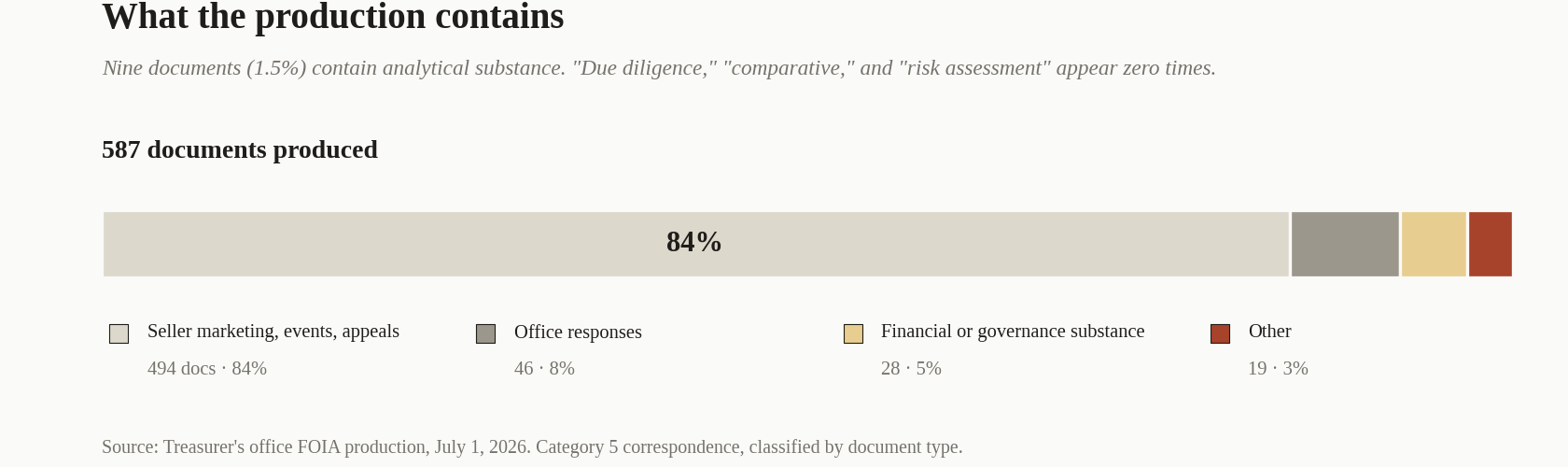
What the file documents, at length, is the register of the relationship the correspondence carries. 84% of the production consists of DCI marketing, event invitations, and appeal content addressed to the office. Substantive office responses make up roughly eight percent. About a dozen documents in the entire production contain financial or analytical content of any kind. Three items from the marketing stream describe the register better than any characterization could.
On May 28, 2024, DCI’s marketing list delivered an email to the Treasurer’s own address under the subject line “They say divest, we say double down” (Exhibit 8). Its text: “The most direct and impactful way to combat BDS is by making additional investments.”
On November 21, 2023, three weeks after the office’s $20 million November purchase and one month after Moody’s placed Israel on review for downgrade, DCI marketing quoted a Moody’s publication calling the bond program “a stable and reliable source of funding” (Exhibit 9). The email’s own footnote reads: “*Israel bonds are not rated.” The instruments Illinois holds carry no rating of their own. The policy’s eligibility test depends on the sovereign’s rating, and the seller’s disclaimer states this distinction precisely.
On May 16, 2024, after the year’s first two downgrades, the Accountant General of the State of Israel, Yali Rothenberg, wrote to Treasurer Frerichs directly, copying DCI’s chairman and its chief executive (Exhibit 10). The letter told the Treasurer that his decision “not only aligns with this fiduciary duty but also reflects a principled stance in support of a longstanding ally,” and spoke of the investment’s “symbolic importance.” The issuer’s own senior fiscal officer, describing the holding, went beyond the financial vocabulary in a single sentence.
The file also shows the relationship running in the other direction. On November 9, 2023, eight days after the November trade date, the Treasurer sent DCI’s Midwest office a recorded video of his remarks, from his phone, for use at an event that Sunday (Exhibit 11).
The answer on file
The question my first piece raised was procedural. Given a universe of statutorily eligible foreign sovereigns paying market-clearing spreads, what process selects this one, and where is it written down? Existing law already obligates public fiduciaries to be able to answer.
The office has now answered, in a signed determination. For every purchase and renewal the request reached, back to June 2023, the memoranda do not exist. The due diligence documentation does not exist. The comparative analysis, if it exists, exists in a form the office calls preliminary. The selection process that has chosen this security, purchase after purchase across a decade, produced 587 documents of the seller’s correspondence, one afternoon’s exchange, and no file of its own for the window examined.
That is not a bad answer. It is no answer.
The record stays open. The Public Access Counselor’s review of the category 2 determination is pending. The Poland request is pending. Another $20 million of the position matures this November, and the next decision will be made under the same policy, by the same office, with the same empty file, unless the office fills it. It can. The policy describes the process; the process would produce documents; the documents would answer the question. The office was provided a summary of these findings on July 1 and invited to comment or correct any error by 5 PM on July 6. No response was received before publication. Any response received afterward will be reflected in this piece.
Methods and record
Spread figures are the difference between each bond’s coupon at issue and the U.S. Treasury par yield at the matching tenor on the issue date, or the nearest business day where the issue date falls on a weekend, from the Treasury Department’s published daily curve. They are coupon spreads on non-tradable instruments, not market option-adjusted spreads. Where the seller’s correspondence states a spread against its own period benchmark, both figures appear with the method identified. The holdings ledger derives from the office’s produced interest advice and trade confirmations, reconciled against the security-level Security Holdings Report in the Treasurer’s Vault; the two sources agree to the dollar in every overlapping month. Corpus statistics cover all 587 produced documents, including optical character recognition of image-only files. The document production is replicable in full: any person may submit the request at Exhibit 1 under 5 ILCS 140. The working data are in Exhibit 13a and Exhibit 13b.
Update: July 10, 2026
The office has responded to the follow-up request on the Republic of Poland holding, the control case this piece flagged as pending. Two findings follow. Both belong in the record.
First, the formal documentation gap is portfolio-wide. For Poland, as for Israel, the office reports no due diligence documentation. It reports no comparative analysis of Poland against other eligible sovereigns. It claims the preliminary-drafts exemption for any memoranda supporting the purchase, the same exemption it claimed for the Israel comparative analyses. On paper, the two files carry matching determinations.
Second, the produced trade file shows the process behind the Poland purchase, and it does not resemble the Israel record. On January 29, 2025, a portfolio staffer emailed the Chief Banking Officer a written comparison of three Poland issues on spread, yield, price, and call structure, with market data attached, and recommended one: “I think the 2029 issue is best.” Two hours later the Chief Banking Officer replied: “I have received the approval to purchase.” The office then bought the bond through a competitive broker at a market price below par, and the file preserves a multi-dealer quote screen and three months of price history. Twenty-eight days later, the same Chief Banking Officer committed $10 million to Israel bonds two hours and thirty-three minutes after the seller’s pitch. The 587-document Israel production contains no written comparison of alternatives and no market check.
Both purchases closed the same day they started. The difference is what filled the hours.
The Poland production is posted in the document archive. A narrowed request for the communications behind the Poland purchase is now pending, and the production has been submitted to the Public Access Counselor as supplemental material in the pending review. A full analysis of the Poland file will follow as the fourth piece in this series.
Sources: Office of the Illinois State Treasurer FOIA response and document production, July 1, 2026 (all quoted correspondence is from that production); Office of the Illinois State Treasurer, The Vault, Security Holdings Report; State Treasury Investments Portfolio Investment Policy Statements effective December 1, 2022 and October 22, 2025; U.S. Department of the Treasury, Daily Treasury Par Yield Curve Rates; Republic of Poland Ministry of Finance, pricing announcement of March 11, 2024; Moody’s, S&P Global, and Fitch rating actions of February 9, April 18, August 12, September 27, and October 1, 2024, as contemporaneously reported and per the agencies’ releases.
Written in a personal capacity. Views are my own and do not represent GrayStak or any affiliated organization. The author holds no position in any security discussed, has no compensated relationship with the Office of the Illinois State Treasurer, Development Corporation for Israel, or any divestment coalition, and was not paid to write this piece. A Request for Review of one determination in the office’s FOIA response is pending before the Public Access Counselor; a second FOIA request concerning the Republic of Poland holding is pending before the office. Statutory and policy interpretations reflect the author’s reading and have not been adjudicated. Spread figures are coupon spreads over the Treasury par yield curve at issue, not market option-adjusted spreads; the instruments are non-tradable. This piece is procedural and analytical. It takes no position on the underlying sovereign, the conflict, or state foreign policy. Not investment advice.
Christopher Sweat (christopher-sweat.com) is a political risk analyst and the co-founder and CEO of GrayStak, a media and political risk company that covers social and political dynamics in real time and produces the Domestic Political Volatility Index (DPVI), an institutional-grade signal product. He is based in Chicago. This piece is the third in a series applying sovereign credit analysis to Illinois public investment, following “The Spread Isn’t Alpha” (May 25) and “The Cut and the Choice” (May 27). The series, including the underlying FOIA work, is reported and written in a personal capacity.