

What happened. Alderman Maria Hadden filed substitute language for O2026-0027165 on August 26. The Committee on Environmental Protection and Energy votes on it September 1.
Why it matters. Municipal Code 18-14-102.3 withholds energy data for buildings with data centers until the city’s Chief Sustainability Officer determines that the benchmarking tool can adjust for them. She then reports that determination to the Mayor and the City Council. No Council vote is required at any point. The city has not said whether it has ever made the determination.
What is pending. Twelve of the committee’s fifteen members already sponsor the underlying ordinance. The Clerk has docketed a substitution action for September 1. The agenda posted August 27 and describes the item in the terms of the version the substitute replaced. Written public comment closes at 2 p.m. August 31.
The substitute grew from one code section to three
Hadden introduced O2026-0027165 on July 15. It ran one page and changed a single provision, striking the letter S from a list of occupancy classifications in Municipal Code 18-14-101.3, the definition of a covered building. The phrase “data center” did not appear in it. GrayStak reported on that ordinance and on the zoning classification behind it on August 17, in Chicago Zones Data Centers as Offices.
Hadden’s substitute runs two pages and amends 18-14-101.3, 18-14-101.4 and 18-14-102.3.
The Clerk’s caption describes it as an amendment of Sections 18-14-101.3 and 18-14-101.4 “regarding covered buildings and related public availability of water usage data” and of Section 18-14-102.3 “removing ‘data center’ exception from benchmarks and performance ratings made public by Chief Sustainability Officer.”
Occupancy classification no longer decides whether the ordinance applies
The letter S stays. The exclusion list still reads Group A-5, F, H, S, or U. The substitute adds an override.
Provided, however, the term “covered building” shall include any Group 1 covered building or Group 2 covered building with a data center.
Under the introduced version, coverage turned on whether the building code assigns data centers to Group S under Chapter 14B-3. GrayStak asked the Department of Buildings that question on August 13. The department has not answered. The city no longer needs to.
Chapter 18-14 already defines the term, and the substitute displays the existing definition without touching it. A data center is a space specifically designed and equipped to meet the needs of high-density computing equipment such as server racks, used for data storage and processing, as defined by the benchmarking tool.
Hadden’s committee wrote on August 18 that the ordinance was drafted to reach data centers, which “had not been contemplated in the initial benchmarking ordinance.”
Two words are deleted from the disclosure exception
Section 18-14-102.3 is titled “Disclosure and rating.” Subsection (g) authorizes the Chief Sustainability Officer to make reported benchmarking information and energy performance ratings publicly available. An exception follows it.
That exception reads:
Unless a different result is mandated by applicable law, the Chief Sustainability Officer shall not make readily available to the public any individually attributable reported benchmarking information or energy performance rating pertaining to a covered building that contains a data center, television studio, or trading floor that together exceed 10 percent of the gross square footage of any such building until the Chief Sustainability Officer determines that the benchmarking tool can make adequate adjustments for such facilities. When the Chief Sustainability Officer determines that the benchmarking tool can make such adjustments, it shall report such determination to the Mayor and the City Council.
Deleted from it are the words “data center” and the comma after “television studio.” Television studios and trading floors stay inside the exception. The determination requirement stays in the code. Neither one applies to data centers now.
The suspension has never governed only the numbers. Subsection (d)(i) withholds the energy rating card from any building exempt from disclosure under 18-14-102.3, and subsection (e) puts that card where the public can see it. An unmade determination keeps the rating card off the building.
Angela Tovar holds the office that can make it. She is Chief Sustainability Officer and Commissioner of the Department of Environment, one person in both roles. She convened the working group under Council ordinance SO2024-0008201 and co-chairs the task force created by Executive Order 2026-5.
GrayStak asked the Department of Environment on August 13 and again on August 21 whether it has ever made or reported that determination. The department has not answered either request.
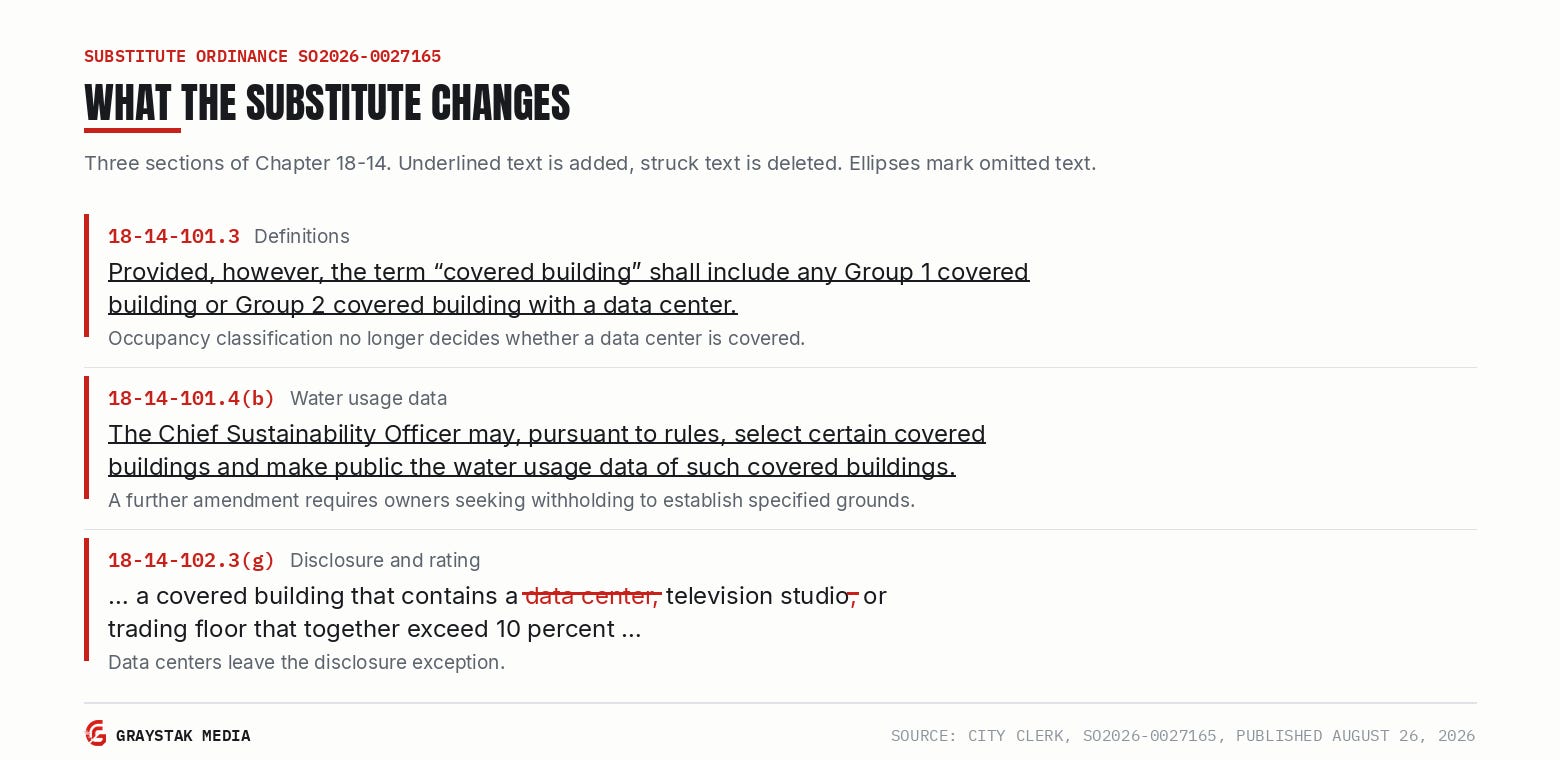
The substitute amends three sections of Chapter 18-14. Underlined text is added, struck text is deleted. Source: City Clerk, SO2026-0027165, published August 26, 2026.
Two city offices described the same document differently
Gina Parra-Hughes, deputy director of policy and outreach for the committee, wrote on August 21 at 11:34 a.m. that the substitute would address “definition and disclosure and rating” and would amend Section 18-14-102.3. She said the Department of Environment was working with the committee on the language and that no copy was available for public distribution.
Asked in the same email whether the Council has ever received a determination under 18-14-102.3, she wrote that she did not have a yes or no answer, and that the question “is something the Chief Sustainability Officer’s office would be better positioned to confirm.”
On the evening of August 25, a spokesperson for the Mayor’s Press Office said that while the Chief Sustainability Officer has jurisdiction over the covered buildings list, the Municipal Code “currently exempts data centers from reporting their energy and water usage,” and that amending the Code “requires City Council action.”
“Amending the Municipal Code requires City Council action.”
Mayor’s Press Office spokesperson, August 25
The Code exempts certain buildings from the definition of a covered building, which governs reporting. A separate section suspends disclosure for buildings containing data centers, and lifting that suspension takes no Council vote. The substitute amends both sections.
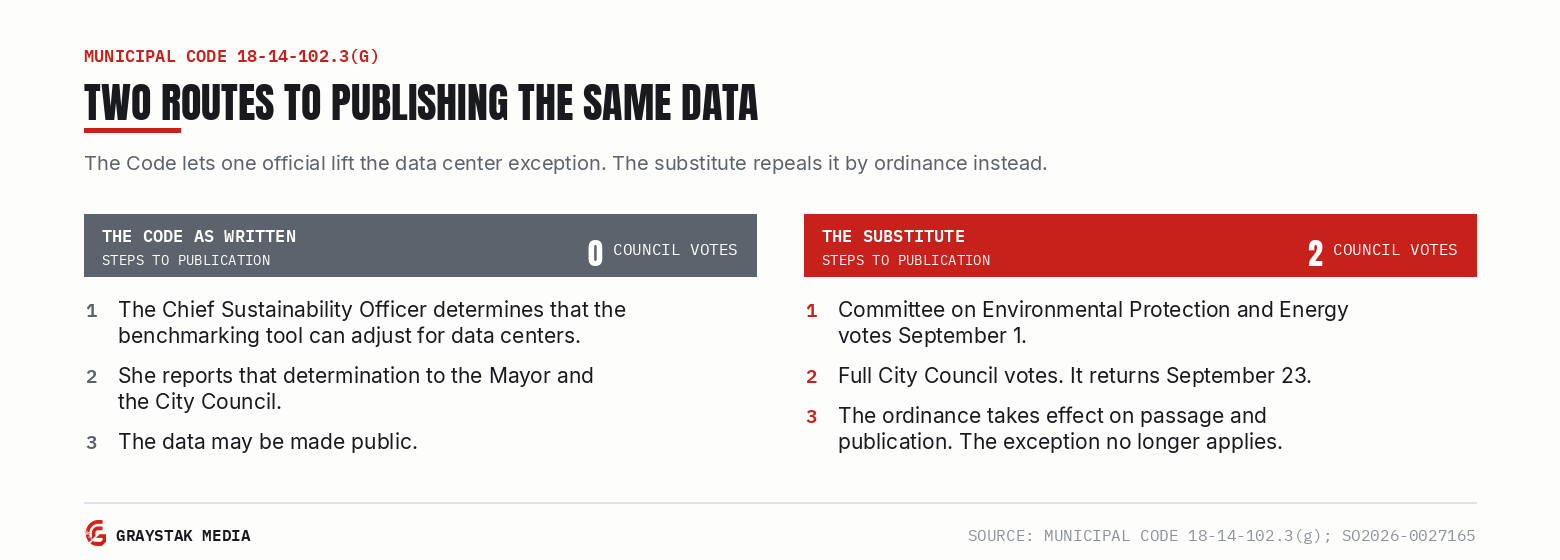
Section 18-14-102.3(g) authorizes the Chief Sustainability Officer to publish the data once she makes and reports a determination. The substitute repeals the exception by ordinance. Source: Municipal Code 18-14-102.3(g); SO2026-0027165.
The posted agenda describes the ordinance the substitute replaced
The Agenda of Matters for the September 1 meeting had not posted as of August 24, when only the July 22 notice was attached to the Clerk's meeting record. It was on the Clerk's site by August 27.
It lists the item under the substitute’s record number and describes it as an “Amendment of Municipal Code Section 18-14-101.3 to remove exemption for buildings where more than 10 percent of floor area is classified as Group S from definition of covered building.”
That is what the July 15 ordinance did. The substitute does not remove Group S from the exemption. It leaves the list intact, adds an override for buildings with data centers, and amends two further sections, 18-14-101.4 and 18-14-102.3. The Clerk’s own caption for the matter describes all three.
The committee will take votes on the ordinance. Two other items are listed: approval of the committee’s Rule 45 report for July 13, and a subject matter hearing on urban flooding in Chicago, on which no votes will be taken.
Public comment runs at the start of the meeting, three minutes per speaker and thirty minutes in total. According to the notice, everyone who signs up may not get to speak.
Twelve of the fifteen members voting already sponsor the bill
Twenty-two members are on the ordinance: Hadden as sponsor and twenty-one co-sponsors. Twelve sit on the fifteen-member committee that votes September 1.
They are La Spata, Ramirez, Lopez, Tabares, Cruz, Conway, Knudsen, Lawson, Clay, Martin, Manaa-Hoppenworth and Hadden. Sigcho-Lopez, Rodriguez Sanchez and Reilly have not signed. Reilly represents the 42nd Ward, which his office describes as Chicago’s central business district.
The co-sponsor list crosses the Council’s factions. It includes Gilbert Villegas, the Zoning Committee chair who called the mayor’s data center executive order a political stunt the day after it was signed.
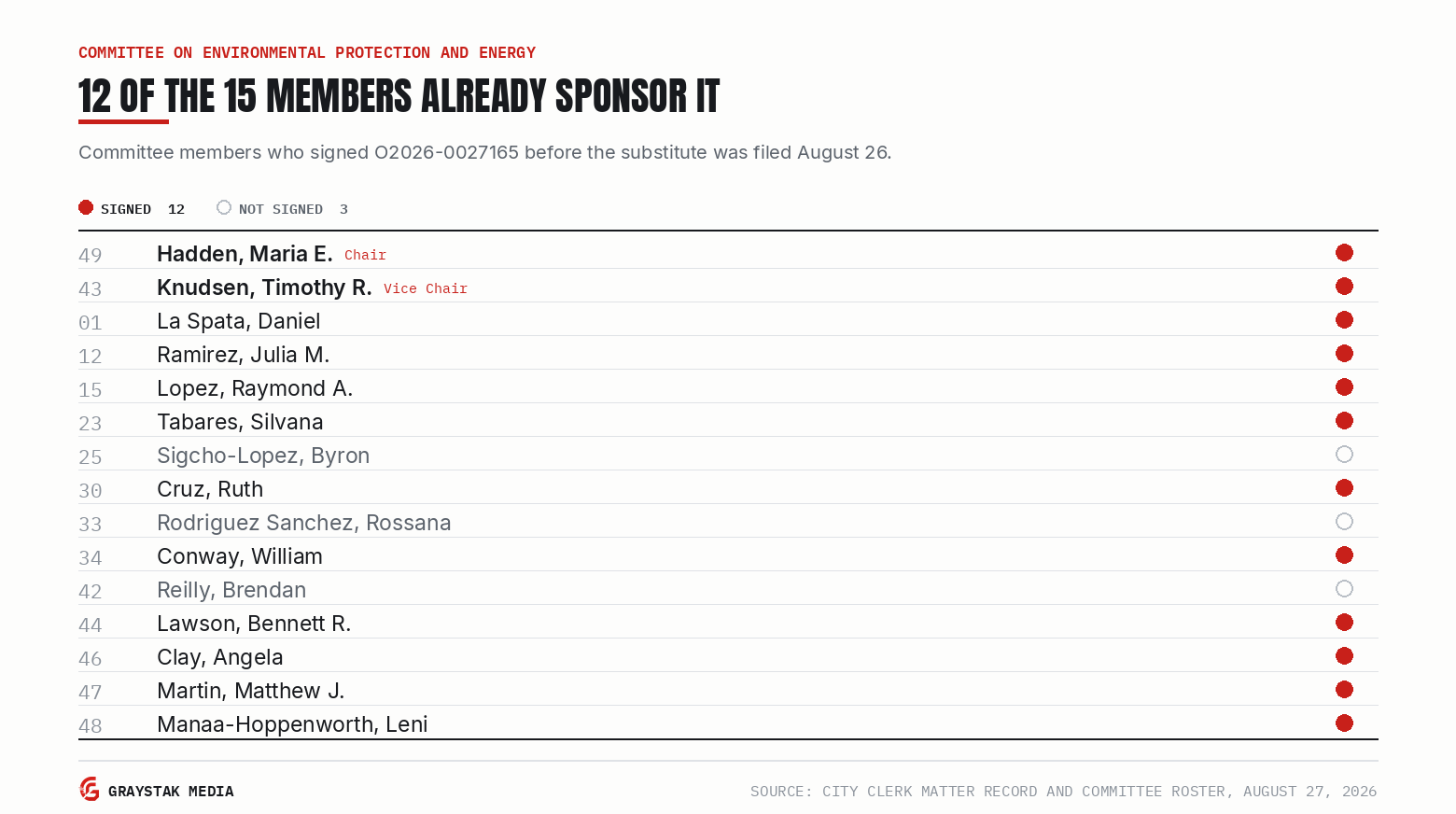
Committee membership verified against the City Clerk’s legislative body record on August 27, 2026. Source: City Clerk matter record and committee roster.
The mayor deferred on the determination and left the moratorium to the Council
At a press availability on August 25, the mayor was asked whether the Chief Sustainability Officer has made and reported the determination required by 18-14-102.3. “I can get back with you on that one,” he said.
His office answered that evening with the statement above. It did not say whether they had made the determination.
He was also asked who would introduce the temporary moratorium on new data center development that he called for on August 11.
“Listen, that is their function,” he said. “City council has the authority to move on a moratorium. I am encouraging them to do that. But if you are asking me to hand-pick a leader, I hope that they are capable of self-selecting in that regard.”
On August 17, his press office had written that the administration “will be working with our partners in City Council to finalize language for the ordinance and plan to introduce it at an upcoming City Council meeting.” No ordinance establishing a data center moratorium appears in the City Clerk’s legislative record as of August 26. Searches of that record on the terms “data center” and “moratorium” return none, and an ordinance captioned purely as a code amendment would not surface in either.
Four dates are already fixed
If the committee reports the ordinance out, it goes to the full City Council, which returns September 23 at 10 a.m.
Executive Order 2026-5 sends the working group’s three recommendations to an interdepartmental task force reporting on or before March 15, 2027, or a later date approved by the Mayor. Air pollution and noise rules under Sections 1 and 2 of the order are due November 9, subject to extension by the Mayor. The Illinois Commerce Commission must act on ComEd’s $15.3 billion grid plan by 5 p.m. on December 15.
GrayStak will report from the September 1 committee meeting.
HOW THIS WAS REPORTED
This piece is built from primary documents.
City records: substitute ordinance SO2026-0027165, filed with the City Clerk and published August 26, 2026, at 3:15 p.m.; ordinance O2026-0027165 as introduced July 15, 2026, and its signature page; the Clerk’s matter record including its action history, sponsor list and attachments, retrieved August 26, 2026; the notice of meeting for the September 1 Committee on Environmental Protection and Energy, dated July 22, 2026 and signed by Chair Maria E. Hadden; retrieved August 27, 2026.; the Clerk’s Legislative Body and Member Report generated July 24, 2026; Executive Order 2026-5; and the Sustainable Data Centers Report dated July 9, 2026.
Municipal Code: Sections 18-14-101.3 and 18-14-102.3, and Chicago Building Code Section 14B-3-302, as published in supplement 2026 S-73.
This piece continues GrayStak’s reporting on Chicago’s data center regulation, which began with Chicago Zones Data Centers as Offices, published August 17, 2026 and corrected August 26.
Written correspondence with the Committee on Environmental Protection and Energy dated August 18, August 21 and August 26, 2026, and with the Mayor’s Press Office dated August 17 and August 25, 2026.
Legislative filings were checked against the City Clerk’s electronic legislative management system on August 26, 2026. That search matches the title and nickname fields of each matter.
WHAT IS NOT YET IN THE RECORD
The Department of Buildings has been asked what occupancy group a data center without routine human occupancy receives under Section 14B-3-302. It has not answered. Whether the Chief Sustainability Officer has ever made or reported a determination under Section 18-14-102.3 has been requested from the Department of Environment twice and from the Mayor’s Press Office once, and has not been provided.
Four requests for comment were sent on August 26, with responses requested by September 2. They cover the water usage provision, the determination, and the occupancy classification question. None had been answered at publication.
The substitute also amends Section 18-14-101.4, which governs water usage data. GrayStak has requested comment on that provision and will report it separately.
COMMENT
Written requests for comment were sent on August 13, 2026 to the Mayor’s Press Office, the Department of Environment, the Department of Buildings, the Department of Law, the Department of Planning and Development, Alderman Gilbert Villegas, Alderman Derrick Curtis and Alderman Maria Hadden. The Mayor’s Press Office answered on August 17 and relayed answers from the Department of Planning and Development the same day, and provided a statement on August 25. Alderman Hadden’s office answered on August 18, August 21 and August 26. The Department of Law responded on August 14 that it does not comment on pending litigation.
The Department of Environment did not respond to requests sent August 13 and August 21 about Section 18-14-102.3. The Department of Buildings did not respond to a request sent August 13 about Section 14B-3-302. Further requests were sent to both departments on August 26. The Department of Planning and Development on its own behalf, Alderman Villegas and Alderman Curtis did not respond.
CORRECTIONS
GrayStak corrects errors on the record and marks the change. Corrections are dated and the corrected text is identified. Send corrections to christopher@graystak.com.
A correction was issued August 26, 2026 on the previous piece in this series, Chicago Zones Data Centers as Offices. It described the occupancy classifications excluded from coverage under Municipal Code 18-14-101.3 as assembly, factory, high hazard or utility. The Code names Group A-5, one of five assembly subgroups under Chicago Building Code Section 14B-3-302, rather than assembly generally. Buildings more than ten percent A-1, A-2, A-3 or A-4 remain covered.
September 3, 2026. An earlier version of this piece stated: "The Agenda of Matters for the September 1 meeting was posted on August 27, a day after the Clerk published the substitute." That sentence has been replaced with: "The Agenda of Matters for the September 1 meeting had not posted as of August 24, when only the July 22 notice was attached to the Clerk's meeting record. It was on the Clerk's site by August 27." GrayStak observed the meeting record on August 24 and again on August 27 and did not observe it in between. The posting date, and the sequence relative to the substitute's publication, were not established. The Methods block was changed from "posted August 27, 2026" to "retrieved August 27, 2026."
UPDATES
Responses received after publication, and the outcome of the September 1 vote, will be added here and dated. The original text stays intact.
DISCLOSURES
GrayStak uses commercially available artificial intelligence tools, including Anthropic products, in its research and production workflow, and holds no financial interest in any of their makers.
ABOUT THE AUTHOR
Christopher Sweat covers Chicago and Illinois government from the public record, reporting local social and political dynamics for a national and international audience. He also reports on national security policy, intelligence oversight, public finance, and the defense technology sector. He is an analyst working across finance, technology, and politics, and CEO and Co-Founder of GrayStak.
GrayStak is a media and political risk company. Our real-time Domestic Political Volatility Index (DPVI) measures the velocity and volatility of U.S. domestic politics. We cover political and institutional risk across the United States, centered in Washington, D.C., New York, and Chicago.