
Before They Exercise Their Potential
The FBI wrote its pre-crime standard in secret in 1968. Justice published it as policy in 2008. The statute behind the biggest collection program expired last month. The collection kept running.

On March 4, 1968, the FBI sent a memo to its field offices. It instructed agents to pinpoint potential troublemakers and neutralize them “before they exercise their potential for violence.” The standard was the potential itself. It required no crime and no evidence of one.
The memo was secret and the program it directed was illegal. The public learned it existed because eight activists broke into a Bureau field office in Media, Pennsylvania, in March 1971 and mailed the files to the press. They picked the night the country was watching Ali fight Frazier. Ali was in the files they stole.
On September 29, 2008, Attorney General Michael Mukasey signed the Attorney General’s Guidelines for Domestic FBI Operations. The Guidelines created a new investigative category called the assessment. An assessment requires no factual indication that its subject has done anything wrong or intends to. At the assessment stage, agents may conduct physical surveillance, search commercial databases, interview subjects under false pretenses, map communities by race and ethnicity, and recruit and task informants. The Brennan Center’s analysis of the change is blunt: the Guidelines authorize investigations of Americans with no indication of wrongdoing.
Nobody burglarized anything to get that document. It is a PDF on the Justice Department’s website, announced with a press release and a fact sheet.
Two documents, forty years apart, describe the same authority: government attention aimed at people who have broken no law, on the theory that they might. A pre-crime standard written in secret for Black and Muslim Americans, exposed only by theft, was rebuilt after 2001 as published policy, scaled by statute and software, and made available against anyone. Hoover ran 2,370 covert actions in fifteen years, and counting them required a burglary. The modern architecture publishes its own numbers every April. They keep going up.
A harder finding runs under the legalization: publication has stopped guaranteeing verification. The court that polices the modern system says its query counts are incomplete. The statute at its center is expired. The collection continues.
COINTELPRO mostly survives as folklore: a film title, a lyric, a shorthand for government treachery, invoked more often than read. The program also left records, and the records support analysis the folklore cannot carry: threat definitions in the Bureau’s own language, action counts by program, named informants, sworn testimony, court opinions. The same is true of the architecture that replaced it. Both eras can be read as the intelligence community’s institutional history, because both eras wrote it down.
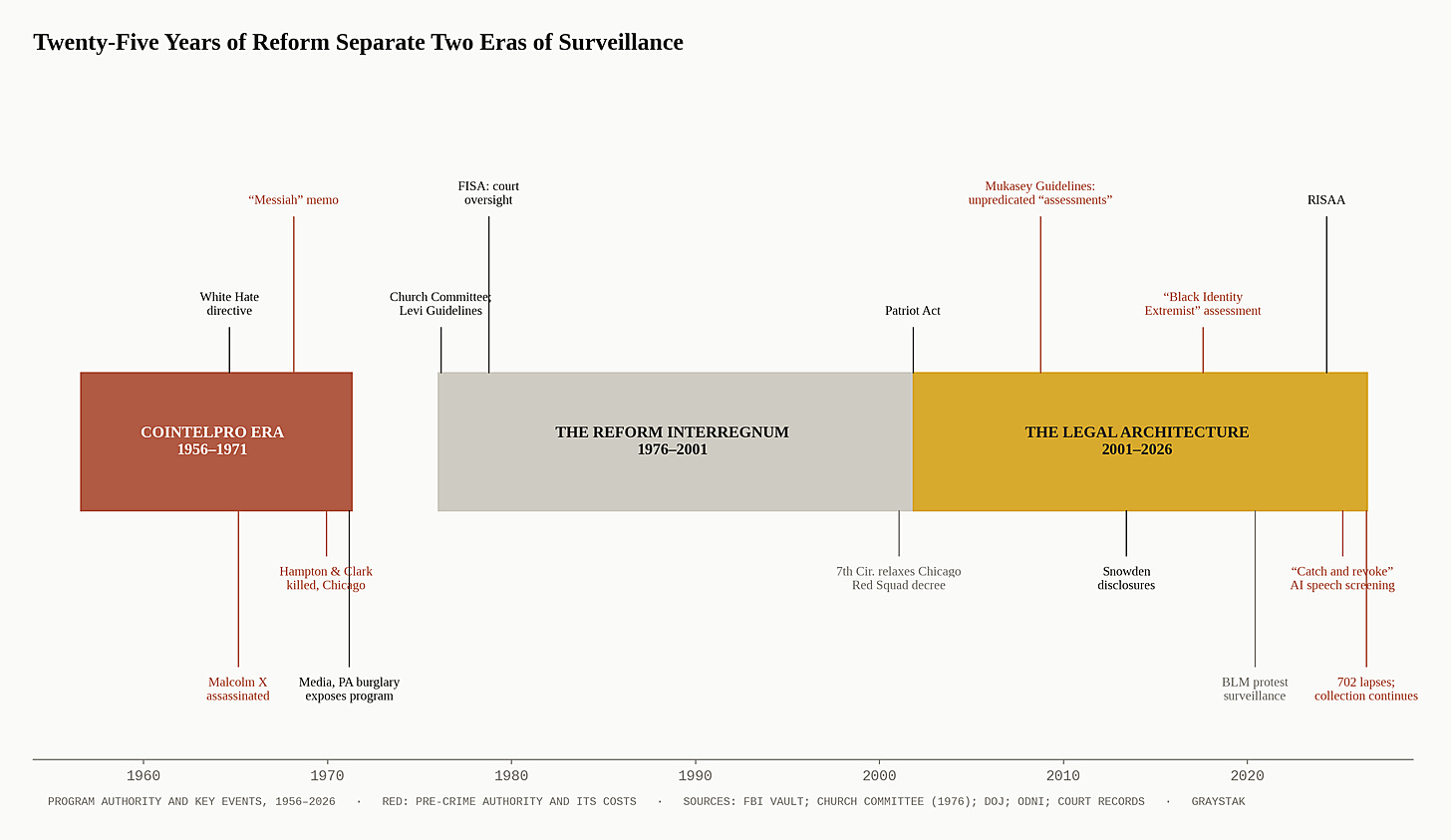
The arc of the piece in one frame: the COINTELPRO era, the twenty-five-year reform interregnum, and the legal architecture built after 2001. Red marks pre-crime authority and its costs.
The two files
PLAIN TERMS · COINTELPRO. Counter Intelligence Program: FBI operations from 1956 to 1971 that went past watching political groups to disrupting them, using informants, forged letters, fake publications, and planted press stories. Secret in its time. The files are public now, and everything quoted from them below carries its file number.
COINTELPRO ran from August 1956 to April 1971. It opened against the Communist Party USA and grew by accretion: the Socialist Workers Party in 1961, Puerto Rican independence groups, the Klan in 1964, black nationalist organizations in 1967, the New Left in 1968. The Church Committee, the Senate select committee that investigated in 1975 and 1976, counted roughly 2,370 approved covert actions out of more than 3,200 proposals.
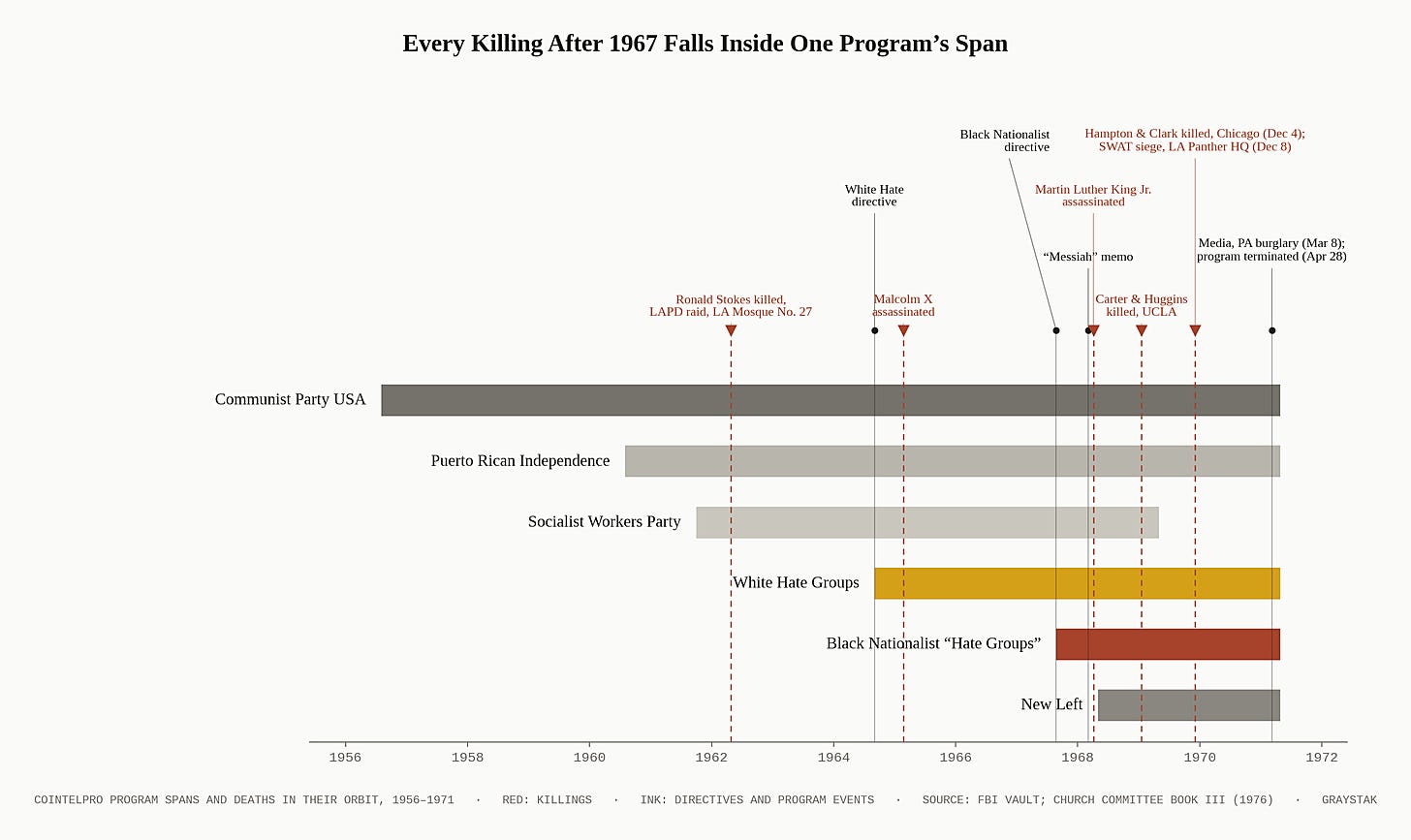
Six programs, one playbook. Every killing after 1967 falls inside the Black Nationalist band.
The founding directives are public, and the language is the whole story. The September 2, 1964 directive opening the White Hate program ordered field offices to expose, disrupt, and otherwise neutralize the Klans. The threat it names is violence. There is no other theory of harm in the document.
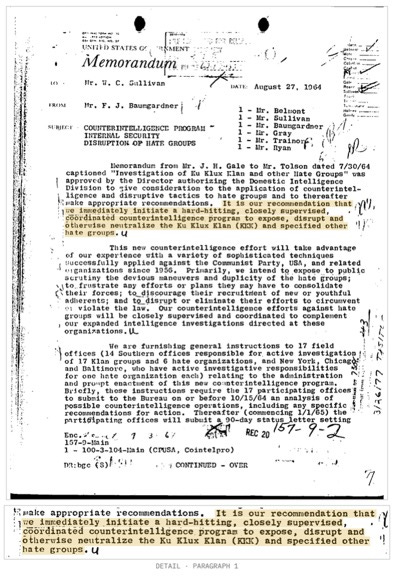
FBI file 157-9, serial 2: F. J. Baumgardner to W. C. Sullivan, August 27, 1964. FBI Vault release. Highlight and detail enlargement added. Transcription below.
EXHIBIT B · SOURCE DOCUMENT · FBI FILE 157-9 · AUGUST 27, 1964
“It is our recommendation that we immediately initiate a hard-hitting, closely supervised, coordinated counterintelligence program to expose, disrupt and otherwise neutralize the Ku Klux Klan (KKK) and specified other hate groups.”
F. J. Baumgardner to W. C. Sullivan, recommending the White Hate program. The Director approved, and the implementing directive went to 17 field offices on September 2, 1964. Its theory of harm is violence. No respectability goal and no leadership-prevention goal appear anywhere in the file. Typeset transcription of the page above.
The Black Nationalist directives name a different threat. The March 1968 memo lists goals absent from the Klan file: prevent the coalition of militant black nationalist groups. Prevent the rise of a “messiah” who could unify and electrify the movement. Prevent such groups and leaders from gaining “respectability.” The memo names its candidates. Malcolm X might have been the messiah, it notes; he was three years dead. The living names were Martin Luther King Jr., Stokely Carmichael, and Elijah Muhammad. King was assassinated one month after the memo issued. The timing is in the record. The record establishes nothing further, and neither does this piece.
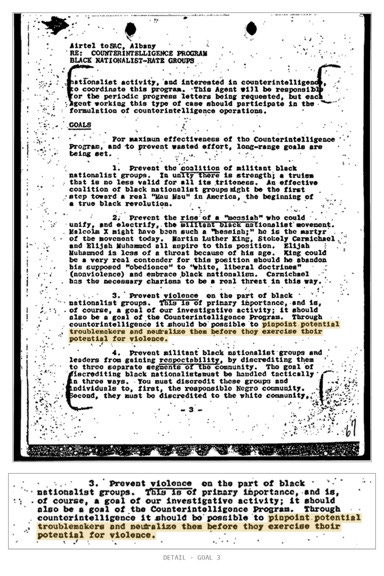
FBI file 100-448006, Section 1: the March 4, 1968 expansion airtel, goals page. Highlight and detail enlargement added. Transcription below.
EXHIBIT A · SOURCE DOCUMENT · FBI FILE 100-448006 · MARCH 4, 1968
1. Prevent the COALITION of militant black nationalist groups. [...]
2. Prevent the RISE OF A “MESSIAH” who could unify, and electrify, the MILITANT BLACK NATIONALIST movement. Malcolm X might have been such a “messiah” [...] Martin Luther King, Stokely Carmichael and Elijah Muhammed all aspire to this position. [...]
3. Prevent VIOLENCE [...] pinpoint potential troublemakers and neutralize them before they exercise their potential for violence.
4. Prevent militant black nationalist groups and leaders from gaining RESPECTABILITY, by discrediting them [...]
Director, FBI, to field offices. Underscored emphasis in the original is rendered here in capitals; bracketed ellipses mark omitted text. Reproduced in Church Committee Final Report, Book III (1976). Typeset transcription of the page above.
Read the two files side by side and the asymmetry needs no interpreter. One program treated violence as the threat. The other treated unity, legitimacy, and leadership as the threat. The program supervisor later told the Church Committee the Black Nationalist file covered many organizations nobody would call nationalist, which were simply Black. The Southern Christian Leadership Conference, a nonviolent organization, was classified as a hate group. So were black student unions.
The asymmetry has been measured before. The sociologist David Cunningham, working from twelve thousand pages of the Bureau’s own files in There’s Something Happening Here (2004), documented systematically how differently the White Hate program pursued its targets from the programs aimed at the left. The two files above are the pattern his data established, read at the source.
Hold that asymmetry, because it is where the pre-crime standard was born. The Bureau invented suspicion without conduct for specific communities. The rest of this piece tracks what happened to the invention: exposed in 1971, outlawed in 1976, and returned to general use in 2008, with no community named at all.
Three cities
The tactics were identical across every file: informants, forged letters, fake publications, planted stories, pressure on employers. The Klan got the same toolbox as the Panthers. The outcomes were not the same, and three cities show the difference.
Los Angeles. The Bureau set two organizations against each other in writing. Field offices circulated forged letters and cartoons between the Black Panther Party and the US Organization, each attributed to the other. On January 17, 1969, US members shot Panthers Alprentice “Bunchy” Carter and John Huggins dead on the UCLA campus. Two more Panthers were killed by US members that year. Then, after the four deaths, a Los Angeles field office memo dated May 26, 1970 stated that US would be “discreetly and appropriately advised” of the time and locations of Panther activities so that the two organizations might be brought together, granting nature “the opportunity to take her due course.” Four men were dead and the field office put in writing that it wanted more.
EXHIBIT C · SOURCE DOCUMENT · FBI LOS ANGELES FIELD OFFICE · MAY 26, 1970
“[US] will be discreetly and appropriately advised of the time and locations of BPP activities in order that the two organizations might be brought together and thus grant nature the opportunity to take her due course.”
Field office to FBI headquarters, written after four Black Panther Party members had been killed by US Organization members. Wording per the Church Committee record. Typeset transcription of a U.S. government record; public domain.
The city’s Muslims had entered this history earlier. An April 1962 LAPD raid on Nation of Islam Mosque No. 27 left Ronald Stokes, unarmed, dead and six other Muslims shot, hardening the internal debates the Bureau spent the next decade inflaming.
Chicago. The Bureau supplied the floor plan. Fred Hampton, the 21-year-old chairman of the Illinois Panthers, had brokered a truce among the city’s street gangs and ran a free breakfast program. The Bureau flagged him internally as a rising threat, which is the messiah goal operating as written. An FBI informant named William O’Neal, who had risen to Panther security chief, drew the layout of Hampton’s apartment at 2337 West Monroe, marked the bed, and drugged Hampton’s drink the night before the raid. Fourteen Chicago police officers entered at 4:45 a.m. on December 4, 1969, and killed Hampton and Mark Clark. Forensic review put nearly every round fired that morning on the police side. The same field office had sent a forged letter to Blackstone Rangers leader Jeff Fort claiming Hampton had ordered a hit on him, and a Bureau memo declined to send the mirror letter to the Panthers because the Rangers were judged the more violence-prone audience. The letter was addressed to the man more likely to kill.
The Bay Area. The Panthers were founded in Oakland in October 1966. Two years later Hoover designated them the greatest threat to the internal security of the country. The organization the designation described ran free breakfast programs and a newspaper. The Bureau’s fabricated correspondence then fed the 1971 rupture between Huey Newton and Eldridge Cleaver that broke the party from the inside.
The Muslim thread runs under all of it and outlasts it. Elijah Muhammad entered Bureau files with his 1942 draft arrest. Malcolm X’s file opened in 1950 and grew past 10,000 pages. The Bureau worked in writing to widen the rift between the two men, and informants saturated both camps; an NYPD undercover officer stood inside Malcolm’s own security detail at the Audubon Ballroom on February 21, 1965, the day he was killed. In 2021 the Manhattan District Attorney exonerated two of the three men convicted of the murder. They had served decades. New York City paid $26 million and the state paid $10 million more, settled in October 2022.
That is what the authority did while it was illegal. The question that organizes everything below is what it does now that it is legal.
What the counts hide
The Church Committee’s tallies: Communist Party, 1,388 approved actions. Black Nationalist, 379. New Left, 291. White Hate, 289. Socialist Workers Party, 45. By raw count the Klan program and the Black program were nearly matched.
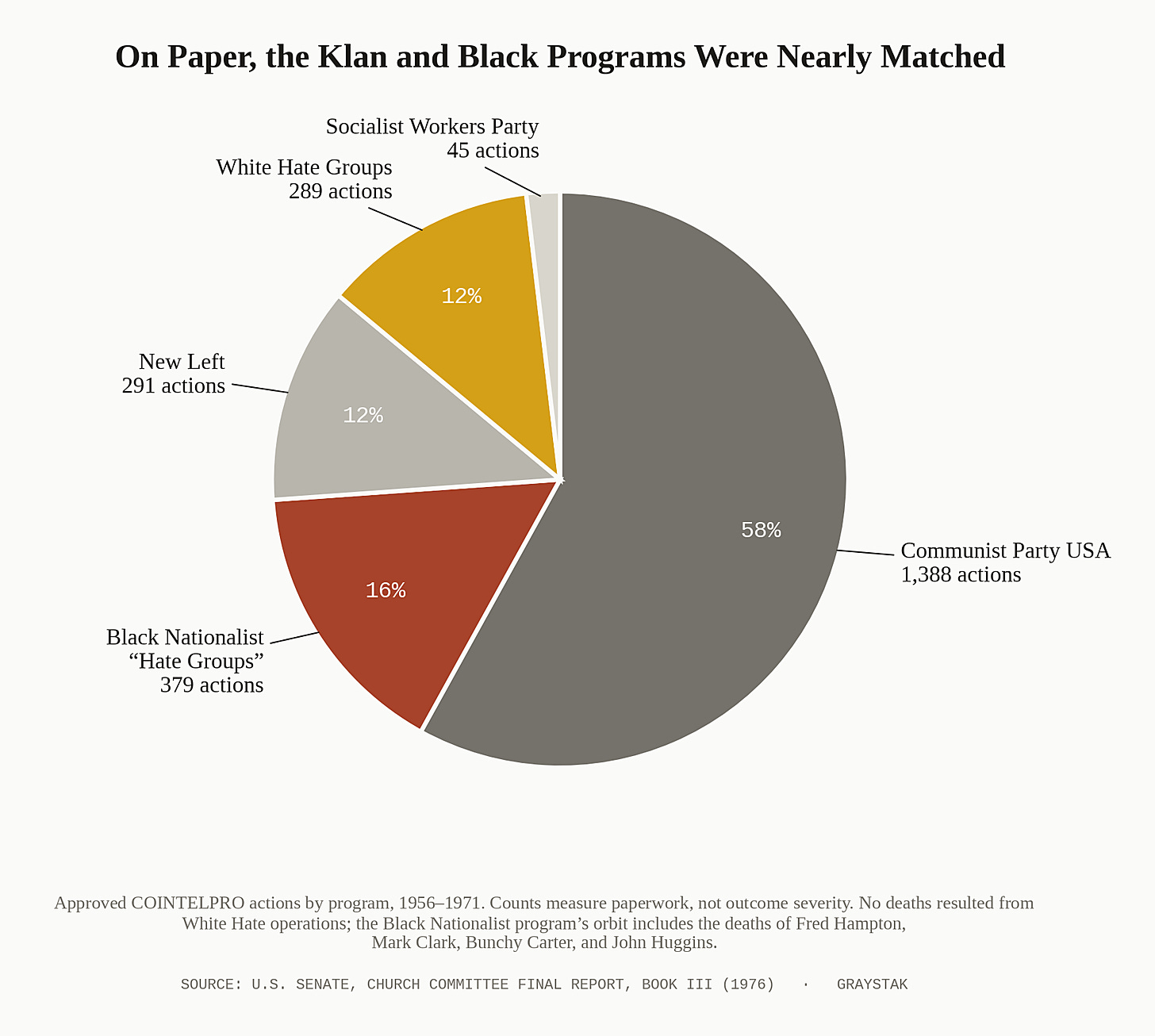
Approved actions by program: the paperwork puts the Communist Party first. The deaths sat in one slice.
The counts measure paperwork, and that lesson governs every number in this piece. The harm lives in the outcomes. Nobody died in a White Hate operation. The Klan file’s worst stain is an informant, Gary Thomas Rowe, present at the murder of Viola Liuzzo. The Black Nationalist file’s ledger includes Hampton, Clark, Carter, and Huggins, plus the “respectability” goal no other program carried. The committee also found that at least 18 percent of all approved actions targeted pure speech: speakers, teachers, writers, meetings, peaceful demonstrations.
The interregnum, and the hinge
PLAIN TERMS · Predicate. The legal word for a factual reason to investigate a person: evidence first, investigation second. The rules in this section turn on whether the FBI must have one before it starts watching someone.
The reforms were real. In 1976, Attorney General Edward Levi issued the first Attorney General’s Guidelines, requiring a factual predicate before the Bureau could investigate. FISA followed in 1978 and put national security wiretaps under a court. Executive Order 12333 drew agency lanes in 1981.
The reforms were multi-agency because the abuses were. The Church Committee’s larger finding was that the FBI had company: the CIA’s Operation CHAOS surveilled thousands of Americans in the antiwar and Black movements from 1967 to 1974, in violation of a prohibition written into the agency’s founding statute in 1947, which gave it no internal-security function, exposed by Seymour Hersh in December 1974. The NSA’s watchlists included King and Muhammad Ali. The Army kept files on civilians. The IRS ran a targeting unit. Parallel programs, uncoordinated, all secret. The reforms drew legal lines between them.
The committee that wrote the reforms also wrote down the risk of relapse. Its final report warned that “COINTELPRO-type activities may continue today under the rubric of ‘investigation.’” The rubric it named is the one this piece tracks. And the fullest account of the relapse came from inside the building: Mike German, a former FBI undercover agent, argued in Disrupt, Discredit, and Divide (2019) that the post-9/11 Bureau used its new authorities to shed the constraints the 1970s had imposed on it. This piece extends that finding to the record since, and to the numbers the government now publishes about itself.
The lines eroded on schedule, and Chicago fell first. On January 11, 2001, nine months before the Patriot Act existed, the Seventh Circuit ordered the modification of the consent decree that had bound the Chicago Police Department’s intelligence operations since the Red Squad litigation of the 1970s. Judge Richard Posner, writing for the panel in Alliance to End Repression v. City of Chicago, 237 F.3d 799, reasoned that the era’s dangers had passed and that the decree impeded the police against incipient terrorism: “The consent decree has done its job.” The city whose police department had put fourteen officers in Fred Hampton’s apartment loosened its municipal guardrail on the eve of the new era, on the stated ground that the culture which required it had evaporated.
The rebuilt architecture
The Patriot Act passed 45 days after September 11. Attorney General Ashcroft’s 2002 guideline revision announced a prevention paradigm; in 2003 the Bureau instructed its 56 field offices to build demographic profiles of their territories, counting mosques among the inputs for setting investigative targets. The 2008 Mukasey Guidelines finished the arc. The Levi Guidelines required a predicate. The assessment removed it. Everything the Levi reforms were written to end came back in that one deletion, published. The deletion gets used: a Government Accountability Office review completed in January 2026, marked for official use only and obtained by reporters the following month, counted roughly 127,000 assessments opened from 2018 through 2024, about 1,200 of them involving politicians, journalists, religious leaders, or academics. Most closed without findings of wrongdoing, which is what a standard requiring no evidence produces by design.
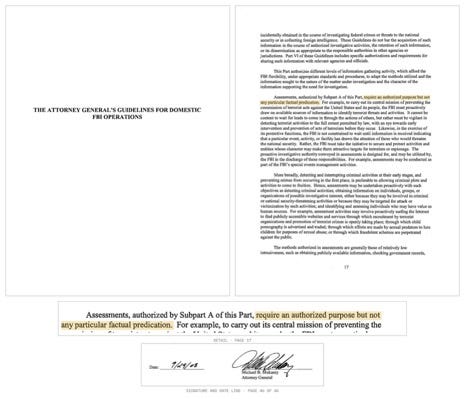
Attorney General’s Guidelines for Domestic FBI Operations, September 29, 2008: cover, page 17, and signature page. justice.gov. Highlight and detail enlargement added. Transcription below.
EXHIBIT D · SOURCE DOCUMENT · ATTORNEY GENERAL’S GUIDELINES · SEPTEMBER 29, 2008
Assessments “require an authorized purpose but not any particular factual predication.” Methods available at the assessment stage include physical surveillance, interviews under pretext, tasking of informants, and database checks.
As implemented in the FBI Domestic Investigations and Operations Guide §5. The quoted sentence appears on page 17 of the Guidelines, shown above. Unclassified from the start; posted at justice.gov since 2008.
The multi-agency structure came back too, this time on purpose. Roughly 200 Joint Terrorism Task Forces put federal, state, and local officers under FBI coordination. The Department of Homeland Security’s Office of Intelligence and Analysis holds the only statutory domestic intelligence mission in the intelligence community. Some 80 fusion centers merge federal, state, local, and private data. The National Counterterrorism Center consolidates agency holdings, including data on Americans.
The scale of the rebuilt enterprise resists an org chart. In 2010 the Washington Post’s Top Secret America investigation counted 1,271 government organizations and 1,931 private companies working on counterterrorism, homeland security, and intelligence at roughly 10,000 U.S. locations, and ODNI’s most recent public reporting puts top-secret clearance eligibility near 1.3 million people. The 1960s enterprise was five secret programs. The current one is not hidden; it is too large to see whole.
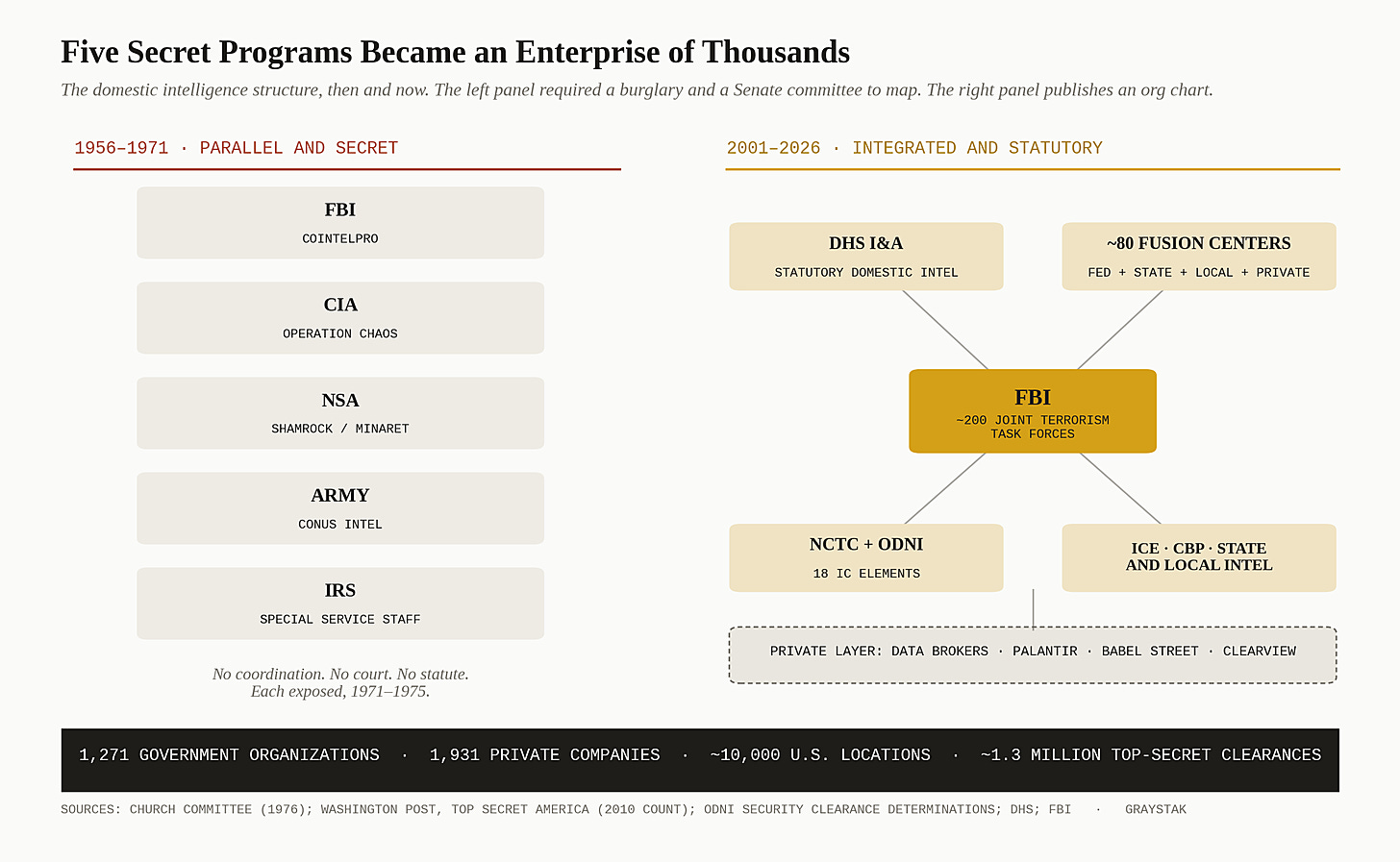
The left panel took a burglary and a Senate committee to map. The right panel publishes an org chart.
The CIA’s documented domestic touchpoint in this era ran through New York. A veteran agency officer, Larry Sanchez, on CIA payroll, helped build the NYPD Intelligence Division’s Demographics Unit, which mapped Muslim neighborhoods, businesses, mosques, and student groups across state lines. The AP’s Pulitzer-winning series exposed it in 2011. The CIA’s own Inspector General reviewed the arrangement and found irregular personnel practices and an embedded officer who believed he faced “no limitations” on domestic activity. The IG found no statutory violation. The statute is the same 1947 charter CHAOS broke; the reading changed.
As for output: in a June 28, 2012 deposition in the Handschu litigation, unsealed that August, Assistant Chief Thomas Galati, commanding officer of the Intelligence Division, testified: “I never made a lead from rhetoric that came from a Demographics report.” The unit had operated for six years. The program mapped a religion and, by its commander’s sworn account, the map led nowhere.
In 1971 the parallel programs were secret and illegal. In 2026 they are integrated and statutory. That is the whole distance between the two eras, and it is the point.
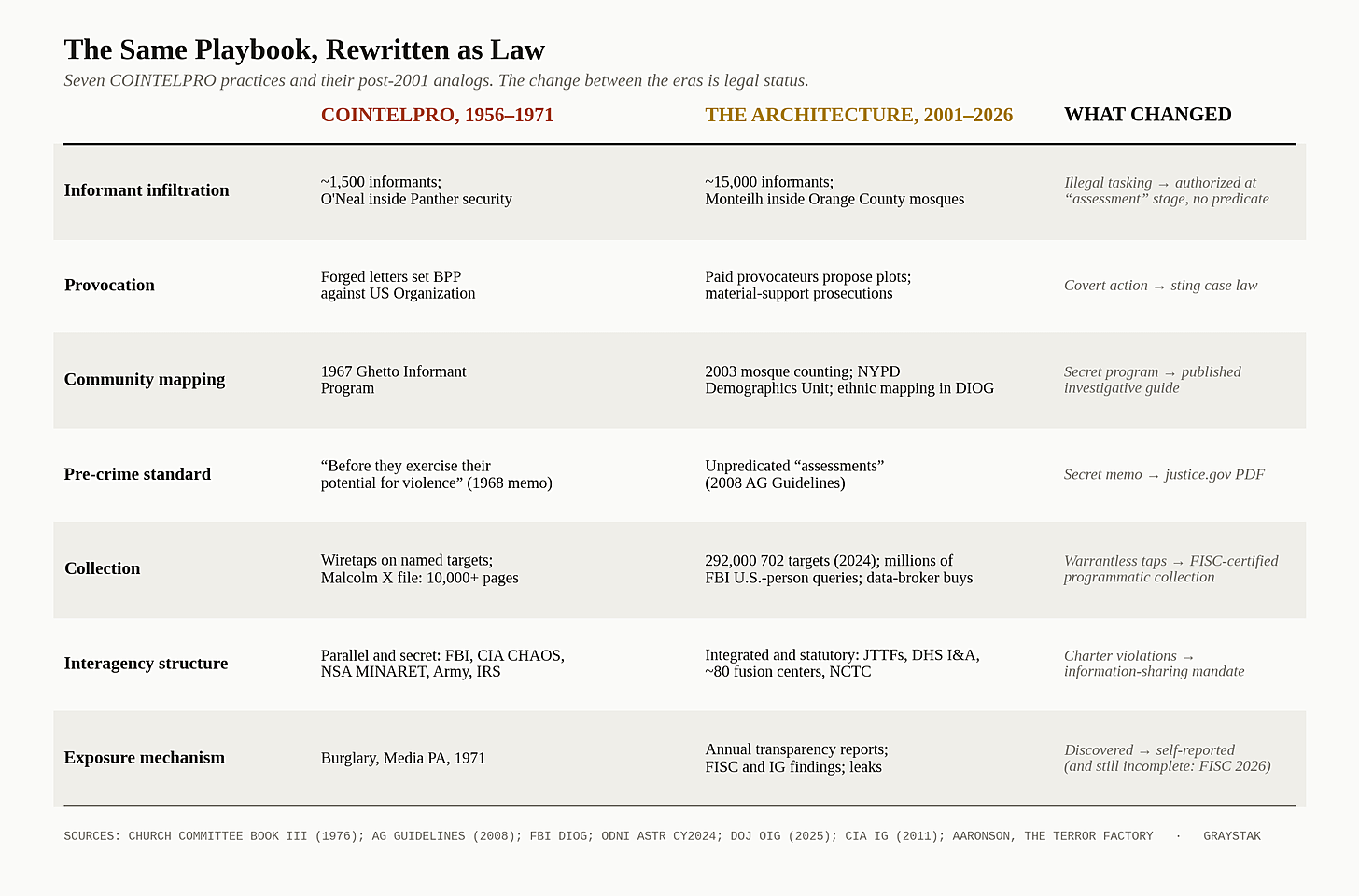
Seven practices, two eras. The third column is the thesis.
The machine
The technology is where the comparison stops being historical, and every piece of it arrives with paperwork attached: a statute, a certification, a contract, a privacy impact assessment. Hoover’s Bureau steamed open letters and paid men to sit in meetings, and hid all of it. The current system runs on purchased data and commercial software, and files the receipts.
PLAIN TERMS · Section 702. A law that lets the government collect emails, calls, and texts of foreigners abroad from U.S. companies, without individual warrants. Americans’ messages enter the pool whenever they communicate with a target, and the FBI can search that pool. A court approves the program each year. It does not approve each target.
The scale layer is Section 702 of FISA, which compels American communications providers to hand over the traffic of foreign targets abroad. Targets grew from 89,138 in 2013 to 291,824 in 2024, by the government’s own annual transparency reports. Americans’ calls, texts, and emails enter the pool whenever they touch a target, and the FBI queries the pool without a warrant.
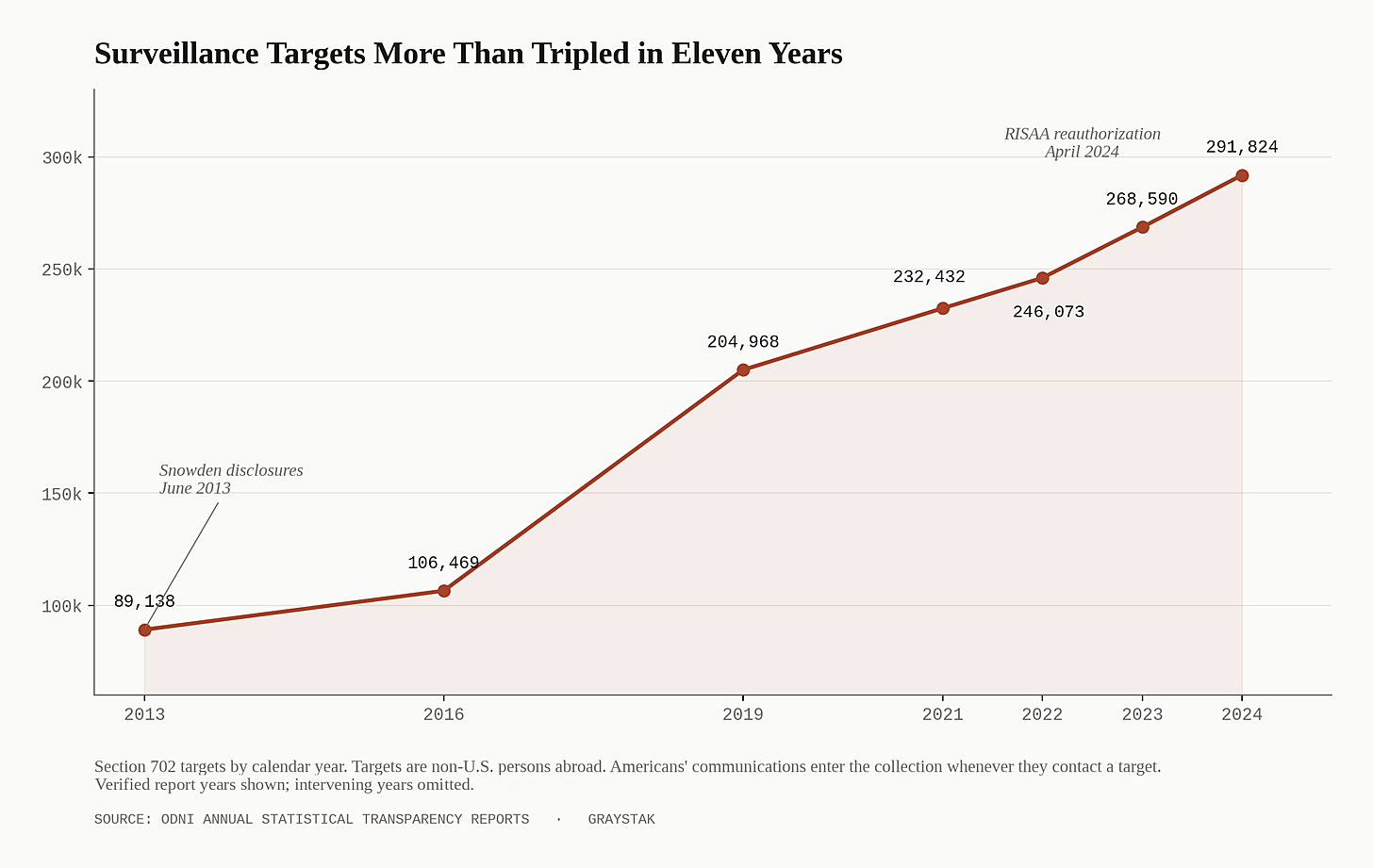
The government’s own published series. Verified report years shown; the curve only bends one way.
The queries are where the record turns. From December 2020 through November 2021, the Bureau ran queries using Americans’ identifiers up to 3.4 million times, the first year the government ever disclosed the number, with roughly 1.9 million tied to a single Russian critical-infrastructure investigation, per ODNI’s transparency report. After reforms and the 2024 reauthorization’s approval requirements, the reported figure fell to 57,094 in 2023 and 5,518 in 2024, per the Justice Department Inspector General, then rose to 7,413 in 2025. Within that rise, Senator Ron Wyden said in April 2026 that the sensitive subset, searches involving American journalists and political and religious organizations, more than tripled in 2025, and that the Bureau declined to explain why. Then, in March 2026, the FISA Court found the collapse could not be taken at face value: agencies had been running queries through “filtering” tools that went uncounted, a practice the court described as extending across the intelligence community. The opinion is classified. The government’s own compliance numbers are, for now, unverifiable by the government.
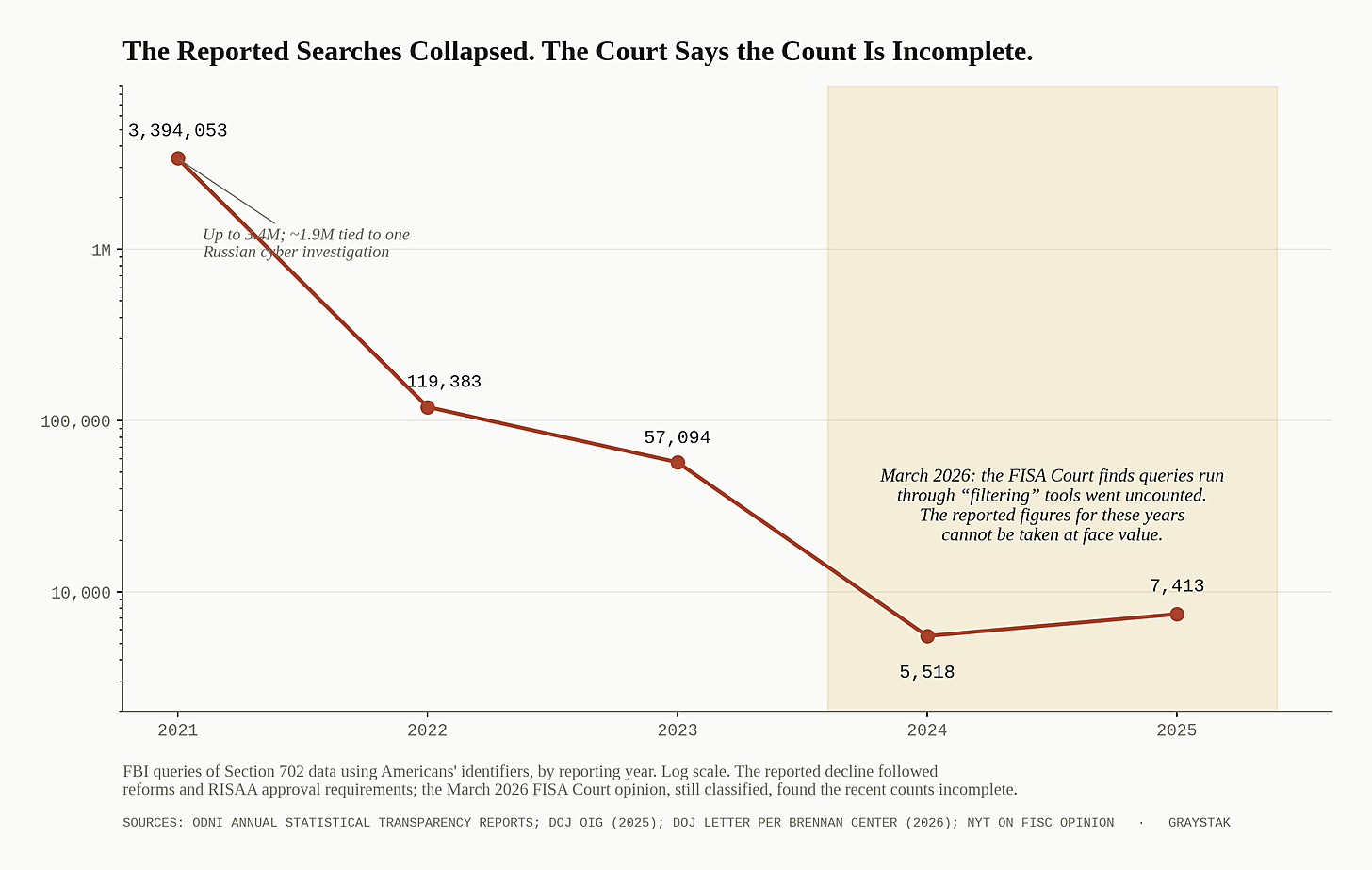
The piece’s harder finding in one frame: the reported figures fell 99.8 percent, and the court that polices the system says the recent counts cannot be taken at face value.
The analytic layer is commercial. ICE awarded Palantir a $30 million contract in April 2025 to identify deportation priorities. The State Department’s screening apparatus draws on tools like Babel Street’s “persistent search,” which continuously re-scrapes the open internet on flagged individuals so that a person, once searched, stays searched. ICE’s own August 2025 privacy impact assessment describes social media monitoring analytics deployed against perceived threats to the agency; the Brennan Center documented the tooling’s reach into facial recognition and location tracking. And the data-broker layer sits under everything: agencies purchase Americans’ location and behavioral data on the open market, no legal process attached, a loophole Congress has voted on and failed to close.
The informant corps scaled with the software. Roughly 1,500 Bureau informants in the COINTELPRO era and roughly 15,000 by 2011, by the most careful available accounting, the journalist Trevor Aaronson’s in The Terror Factory, with many tasked into Muslim communities. The provocation model survived intact. In Orange County the Bureau paid an informant named Craig Monteilh to infiltrate mosques in 2006 and 2007; he talked of weapons and jihad until congregants reported him to the FBI and sought a restraining order. The mosque called the Bureau on the Bureau’s own informant. The 1968 playbook, running on 2006 hardware, defeated by the community it targeted.
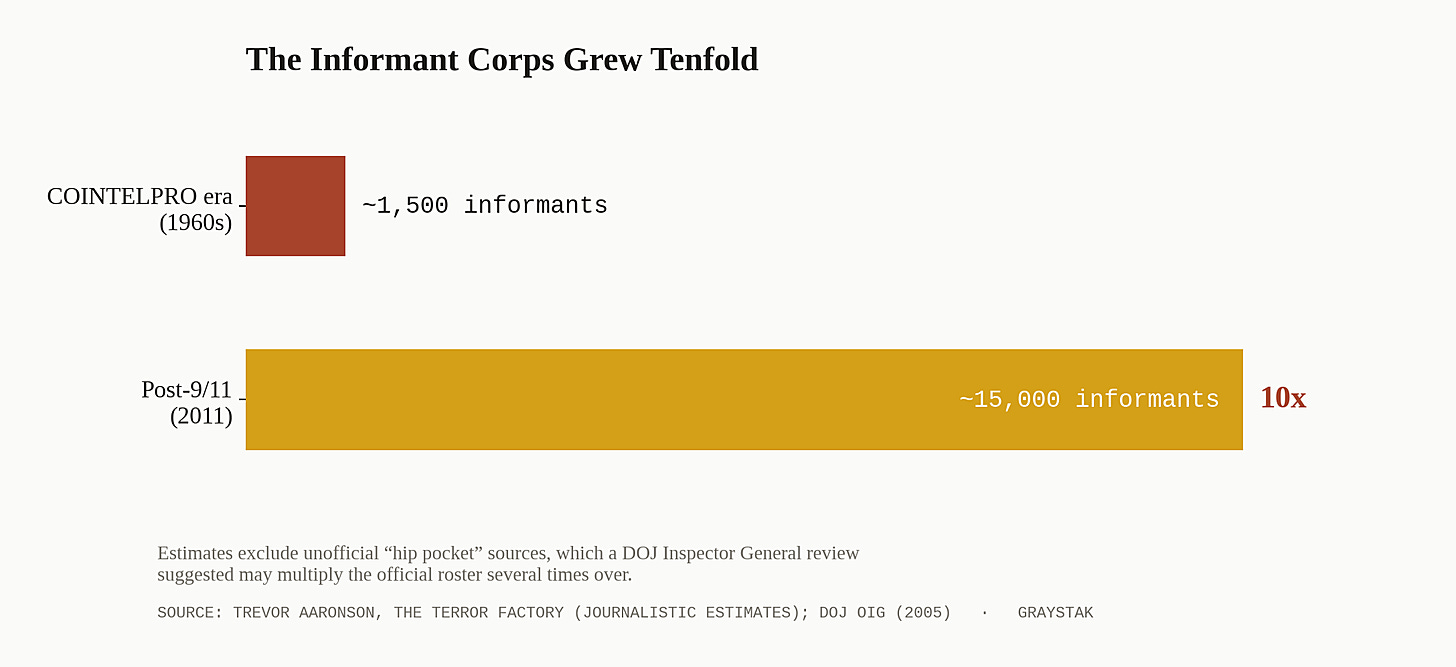
The corps grew tenfold. The tactic did not change.
On June 12, 2026, Section 702 lapsed. Two short-term patches had carried the statute past its April 20 sunset; the House passed a three-year extension on April 29; Senate cloture failed on June 5; and on June 11 the House voted down a final extension 198 to 218, with most Democrats refusing to extend the authority while Bill Pulte, an appointee with no intelligence experience, was set to assume the role of acting Director of National Intelligence, and a bloc of conservatives refusing to extend it without reforms. Collection continues anyway. The FISA Court approved fresh certifications in March 2026, which remain valid until March 2027, and providers face fines of $250,000 a day for refusing directives issued under them. The central statute of the modern architecture is expired, and the machine has not noticed.
The label moves
Threat definitions migrated the way the 1968 memo’s did: from what people do to what they are to what they might become. The Cold War word was subversion. The post-2001 word was radicalization, a framework under which mosque attendance and markers of religiosity became indicators. In August 2017 an FBI intelligence assessment created a category called Black Identity Extremists, predicting violence against police from perceptions of police brutality. The document leaked and the Bureau renamed the category. The method survived the renaming: threat inferred from identity and grievance.
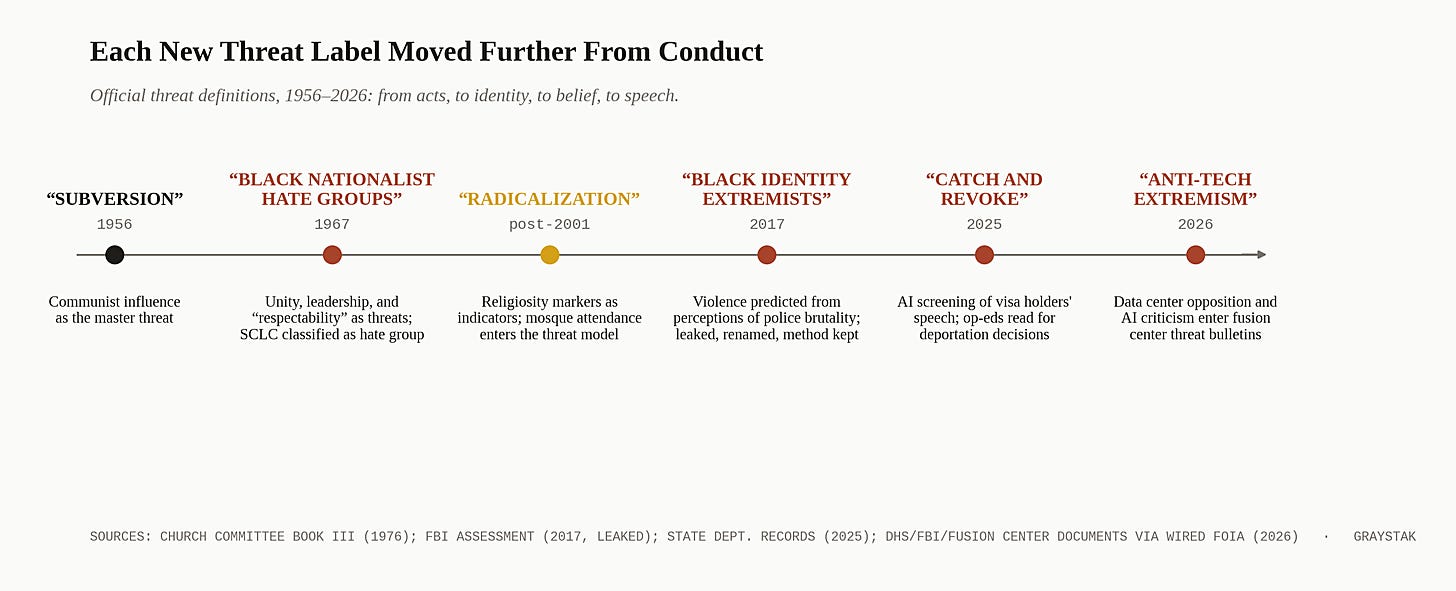
Six labels, seventy years. Each one moves attention further from conduct.
PLAIN TERMS · Fusion center. One of roughly 80 intelligence hubs created after 9/11 where federal, state, and local police share threat information. They write bulletins. A bulletin is analysis, not a charge: no court reviews it, and there is no formal process to learn you appear in one or to contest it.
The newest label arrived this spring, and it reaches a beat I cover. In May 2026, WIRED obtained more than a thousand pages of DHS, FBI, and fusion center documents showing an emerging threat category the agencies call anti-tech extremism. A December bulletin from Philadelphia’s fusion center assessed that domestic violent extremists are likely interested in targeting AI data centers. Its short-term indicator list ran “disruptive First Amendment activity” alongside online calls to boycott or protest local data centers and criticism of higher utility bills tied to data center power use. Asked about the bulletin, a Philadelphia police spokesperson told The Intercept that fusion center assessments provide situational awareness and are not meant to characterize lawful activity or protected speech as criminal conduct. Northern Virginia’s fusion center applied its anti-government extremist category and logged residents’ appearances at an Arlington County budget meeting and a Fairfax County school board meeting.
The bulletins are not empty of predicate: per the documents WIRED obtained, one flagged a chat in which a user called for violence against executives and power plants, and a January 2025 DHS analysis warned of targeted violence against corporate figures. The pattern the documents show is the familiar one: a real violence concern at the center, and lawful politics swept into the indicator list around it. The movement being monitored is, on the record, zoning and utility politics: Data Center Watch counts well over a hundred opposition groups across dozens of states, with blocked or stalled projects worth $156 billion in 2025. Complaining about an electric bill can now place a resident in a threat bulletin.
The current terminus is running in immigration enforcement, and it is running through Chicago. The State Department’s catch-and-revoke effort applies AI-driven social media screening to visa holders’ speech; Secretary Rubio put the count above 300 revocations by late March 2025, on the department’s stated grounds of national security and foreign policy. Rümeysa Öztürk, a Tufts doctoral student, was taken off the street by plainclothes officers after co-writing a student newspaper op-ed; in February 2026 an immigration judge found no grounds to deport her. A federal judge ruled in September 2025 that targeting noncitizen academics for their views violated the First Amendment. In October 2025, three labor unions sued to stop the surveillance program itself. Operation Midway Blitz brought the enforcement surge to Chicago in late 2025; this May, federal prosecutors dropped, with prejudice, the charges against the Broadview protesters. The University of Illinois confirmed it monitored students’ social media in support of felony protest charges.
The 1968 memo aimed to deny leaders respectability. The 2025 program reads op-eds for visa decisions. The distance between those two sentences is a change in medium. And the arc between them belongs to no party: the Guidelines were Bush’s, the collection peak was Obama’s, the BIE assessment came in the first Trump term, RISAA was signed by Biden, and catch-and-revoke is running now. Four administrations built this; each kept what the last one added.
What improved
PLAIN TERMS · The oversight bodies. The FISA Court: federal judges who approve and police the surveillance programs. The Privacy and Civil Liberties Oversight Board: an independent review agency. Inspectors General: internal government auditors. Their published reports supply most of the numbers in this piece.
A lot did, and complete analysis puts it on the record with the same care as the continuities. The modern system produces its own paper trail: FISA Court opinions, Privacy and Civil Liberties Oversight Board reports, Inspector General audits, annual transparency statistics, published guidelines. Congress debated the 2024 reauthorization in the open and came within a single House vote of a warrant requirement. Every scale figure in this piece exists because post-Church law compels its publication. COINTELPRO produced no such record. Learning of it required a burglary.
The paper trail carries real weight in any assessment of the two eras. A system that documents itself, submits to a court, and loses in litigation differs from a system that killed a sleeping man and filed the memo. The deaths of Fred Hampton, Mark Clark, Bunchy Carter, and John Huggins have no analog in the post-2001 domestic record. The question the documents leave is narrower and harder: whether a pre-crime authority that is published, audited, and lawful produces different outcomes for the communities underneath it than one that was secret and criminal, or the same outcomes with better filing. The Demographics Unit’s zero leads, the FISC’s uncounted queries, and the op-ed detentions are the current evidence file on that question.
What would change this analysis
Three tests sit on the calendar, registered here before they resolve. Declassification of the March 2026 FISA Court opinion will show whether the reported collapse in FBI queries was real; the chair and ranking member of the Senate Intelligence Committee demanded its release by mid-May 2026 and have been ignored, which is itself a data point on how the self-reporting system performs under pressure. The Section 702 fight will show whether Congress restores, restrains, or abandons the central collection authority. The catch-and-revoke litigation will show whether courts treat speech-based immigration surveillance as the First Amendment violation one district court has already found. This piece predicts continuity in the threat-definition pattern and no narrowing of the assessment authority. If the FISC opinion shows the query decline was genuine, if the 2008 framework is narrowed, or if the terminus programs are struck down and dismantled, the legalization thesis loses force, and a follow-up will say so.
Coda: the memo in the culture
The Bureau’s vocabulary outlived the Bureau’s secret. D’Angelo titled his 2014 album Black Messiah. The 2021 film Judas and the Black Messiah took its title straight from the March 1968 memo and put Hampton’s killing in front of an Oscar audience; fact-checkers verified the memo’s language for general readers, which makes the founding document of the Black Nationalist program one of the most publicly authenticated texts the Bureau ever produced. Hip hop carried the program’s name across three decades, from Public Enemy’s wiretap paranoia to Rakim on the 2021 soundtrack. The words written to prevent a messiah became the culture’s name for the man killed in his bed in Chicago with the Bureau’s floor plan.
The 2008 Guidelines have no film. They have a press release and a fact sheet. They are in effect today.
Disclosure. Research, verification, and visual assets for this piece were produced in part with AI tools, including Anthropic’s Claude. Anthropic holds commercial stakes in the AI data center buildout this piece discusses. Every claim traces to the cited primary documents.
Comment requests. Comment requests were sent before publication to the FBI National Press Office, the Justice Department’s Office of Public Affairs, ODNI’s Civil Liberties, Privacy, and Transparency office, the State Department, the NYPD, and the Philadelphia Police Department, each with a documented response deadline. Responses will be appended to this piece as they are received. The Philadelphia Police Department’s on-record statement to The Intercept is cited above.