

CHRISTOPHER SWEAT, reporting from the Illinois Commerce Commission docket and Chicago City Hall
In brief
What happened. Chicago’s case before the Illinois Commerce Commission changed character in the fall of 2024. The City’s witness became an assistant commissioner at the Department of Aviation, its subject became what O’Hare pays ComEd for new service, and its invoices began to be paid on Department of Aviation vouchers.
Why it matters. Two Commission decisions, not the Council’s data center ordinances, will set what large new electric loads cost everyone else. In both proceedings, the City appears as a large customer. The Citizens Utility Board argues that data centers should pay for the capital built to serve them.
What is pending. The Corporation Counsel who oversaw the change leaves office today. The Commission rules on ComEd’s grid plan by December 15 and on cost recovery for large demand customers by February 26, 2027. Chicago’s municipal election falls on February 23, 2027. The City’s data center task force reports in March 2027, after both rulings.
Chicago is a party to the two proceedings that will decide what a new data center pays to connect to the electric grid, and what every other customer pays if it does not. In the proceeding that sets those terms, the City has one witness. He is an assistant commissioner at O’Hare, and his testimony concerns the deposits ComEd requires of the airport.
The airport has also been paying the City’s lawyers. Of the $863,972 Chicago paid its outside utility counsel between January 2024 and August 19, 2026, $527,059 went out on Department of Aviation vouchers. The City issued the first on October 4, 2024, three months before the Law Department wrote the memorandum that authorized the arrangement, and the memorandum covers one docket while the invoices cover five. The airport’s chief legal officer approves each bill. Twice in 2025, he instructed the Law Department to restore charges the City billing system had stripped out under the Law Department guidelines.
The City sold $1.12 billion in airport bonds in November 2025. It told investors that all revenue generated at O’Hare must be spent on the airport, and that diverting it carries penalties of up to three times the amount diverted. Seven days after that document went to investors, the City paid an invoice billed to the airport for work in a natural gas proceeding.
None of this appears in the Council’s legislative record, even after a publication search. Meza signed the engagement letter in the final weeks of the Lightfoot administration, without competitive bidding.
Chicago’s public argument over data centers has been an argument about buildings: where they may go, what they must disclose, whether approvals should pause. The Illinois Commerce Commission sets the price, in two proceedings that close before the City’s data center task force reports.
One sets what a new large load pays to connect. The other decides who pays for the capital ComEd builds to serve those loads, if the customers who caused it do not. The Citizens Utility Board’s answer, in its brief, is that most of it “will likely be socialized across the entire ComEd customer base,” which means it arrives on everyone’s delivery charge.
Chicago is a party to both proceedings. This is an account of who has been speaking for the city in them, and who has been paying for it.
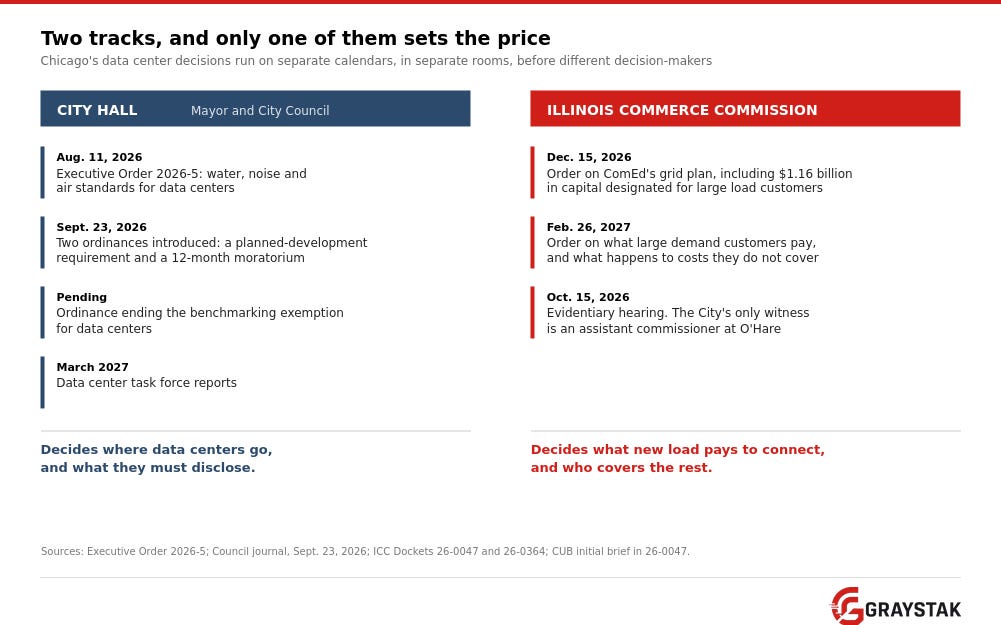
Figure 1. Two tracks, and only one of them sets the price.
QUESTION: Who argues for Chicago at the Illinois Commerce Commission on the cost of new electric load, and who pays for that argument?
What the record shows
The City’s only witness in the case that sets the price works for the airport
On June 26, the City filed direct testimony in the Commission’s investigation of ratepayer protections and cost recovery for large-demand customers of ComEd, Docket 26-0364. Its witness was Joseph McHugh, assistant commissioner for GIS and utilities at the Chicago Department of Aviation, and he testified about the deposits and security ComEd requires for large projects, including the airport’s. On September 9, the City filed a rebuttal testimony. The witness was McHugh again, the only one the City put forward.
That docket matters more than its name suggests. In March, the Commission approved larger deposits for large load projects. It found a pipeline of more than seventy-five projects seeking over 28,000 megawatts, against a historical system peak near 24,000, and said that pipeline carried risks to reliability and affordability it had not yet addressed. It opened this investigation to address them. Commission Staff has since moved the question of how those costs are allocated into this proceeding. What the Commission decides here will govern what a new data center pays to connect and what everyone else pays if it does not.
The Citizens Utility Board argues that ComEd should charge the cost of that capital to the large loads that cause it. ComEd’s plan includes $1.16 billion in capital “specifically designated for new, large load customers,” with about $438 million of it for data centers. In CUB’s reading, “most of the $1.16 billion will likely be socialized across the entire ComEd customer base.” CUB tells the Commission that ComEd “should be directly assigning much, if not all, of the distribution-related costs caused by large loads.” CUB’s brief does not name the City of Chicago or the airport.
Asked whether the City intends to offer testimony on behalf of residential customers in that proceeding, the Department of Law declined to answer, saying the City does not comment on pending litigation. It gave the same answer when asked whether the firm appears in the docket as a ratepayer advocate, as a large customer, or both, and who at the City sets that position.
Five parties filed rebuttal testimony in 26-0364 on September 9. The City, its witness, and the program it proposed appear in none of the five. ComEd’s rebuttal is due October 6, and the evidentiary hearing is October 15.
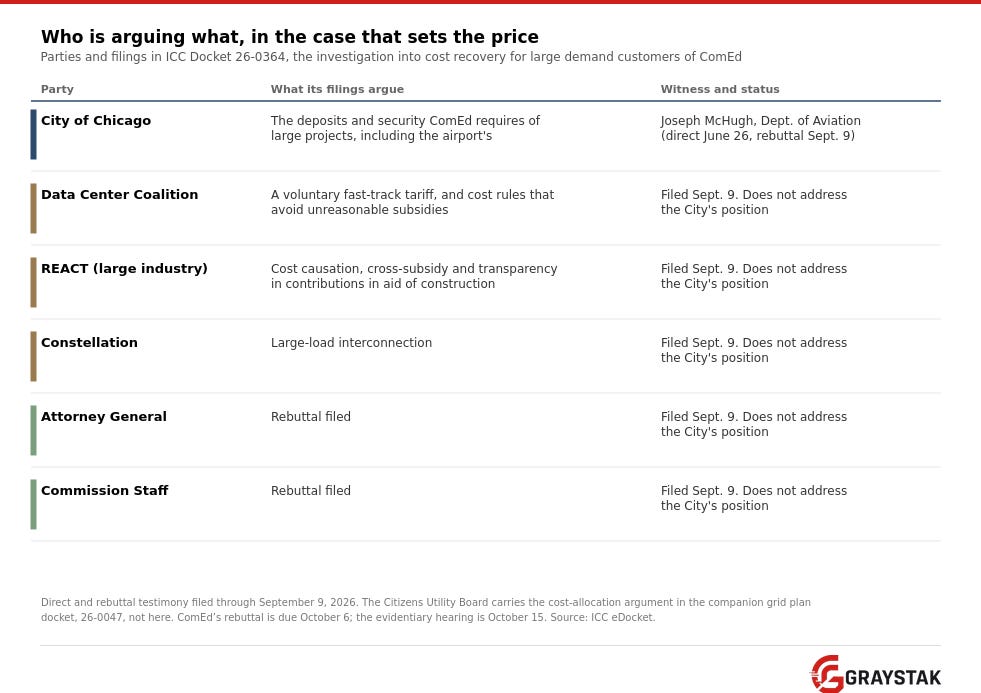
Figure 2. Who is arguing what, in the case that sets the price.
The engagement was not competitively bid, and it does not appear in the Council’s record
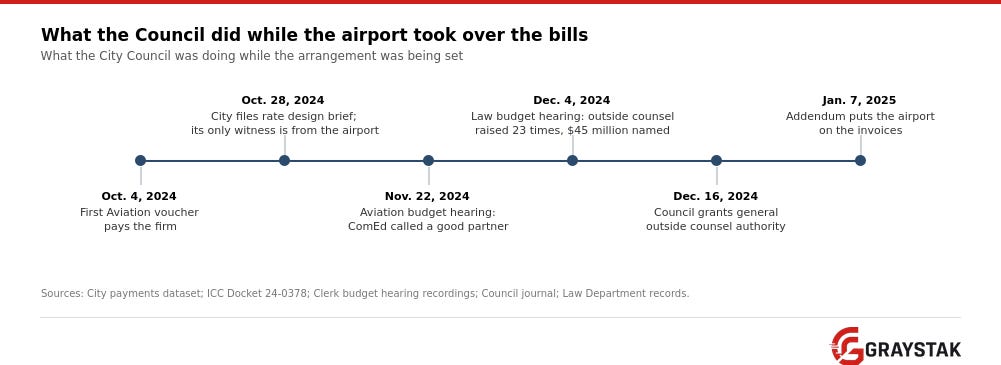
Figure 3. What the Council did while the airport took over the bills.
Corporation Counsel Celia Meza signed the engagement letter on March 24, 2023, seven weeks before Lori Lightfoot left office. It sets the rate at $350 an hour for two consolidated ComEd dockets and one Peoples Gas docket, and “$495.00 per hour for any other ICC proceedings.” The Law Department says it holds no procurement records and no request for proposals for the engagement. Through July 2026, the firm had billed about $1.2 million.
The firm does not appear in the Council’s legislative record, searched by keyword against the full index on September 24 and again on the morning this piece ran, and neither does the City’s participation at the Commission. The floor transcript and the Clerk’s record of the Council’s September 29 meeting also contain no mention of it. In December 2024, the Council added a Municipal Code provision authorizing the Corporation Counsel to contract for outside counsel, subject to appropriation. It names no firm and no matter. The Council has appropriated the O’Hare legal expense line in Finance General at $3,030,000 in each budget from 2023 through 2026. The Council pays for this work and has not examined it. No ordinance or resolution in its record names the firm.
On December 4, 2024, six weeks before the Law Department put the airport on the invoices, the Committee on the Budget and Government Operations questioned Richardson-Lowry for more than eight hours. Outside counsel came up twenty-three times. She presented a slide on it, told the committee the outside share of the department’s work is “much smaller than is often depicted,” and cited specialized expertise, conflicts, case volume, and a docket of roughly 17,000 active matters. She put the year’s outside counsel spending at $45 million. Duncan & Allen, the Commerce Commission, and the question of which department was paying did not come up.
Twelve days earlier, the same committee had questioned Aviation Commissioner Jamie Rhee. Her department had already paid the firm twice by then. ComEd came up three times, all three about energy efficiency, and Rhee called the company “a great partner.”
The airport began paying three months before the document that authorized it
A one-page addendum dated January 7, 2025, signed by Deputy Corporation Counsel Fiona Burke with Richardson-Lowry’s name printed beneath, states that “billing for ComEd Rate Design Investigation, ICC 24-0378 will be billed separately to, and paid by, Chicago Department of Aviation,” effective January 1 of that year.
The City paid the first Aviation voucher three months before the Law Department wrote that sentence. Sixty-one percent of what the City has paid the firm since January 2024 has gone out on Aviation vouchers.
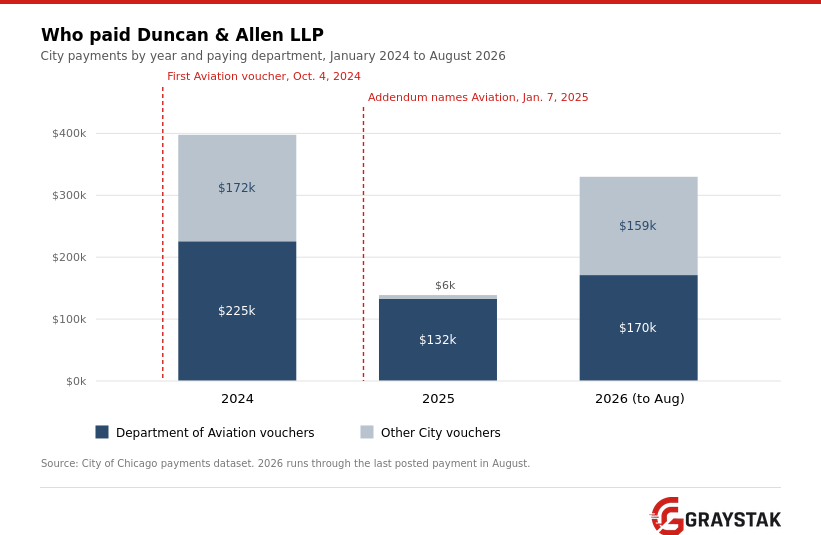
Figure 4. Who paid Duncan & Allen LLP.
The addendum names one docket. The invoices the airport approved cover five: the Peoples Gas rate case, the Commission’s Future of Gas proceeding, the grid plan itself, and testimony prepared for the Department of Environment and the Department of Transportation. The invoice for February 2025 services, which the airport approved on March 5 of that year, is entirely gas policy work with a Department of Environment staffer.
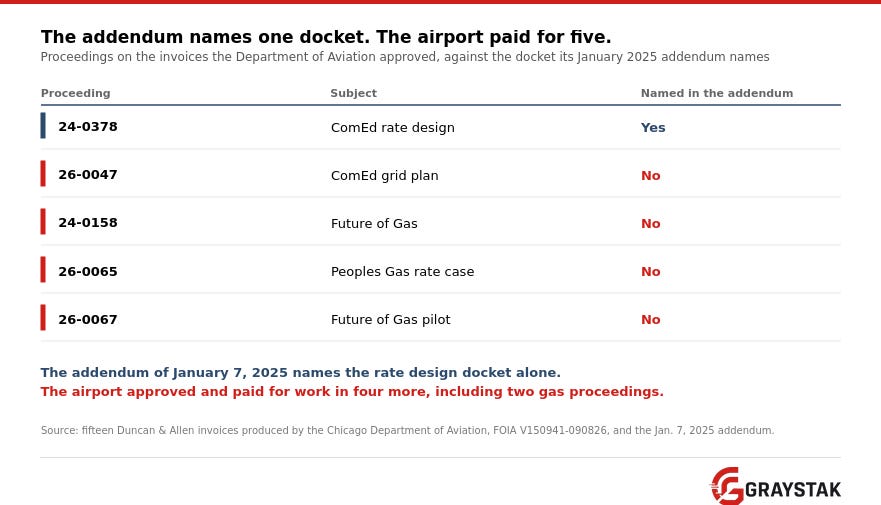
Figure 5. The addendum names one docket. The airport paid for five.
Asked under what authority and at whose direction airport money pays for work beyond the docket the addendum names, the Department of Law said this: “The invoices were sent to the Chicago Department of Aviation (CDA) for payment after DOL review, as is the standard practice with approved CDA legal engagements.” Duncan & Allen was asked the same question and did not answer. The Department's response carried the firm's questions too, and answered this one the same way. The answer describes a routing practice. It does not identify the authority the question asked about.
All fifteen invoices carry the same three signatures. A paralegal in the Law Department’s aviation division sends each one to David P. Winters, the airport’s chief legal and accountability officer. On February 27, 2025, Winters wrote back: “Approved, and please restore the item deleted by Counsel Link.” The deletions were charges the billing system flagged under the Law Department guidelines that govern the engagement, which provide that charges above an approved rate “will be written down to the approved rate for that date.” He did the same a week later on two more invoices. Twice in 2025, the department paying the bills asked the department that wrote the rules to reverse what the rules had caught.
“Both are approved, Pat, and please restore the Counsel Link deletions.”
David P. Winters, Chief Legal and Accountability Officer, Chicago Department of Aviation, approving two more Duncan & Allen invoices a week later, March 5, 2025, produced under FOIA V150941-090826.
One invoice carries a handwritten note across the middle of its first page, unsigned, directing that it be submitted “to CDA for payment per 1/7/25 addendum to engagement.” It is invoice 47622, for January 2025 work, marked ok to pay on February 27, 2025. Three airport officials signed it between December 1, 2025 and January 23, 2026, and the City paid it on February 5, 2026, eleven months after approving it.
Invoices from 2025 took five to twelve months to pay. In 2024 and 2026, they took five to eight weeks.
The Department of Law said its review “requires a multi-step review process, and with CDA matters, it requires invoices being sent for payment to CDA to process.”
The City told bondholders that airport money is for the airport
On November 13, 2025, the City sold $1,123,295,000 in O’Hare general airport revenue bonds. The official statement, issued over the names of Richardson-Lowry and Aviation Commissioner Michael McMurray, tells investors that as a recipient of federal grants, the City must use all revenue generated at O’Hare for the capital or operating costs of the airport, the local airport system, or other City facilities “directly and substantially related to the air transportation of passengers or property.” It sets out what diversion would cost: withheld federal grants, civil penalties of up to $75,000 or three times the diverted amount, and a possible default under the senior lien indenture. Chicago's only grandfathered exception is the aviation fuel tax at its 1987 rate, and the document states that no pledged revenue falls under it.
Elsewhere, the document describes the airline use and lease agreements as residual, with airline rates and charges set each year to cover the airport’s operating and debt service requirements. Under that structure, the airlines absorb what the airport spends. United accounted for 47.5 percent of O’Hare enplanements in 2024 and American for 30.2 percent.
Seven days after that document went to investors, the City paid an invoice billed to the Department of Aviation for the firm’s work in the Future of Gas proceeding.
The City’s voice changed in the fall of 2024
In the 2023 grid plan case, the City’s brief was filed by a Law Department attorney, its witness was a City sustainability adviser, and the argument focused on affordability and equity. In the rate design brief the City filed in October 2024, the words residential and ratepayer do not appear at all, and the Department of Aviation appears fifty-seven times. The witness was McHugh.
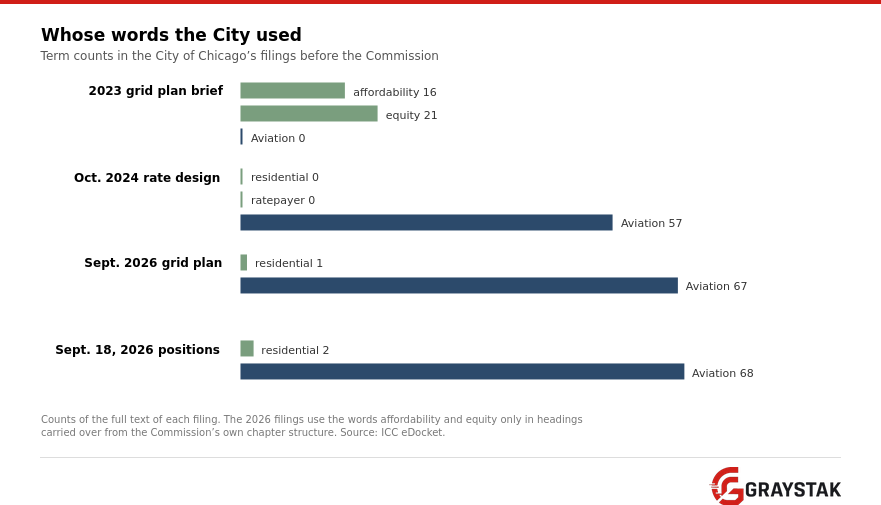
Figure 6. Whose words the City used.
The City’s brief in the current grid plan case, filed September 3, devotes seventeen pages to asking the Commission to impose protocols on ComEd’s review and pricing of large commercial and industrial projects. Those protocols began as a draft between the airport and ComEd dated March 29, 2024, which the firm reworked into a proposal for the Commission. In its answering brief, ComEd says its existing processes “have been tailored to address unique CDA concerns,” and that the City “offers nothing to suggest these processes would be beneficial, or even applicable, to any other customer.”
“It would not be appropriate to modify ComEd’s tariffs, which apply to all customers, to reflect language and concerns applicable only to CDA.”
Commonwealth Edison Company, initial brief in ICC Docket 26-0047, filed September 3, 2026.
The City revised that brief on September 18 and filed a forty-three-page statement of positions the same day. Under the headings for the large load docket, cost allocation, and the marginal cost of service study, the City’s statement carries no text.
One department released what the other withheld
The Law Department produced forty-six of the firm’s invoices in August with the task descriptions and timekeeper names blacked out on each one, citing attorney-client privilege and work product. The Department of Aviation produced fifteen invoices from the same firm in September with those fields intact: names, identification numbers, rates and the description of each charge. Two components of one public body took opposite positions on identical records. What the airport released is the basis for much of what is set out above.
A second contradiction came out of the same request. Asked in August for records of the amount authorized for the engagement, the Law Department replied that it was “not in possession of additional documents which contains the information you seek.” It produced six budgets fifteen days later. Asked in September why the budgets had not come with the August production, the Department answered: “Yes. They were not provided because we did not interpret your August 14 FOIA as asking for them.” The engagement letter requires a budget covering the whole matter as well as annual figures. Asked whether the firm had ever filed one, the Department said: “An annual budget is a global budget for a 12-month matter.”
The rate has an answer, and the Department produced it the morning this piece ran. The associate rate on this engagement was $275, the figure set by the August 2023 addendum, through work performed in December 2024. It appears at $300 for the first time on work performed in February 2025.
A CounselLink record the Department released on October 1 shows what happened. Duncan & Allen submitted a fee offer at 9:59 a.m. on March 4, 2025, raising the associate from $275 to $300, and gave as its reason: “Tim updated rate is 300. Please backdate to 2/1/25.” The City approved it at 11:25 that morning, eighty-six minutes later, and recorded the action as a backdated fee offer with an effective date of January 31, 2025. The June 12, 2026 approval the Department produced in September is the record that replaced it.
That answers the rate and leaves the records question. On August 20 the Department told this request that it held no responsive records on what authorized the $300 rate. The March 2025 record existed when it wrote that. The copy the Department sent on October 1 carries a print date of September 22, the day after these questions were put to it.
The City joined the consumer parties on access to the record, and lost
In 26-0364 the City was a movant, with the Attorney General and a coalition of non-governmental organizations, on a motion challenging ComEd’s confidentiality designations over interconnection cost data. The movants argued that sealing the data would remove from public view the facts on which the Commission will reason. ComEd, the Data Center Coalition, the industrial customers group, and REACT opposed it.
The administrative law judges denied the motion on September 25. They wrote that they recognized the movants’ interest in transparency about the costs and impacts of large demand projects, but that “the law prohibits public disclosure,” citing the Consumer Fraud and Deceptive Business Practices Act and the Commission’s 15/15 rule, which ComEd had agreed in an earlier docket to apply to large load customer data.
The dispute concerned access to the record, not who pays for new load, and the City was the third-named movant. It remains the one filing in which the City stood with the consumer parties, and the judges rejected it.
The department changes hands today
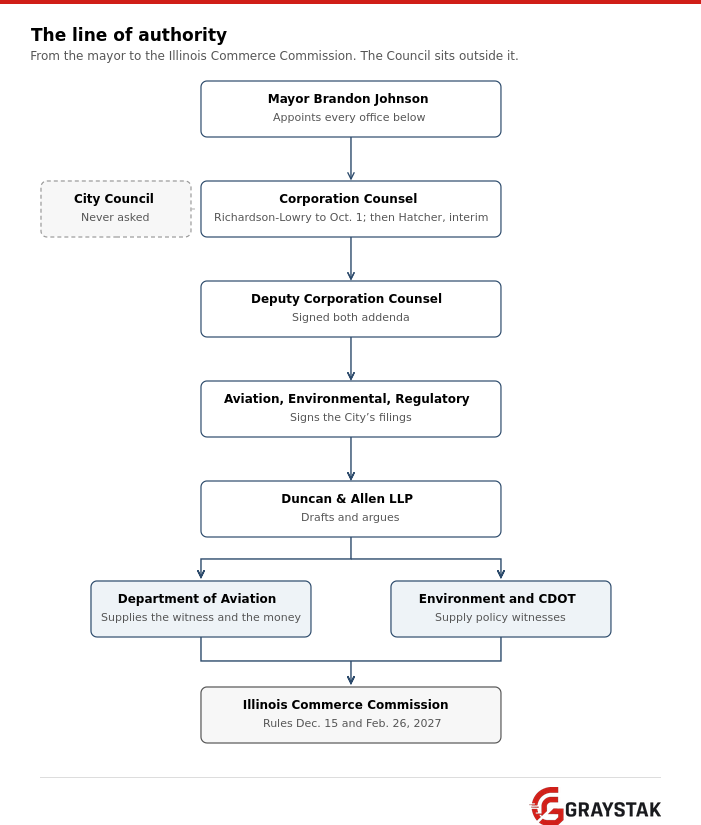
Figure 7. The line of authority.
Richardson-Lowry, who signed the addendum that put the airport on the invoices and led the Law Department through the period when the City’s case at the Commission became the airport’s, leaves office today. Renee Hatcher, a clinical professor at UIC Law who directs its Community Enterprise and Solidarity Economy Clinic, takes over today as interim corporation counsel, pending Council approval. Announcing the change, the mayor told WBEZ he wants the department doing more affirmative litigation, and that the City has to be “far more aggressive in protecting working people.”
Hatcher inherits two proceedings today, and in both, the City’s filings are the airport’s.
The dates ahead
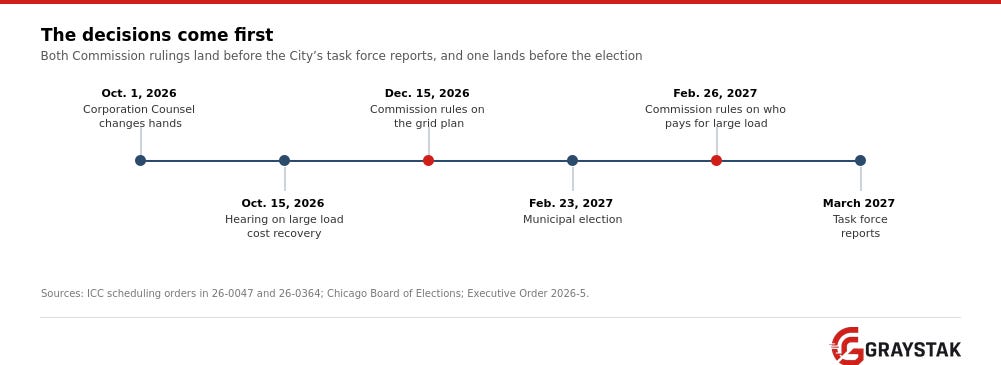
Figure 8. The decisions come first. Sources: ICC scheduling orders in 26-0047 and 26-0364; Chicago Board of Elections; Executive Order 2026-5. Graphic: GrayStak Media.
Assessment
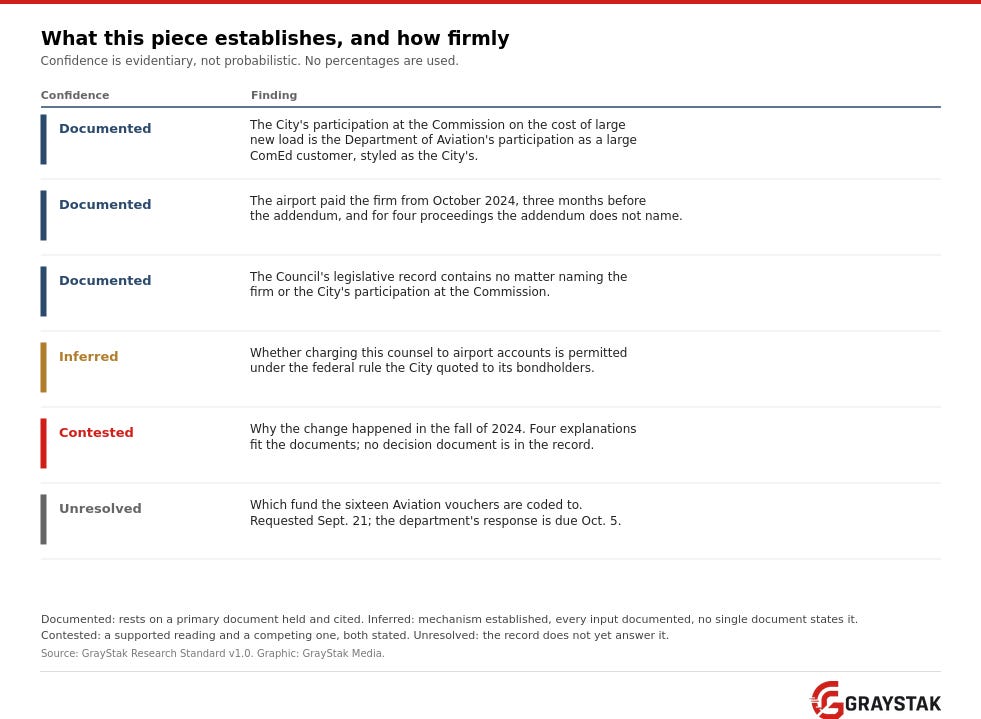
Figure 9. What this piece establishes, and how firmly. Source: GrayStak Research Standard v1.0. Graphic: GrayStak Media.
The case for the City, in its strongest form. O’Hare is among ComEd’s largest customers. Its complaints are concrete: deposits it believes were miscalculated, bills that arrived late, a connection process it cannot predict. A city that pays those bills has a real interest in how the tariff governing them is written, and a municipal law department with no rate case unit has every reason to send the client with the documented grievance. McHugh is a qualified witness on what he testifies to. The City is one intervenor among dozens in a proceeding where the Attorney General and CUB represent consumers by statute, and nothing requires Chicago to duplicate them.
What the City says. The Department of Law states that its work in these matters “is guided by a commitment to transparency in utility ratemaking and reducing costs for ratepayers,” and that it engages outside counsel “when specialized expertise is required.” It says Duncan & Allen “represents the City acting through various City departments, including the Chicago Department of Aviation.” On the money, it describes the routing to the airport as standard practice for approved airport legal engagements. It did not identify a legal authority for charging airport accounts, and it declined to say whether the City will offer residential-customer testimony in the proceeding that sets what large loads pay.
Why it happened. Contested. Four explanations fit the documents, and they are not exclusive. The first is money: the corporate legal line in Finance General rose from $400,000 in 2023 to $3.88 million in 2025, while the O’Hare line sat unchanged at $3,030,000, and moving a half-million-dollar-a-year bill onto a self-supporting fund in a hard budget year is an ordinary thing for a budget office to do. The timing fits this best; the first Aviation voucher precedes the paperwork. The second is standing: a customer with a grievance is a stronger intervenor than a government with a preference. The third is capacity: the City has no rate case unit, and the department with staff who understand tariffs is the one that runs an airport. The fourth is alignment: an airport and a data center are both large loads that want connection costs off their own bills. What the record does not show is a decision document, or any record of the mayor’s office being consulted.
What would show this wrong
▪ The sixteen Aviation vouchers are coded to the Corporate Fund or to a reimbursement, and not to an airport fund. Requested from the Department of Aviation, which extended its deadline on September 28 and is now due to respond in the week of October 5.
▪ The airport or the Federal Aviation Administration states a basis on which utility-rate counsel in gas proceedings is an airport purpose.
▪ The City files residential-customer testimony in 26-0364 before the October 15 hearing.
▪ A budget response, committee record or written answer shows the arrangement was disclosed to aldermen.
▪ The City joins the consumer parties on cost allocation, and not only on access to the record.
Implications
Aldermen have until those two rulings to put a position on the record. Both dates precede the City’s data center task force report in March 2027, and the first falls before the February 23 municipal election.
The incoming Corporation Counsel takes office with both proceedings live and the City’s filings written in the airport’s voice. The budget office is the other place an answer sits, if the shift in 2024 was a budget decision about which fund pays.
If the vouchers show airport revenue, the question reaches the airlines, which absorb the airport’s costs under a residual agreement, and the Federal Aviation Administration, which enforces the rule the City quoted to its bondholders.
And for anyone planning a large electric load in Chicago, the City’s seat at the Commission is not what it appears to be. The party arguing that new load should pay its own way is the Citizens Utility Board.
How this was reported
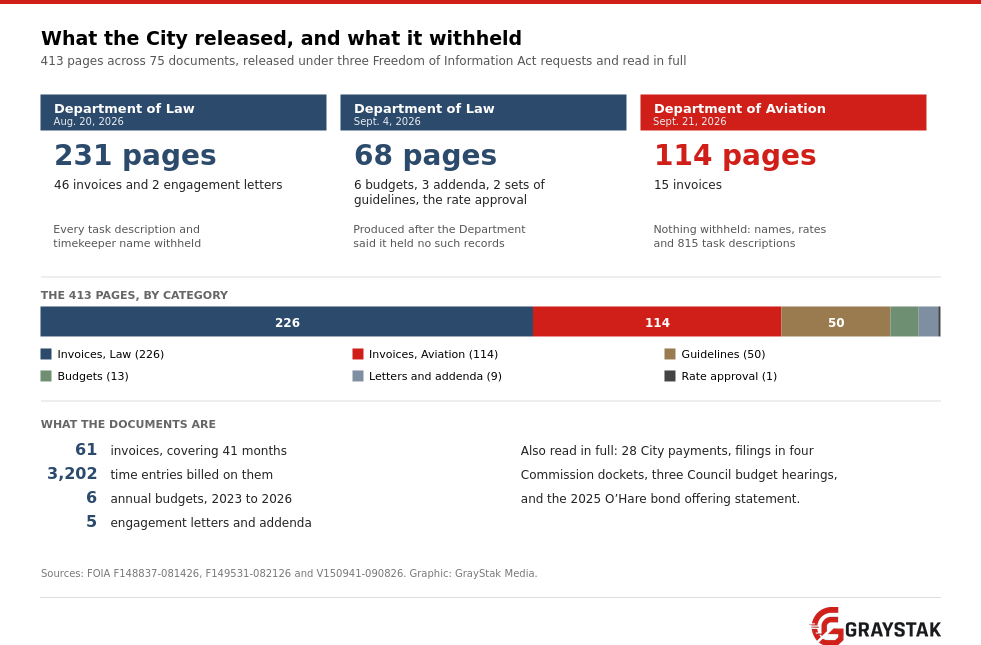
Figure 10. What the City released, and what it withheld. Sources: FOIA F148837-081426, F149531-082126 and V150941-090826. Graphic: GrayStak Media.
This account rests on three Freedom of Information Act productions totalling 413 pages, all of which were read, together with filings in four Commission dockets and the City’s published financial data.
The Department of Law produced the engagement letters and forty-six invoices on August 20, with every task description and timekeeper name withheld under the attorney-client and work product exemption, and produced the rate paperwork, six budgets and its outside counsel guidelines on September 4. The Department of Aviation produced fifteen invoices on September 21 with none of it withheld, and a narrowed request for the underlying vouchers and approvals is open. The Aviation invoices are image scans; they were converted to text by optical character recognition at multiple settings and a figure was accepted only where the passes agreed. Filings in Dockets 26-0047, 26-0364, 24-0378 and 22-0486 were read in full from the Commission’s eDocket between September 4 and publication, including the administrative law judges’ ruling of September 25. Payment figures come from the City’s payments dataset, accessed September 21 and re-checked on the morning of publication, and stated as of August 19, 2026, the last posted payment; the department attribution in those figures comes from the voucher prefix, and the fund coding behind it has been requested and not yet produced. Appropriation figures come from the annual budget ordinances for 2023 through 2026. Three City Council budget hearing recordings were searched by transcript after the Clerk’s office enabled captions on September 23 at our request.
The Law Department produced 46 invoices across two matters and the airport produced 15, all of which appear in the Law production except one, issued three days before the Law response. Every page of all three productions was read, and no task description or timekeeper name survives anywhere in the Law invoices. Excluded: the task descriptions the Law Department withheld, and the work of Duncan & Allen on matters outside the Commission, which this account does not address.
Requests for comment, and what each party said or did not say, are set out under Comment below. Two claims were removed during verification. An earlier account of a 2023 ComEd franchise agreement was wrong: the franchise was introduced in February 2023 and never adopted, and Chicago has had no franchise since 2020. A reading that made Docket 25-0383 a City complaint against ComEd was also wrong; it is ComEd’s annual reconciliation proceeding, in which the City is one intervenor.
What is not yet in the record
The fund coding on the sixteen Aviation vouchers, the approval records behind the January 2025 arrangement, and the authorization for McHugh’s testimony, all requested from the Department of Aviation, which extended its deadline on September 28 and is now due to respond in the week of October 5. Two invoices the airport has not produced. The City report on data centers that the firm billed for revising in June 2026, requested from the Department of Environment. The records approving the charge to airport accounts, requested from the Office of Budget and Management. The task descriptions the Law Department withheld, which are on appeal to the Public Access Counselor.
Comment
The Department of Law answered on September 30, the day before publication and two days after the deadline it had been given, having written on September 28 that its teams were still working through the material. Kristen Cabanban, its director of news affairs, returned answers to all eleven questions: the six put to the Department and the five put to Duncan & Allen. The firm did not respond separately.
For attribution, the Department said: “While we cannot comment on pending litigation, the City’s work in these utility matters is guided by a commitment to transparency in utility ratemaking and reducing costs for ratepayers.” It added that it “engages outside counsel when specialized expertise is required, including in utility matters before the Illinois Commerce Commission,” and that “Duncan & Allen LLP represents the City acting through various City departments, including the Chicago Department of Aviation (CDA).”
It answered five questions and declined three, each time on the ground that the City does not comment on pending litigation: whether it will offer residential-customer testimony in 26-0364; whether the City reduced the scope of its participation at the Commission in 2025 and who communicated that; and whether the firm appears as a ratepayer advocate, a large customer, or both. Its answers on the routing of invoices, the payment lag, the budgets, the global budget and the $300 rate appear in the sections above.
The Department answered again on the morning of October 1, after a follow-up question about the rate. It wrote that the firm gave notice on March 4, 2025 that the associate’s rate was $300 as of February 1, 2025, and that the City accepted the fee offer’s terms the same day, and it attached the CounselLink record of that approval. That record and the Department’s full answers are described above.
Requests for comment sent September 21 to Aviation Media Relations and to Natalie Karas at Duncan & Allen, and September 22 to Ald. Jason Ervin as chair of the Committee on the Budget and Government Operations, to Constellation, and to United and American Airlines, each with a deadline of 5 p.m. September 28, had received no substantive response at publication. Robert Kelter of the Environmental Law and Policy Center and Joe Ferguson of the Civic Federation were asked on September 22 to assess the arrangement and did not respond.
Corrections
None in this piece.
Updates
Responses received after publication, the Department of Aviation’s production due in the week of October 5, and ComEd’s rebuttal due October 6 will be added here and dated. The original text stays intact.
Disclosures
GrayStak holds no position in any company named in this analysis, and neither does the author. GrayStak has approached data center operators and developers about its analytics products; none are clients. GrayStak uses commercially available artificial intelligence tools, including Anthropic products, in its research and production workflow, and holds no financial interest in any of their makers.
Archive entry
Forward calls. Six calls were entered on September 21, 2026, before any resolving date. One of them, on the authorization for the $300 rate, resolved on the morning of publication when the Department of Law produced the record, and it is retired in the registry. The five below remain open.
▪ ICC-01: The sixteen Aviation vouchers are coded to an airport fund.
Scored on the Department of Aviation’s production, due in the week of October 5.
▪ ICC-02: The City offers no residential-customer witness in 26-0364 before the evidentiary hearing.
Scored on the Commission’s docket as of October 15.
▪ ICC-03: No City Council matter naming the engagement or the City’s participation at the Commission is introduced through October 14.
Scored on the Clerk’s legislative record.
▪ ICC-04: No record produced by the City identifies who decided that airport funds would pay for work beyond Docket 24-0378.
Scored on the Department of Aviation’s production of the vouchers, approvals and the authorization for the City’s testimony, due in the week of October 5.
▪ ICC-05: The airport’s approval record shows sign-off at managing deputy commissioner level, with no commissioner or mayor’s office approval.
Scored on the approval records requested September 21.
▪ ICC-06: The Commission’s order on cost recovery for large demand customers is entered before the City’s data center task force reports.
Scored on the Commission’s order, due February 26, 2027, against the task force report due March 2027. A near-certain call: the Commission’s schedule is set and the task force has no published date earlier than March.