

CHRISTOPHER SWEAT, reporting from City Hall
Fifth in a series on Chicago’s data center regulation. Previously: Chicago Zones Data Centers as Offices, Aug. 17; A Council Committee Votes September 1, Aug. 27; The Council Rewrote the Bill in the Room, Sept. 3; Chicago’s Mayor Sent Data Center Zoning to a Task Force. An Alderman Filed It., Sept. 22.
The series so far. GrayStak Media has followed Chicago’s effort to regulate data centers since August, starting with a zoning code that treats them as offices. On Aug. 11, Mayor Brandon Johnson signed Executive Order 2026-5, which sent the zoning question to a Data Centers Task Force due to report by March 15, 2027; his office said the administration would work with the City Council on a temporary moratorium on new data centers. On Sept. 1, the Committee on Environmental Protection and Energy rewrote and advanced Ald. Maria Hadden’s bill ending the data center exception in the city’s energy benchmarking rule. On Sept. 17, Ald. Bill Conway filed an ordinance to end by-right zoning for data centers, and on Sept. 22, the night before the Council met, GrayStak registered three forward calls on what it would do.
This report. The Council met on Sept. 23. What follows covers that meeting, the mayor’s press availability afterward and the public record through Sept. 28: what passed, what was introduced, where each measure now sits and what comes next.
QUESTION: What did the City Council do on data centers on Sept. 23, and how did the three calls GrayStak registered the night before hold up?
What happened. The Council passed Ald. Maria Hadden’s benchmarking ordinance, SO2026-0027165, 50 to 0 on another item’s roll call. Mayor Brandon Johnson introduced a one-year data center moratorium, and Ald. Nicholas Sposato (38th) introduced a six-month one. Both went to the Committee on Committees and Rules, as did Ald. Bill Conway’s data center zoning ordinance and Ald. Andre Vasquez’s resolution for a 40th Ward advisory question.
Why it matters. The ordinance that passed brings buildings with data centers into the city’s energy benchmarking rule, and it allows the city to publish the results without requiring it to. The two moratoriums would not stop the same projects: the mayor’s exempts only a project holding a building permit, while Sposato’s exempts any project that filed a permit application before Sept. 23, and a Loop data center conversion at 300 W. Adams St. falls between them. Neither can come to a vote until the Rules Committee reports it, and the committee has posted no meeting; a motion to take a matter from committee becomes available only after it has been pending more than 60 days. Under the mayor’s executive order, a moratorium approved by the Council would let him move his task force’s March 15, 2027 deadline to match it.
What is pending. The Council meets next on Tuesday, Sept. 29, a date it set on Sept. 23 so it could act on the parking meter deal before a Sept. 30 deadline; it deferred that deal at a special meeting on Sept. 25. The Sept. 29 agenda, posted by Sept. 26, lists no data center item.
Hadden’s bill passed 50 to 0 and makes buildings with data centers report energy use
When Hadden reported for the Committee on Environmental Protection and Energy, she moved passage of SO2026-0027165 “by the first favorable roll call vote of the Committee on Finance,” and no member asked for a separate vote. That roll call was on Item 1 of the Finance report, an amendment to the Central West TIF plan, and the chair announced it as “49 yeas, zero nays.” Ald. Lamont Robinson was “not present in chambers” for the vote; later in the meeting he asked “to be recognized as a yes for the first favorable vote,” and the chair had him added. The Clerk’s record lists 50 yeas on Hadden’s bill.
The ordinance, as amended in committee on Sept. 1, changes three sections of Chapter 18-14 of the Municipal Code. It adds a sentence to the definition of a covered building: “Provided, however, the term ‘covered building’ shall include any Group 1 covered building or Group 2 covered building with a data center.” That brings buildings with data centers under the city’s benchmarking rule, which, as the city describes it, requires owners of covered buildings, generally those of 50,000 square feet or more, to track their energy use and report it to the city each year. It changes “may” to “shall” in the provision on water data, so the Commissioner of Water Management “shall transmit water usage information for covered buildings to the Chief Sustainability Officer.” It then says the officer “may, pursuant to rules, select certain covered buildings and make public the water usage data of such covered buildings.” And it strikes “data center” from the exception in Section 18-14-102.3 that kept certain buildings’ energy ratings from public release, under a section that says the officer “is authorized to make reported benchmarking information and energy performance ratings readily available to the public.” The title the Council passed reads “now requiring public release of data center benchmarks and performance ratings by Chief Sustainability Officer.”
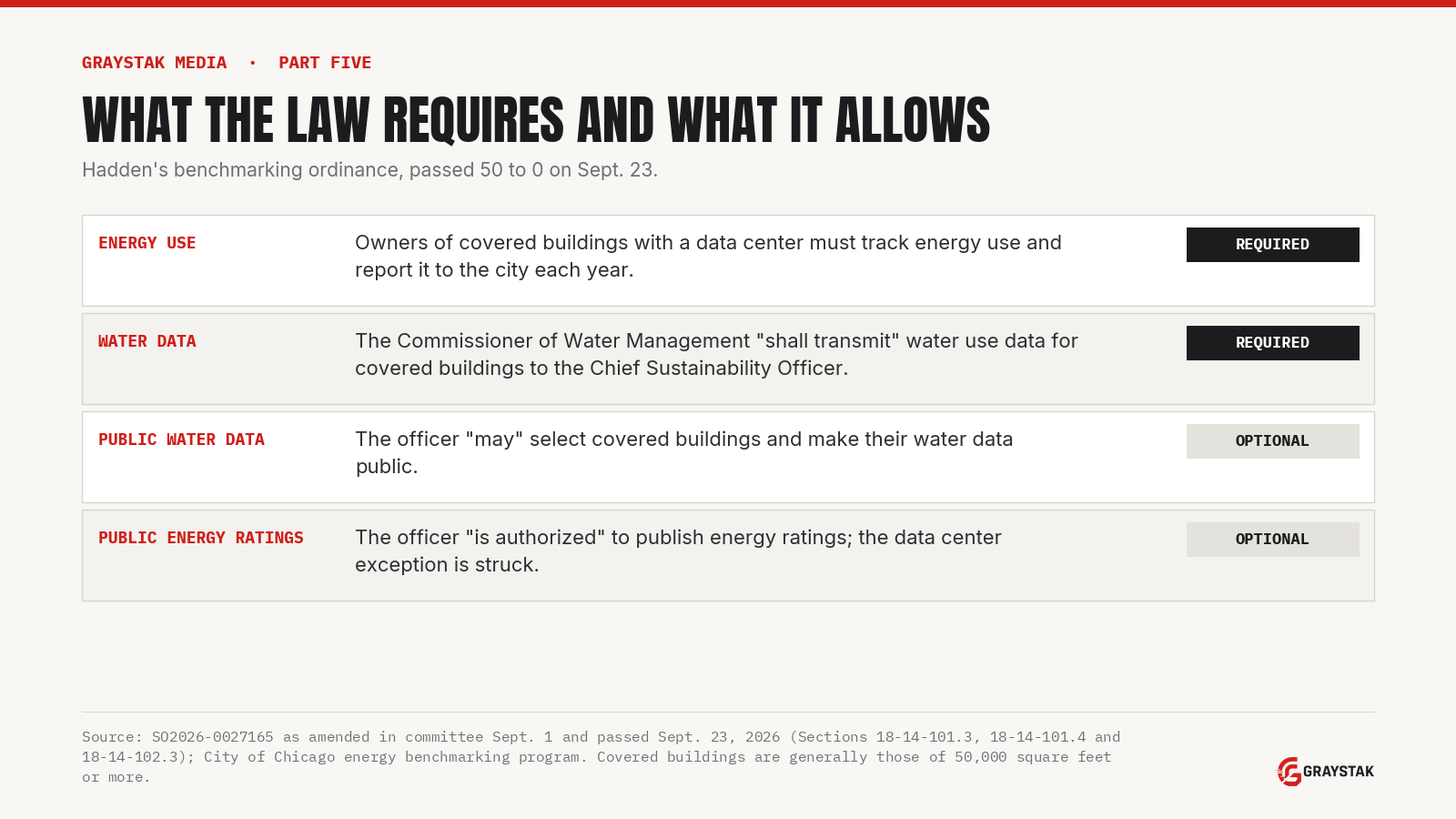
What SO2026-0027165 requires and what it allows. Covered buildings are generally those of 50,000 square feet or more. Source: SO2026-0027165 as amended in committee Sept. 1; City of Chicago energy benchmarking program. Graphic: GrayStak Media.
In the mayor’s release, Hadden called the measure “stronger benchmarking requirements that will give Chicagoans greater transparency into these facilities’ energy and water use.” Asked whether the mayor would direct that water data be requested and published, a spokesperson for the Mayor’s Press Office wrote on Sept. 25 that the Mayor’s Office and the Department of Environment support Hadden’s ordinance, “which passed September 23 and requires data centers to report their energy and water usage to the City.” In the text, the energy requirement comes through the covered-building definition; the water data comes from the Commissioner of Water Management, not from the buildings’ owners. Hadden’s office did not respond by the 5 p.m. Sept. 25 deadline to questions sent Sept. 21 and Sept. 23, including why the text says “may.”
“The Chief Sustainability Officer may, pursuant to rules, select certain covered buildings and make public the water usage data of such covered buildings.”
SO2026-0027165, Section 18-14-101.4(b), as amended in the Committee on Environmental Protection and Energy on Sept. 1 and passed by the City Council on Sept. 23; City Clerk matter record
Before the amendment, the exception in Section 18-14-102.3 covered data centers “until the Chief Sustainability Officer determines that the benchmarking tool can make adequate adjustments for such facilities.” GrayStak has asked since Aug. 13 whether the officer ever made that determination. The spokesperson answered on Sept. 25: “Adding data centers to the list of buildings required to report requires action by City Council.” The statement did not say whether a determination was made.
The bill has 23 sponsors in the Clerk’s record. They include Hadden, a co-sponsor of the mayor’s moratorium; Sposato, who filed the other one; Conway; and Ald. Gilbert Villegas, who chairs the Zoning Committee.
The mayor introduced a one-year moratorium with three co-sponsors
Mayor Johnson signed Executive Order 2026-5 on Aug. 11. That day, in the news release announcing the order, his office said the administration would “work in partnership with the City Council to advance legislation establishing a temporary moratorium on new data centers and the material expansion of existing facilities.” The Clerk’s record showed no moratorium ordinance through the night of Sept. 22.
On the morning of Sept. 23, his press office announced that he and Alds. Hadden, Leni Manaa-Hoppenworth and Robinson had introduced the ordinance. The Clerk read it into the record during the mayor’s communications as transmitted together with Alds. Hadden, Robinson and Manaa-Hoppenworth. It is O2026-0028856. The Clerk’s record listed Johnson alone through Sept. 24 and added the three co-sponsors by the morning of Sept. 25.
The text sets a one-year moratorium, starting on the effective date, on any city “permit, approval, license, or other permission in furtherance of establishing a new or expanded data center” for which a building permit, other than for demolition or repair, has not been issued by that date. It names zoning approvals under Title 17, building permits, air pollution control permits and public way work licenses. It expires after one year “without further action by the City Council.” It excludes data centers owned and used exclusively by government or by medical facilities. It takes effect “upon passage and approval.”
It defines a data center by floor area, not power: a use occupying at least 1,000 square feet and at least 20 percent of a business’s enclosed floor space, primarily for storing and processing electronic data, without routine human occupancy. There is no megawatt threshold.
Under the text, a pending project is exempt only if it holds a building permit on the effective date. A project allowed by right but without one would be covered, and landmarks review is not a building permit.
The preamble states the city has “approximately 39 data centers” and that typical facilities use “approximately 300,000 gallons per day.” The text says nothing about the task force or its March 15 date.
The release says the moratorium would give the city’s Data Centers Task Force time to develop long-term policies. It describes the task force as “co-chaired by the Mayor’s Chief Sustainability Officer and Chief of Policy,” with representatives from the Departments of Buildings, Environment, Planning and Development, Technology and Innovation, Water Management and other agencies. Angela Tovar holds both the Chief Sustainability Officer post and the Department of Environment commissionership, the release says.
Section 4 of Executive Order 2026-5 gives that task force until “March 15, 2027, or such other date approved by the Mayor that is consistent with the timing and duration of any data center development moratorium approved by the City Council.” Asked whether the task force will still report by March 15, the spokesperson wrote: “The Data Centers Task Force will continue its work on the long-term regulatory framework. The work is ongoing and we do not have an update at this time.” Asked whether it has met, the spokesperson wrote: “The Task Force will begin meeting bi-weekly next week.”
Ald. Sposato filed a narrower, six-month moratorium the same day
During the call of the wards, the Clerk read an ordinance from Sposato titled in the Clerk’s record “Establishment of temporary moratorium on receipt of new applications for zoning or licensing of new or substantially expanded electronic data storage centers.” It is O2026-0028838, with Sposato as sole sponsor, and it went to Rules.
The filed text, three pages signed by Sposato, runs six months. It stops the city from accepting new applications for zoning map amendments, planned developments and new business licenses for electronic data storage centers; building permits fall outside it. Applications begun before it takes effect are exempt, and a hardship process lets the Planning and Business Affairs commissioners approve projects that meet four tests, including substantial investment made in reliance on current law.
Its vested-rights section exempts any project that, before the ordinance was introduced, had submitted “any permit application, including, without limitation, building, excavation or foundation permits, interior demolition permits, and other phased construction,” had site plan approval, or had land use approval or authorization from a state agency or another unit of local government.
Section 6, headed “Contracted Power,” exempts projects that before introduction “signed a definitive agreement with” and the filed copy ends there: page two breaks mid-sentence and page three begins with Section 7. Sposato’s office did not respond by the Sept. 25 deadline to a request for the complete section. The Clerk’s record shows no corrected copy as of Sept. 28.
“... signed a definitive agreement with”
O2026-0028838, Section 6, as filed with the Office of the City Clerk on Sept. 23; the filed copy breaks off here, at the foot of page two
Most of its preamble matches the mayor’s word for word, including both counts. It adds that most of the 39 are “relatively small- to medium-sized” and that data centers support “relatively few permanent on-site operational jobs.” The first page carries a handwritten notation reading “Zoning.”
Sposato’s office did not respond by the deadline to questions sent Sept. 23 on why he filed separately from the mayor.
The two texts would not stop the same projects. A project that filed any permit application before Sposato’s ordinance was introduced is exempt under it; under the mayor’s, only an issued building permit exempts a project.
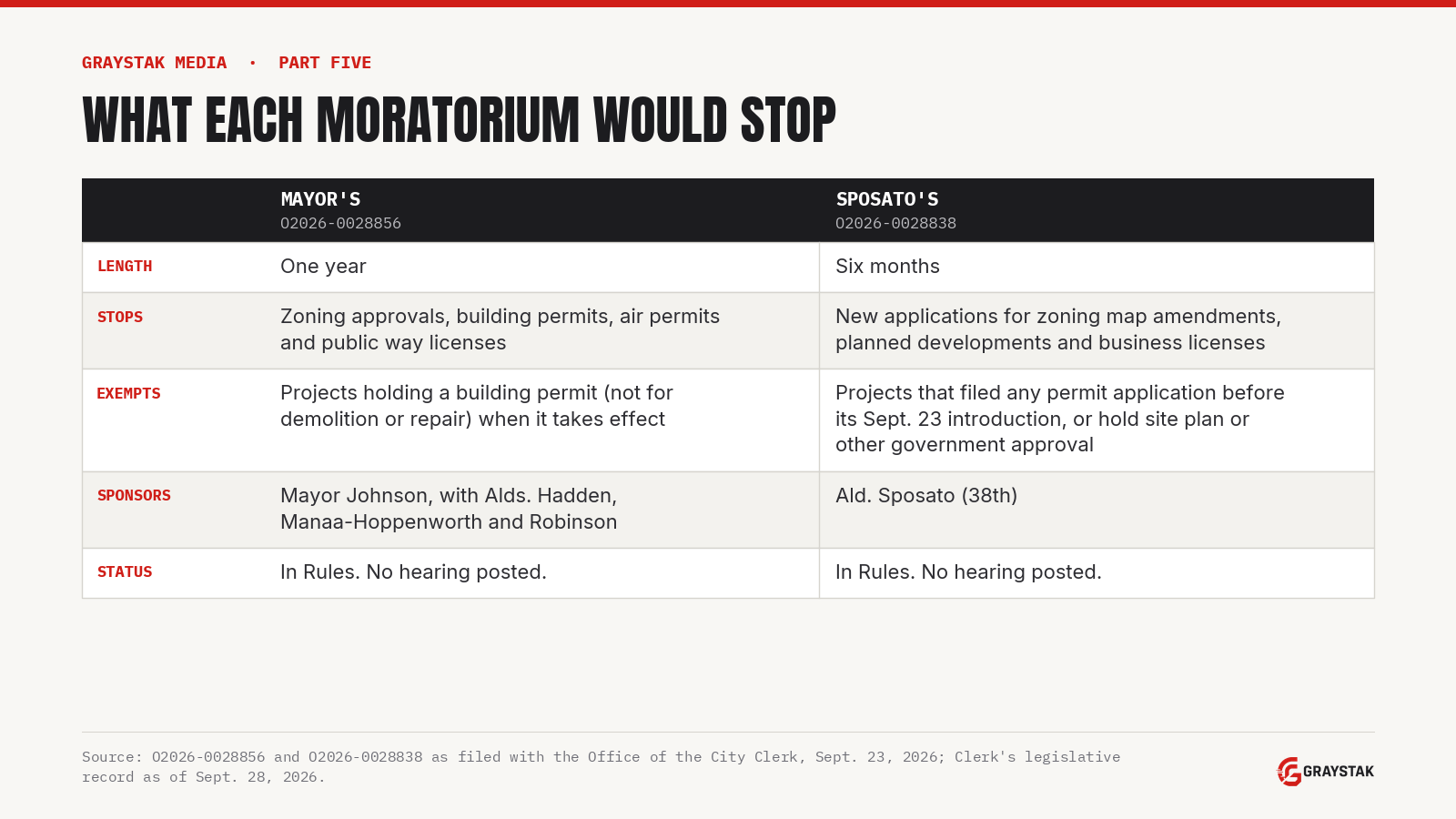
What each moratorium would stop: the mayor’s O2026-0028856 and Ald. Sposato’s O2026-0028838 as filed. Source: City Clerk matter records. Graphic: GrayStak Media.
The permit history of 300 W. Adams St. places it on the line under both texts. The Permit Review Committee of the Commission on Chicago Landmarks approved a plan on Aug. 6 to convert floors two through six of the building to a data center with a new ComEd vault, the Chicago Sun-Times reported on Aug. 13. The city’s building permit data, current through Sept. 22, shows two recent permits there. On Aug. 5 the city issued a self-certified permit for interior demolition on the basement and floors two through six, noting that tenant build-outs would be done “under separate building permit applications.” On Sept. 16 it issued a $1 million renovation permit, applied for Feb. 13, for “interior alterations to existing 1st floor space for new ComEd vault & bathrooms.” Neither permit names a data center.
Under Sposato’s vested-rights language, the Feb. 13 application and the Aug. 5 permit would appear to exempt the project; his office did not respond by the Sept. 25 deadline to a Sept. 23 question on whether they would. Under the mayor’s, the question is whether the Sept. 16 permit counts as a building permit “in furtherance of establishing” the data center under Section 2. Asked that question, the Mayor’s Press Office spokesperson wrote that the moratorium “would temporarily halt new data center development and the expansions of existing data centers that require a building permit, subject to the terms of the ordinance.” The statement did not address 300 W. Adams.
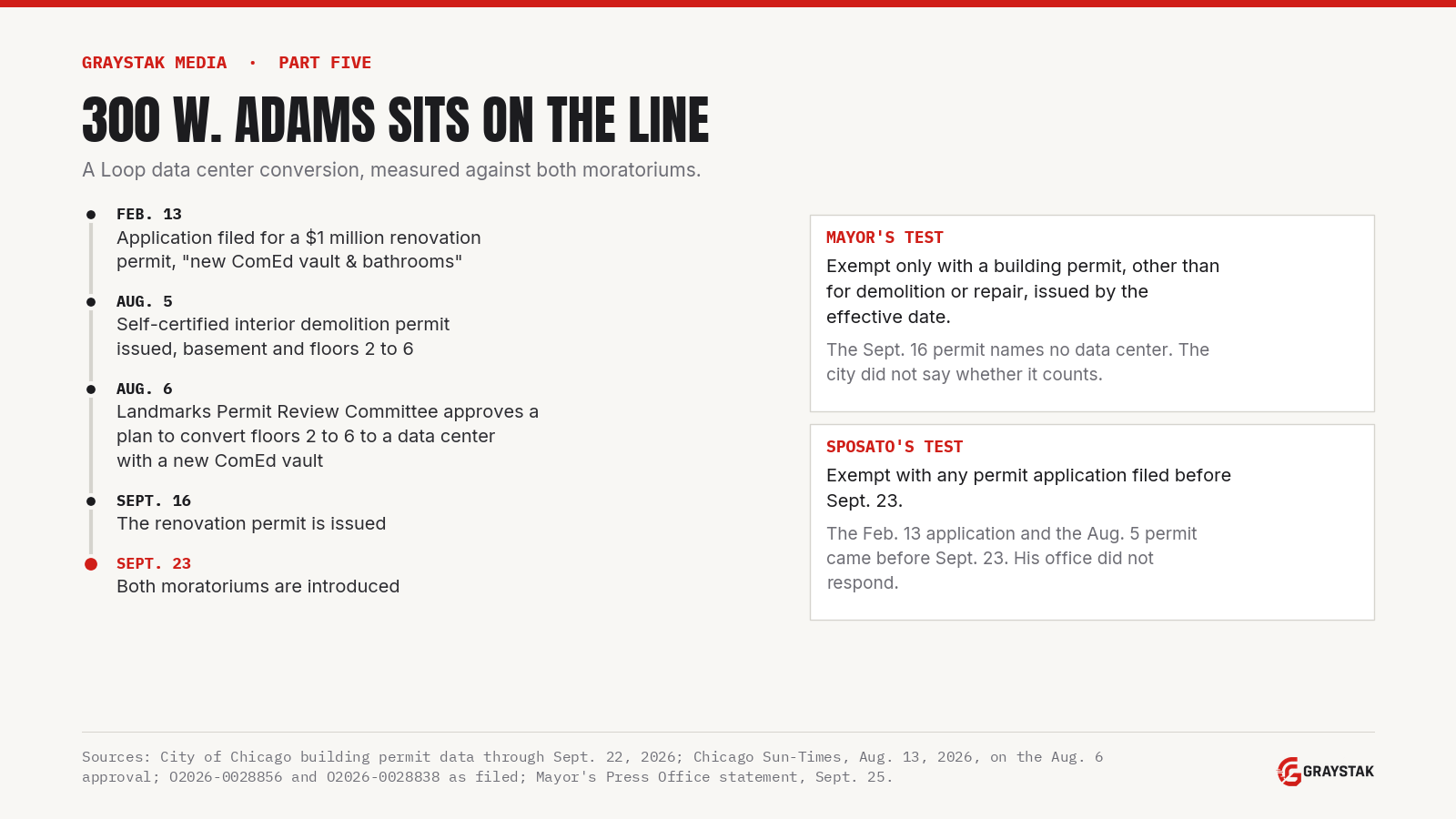
300 W. Adams St., measured against both moratoriums. Sources: City of Chicago building permit data through Sept. 22; Chicago Sun-Times, Aug. 13, on the Aug. 6 approval; O2026-0028856 and O2026-0028838 as filed; Mayor’s Press Office statement, Sept. 25. Graphic: GrayStak Media.
At the availability, the mayor blamed “a corporate-aligned member”
In his opening remarks the mayor thanked “Chairwoman Hadden,” Ald. Leni Manaa-Hoppenworth and Ald. Lamont Robinson “for recognizing the importance of this work and partnering with my administration on this ordinance.” Then he said: “While we are hoping to bring this moratorium before a joint committee of zoning and environment for robust conversation and further consideration, unfortunately, a corporate-aligned member sent the ordinance to the Rules Committee. Chicagoans are certainly sick and tired of political tricks.” He did not name the member. The floor transcript records only that “two committees” were called. The Mayor’s Press Office wrote to GrayStak that evening: “It was 13th Ward Alder Marty Quinn who sent it to rules.” Quinn’s office did not respond by the Sept. 25 deadline to questions sent Sept. 23 and a reminder Sept. 25.
“Unfortunately, a corporate-aligned member sent the ordinance to the Rules Committee.”
Mayor Brandon Johnson, press availability after the City Council meeting, Room 201A, City Hall, Sept. 23; GrayStak recording of the availability, covered remotely
A reporter asked about Conway’s ordinance, saying Conway worries the moratorium “would end up in court.” The mayor said: “I’m grateful that Alderman Conway has elevated his participation.” He added: “Now, what I don’t think is appropriate, though, is to create more bureaucracy.” He closed the answer: “And I still believe that the moratorium is the most just, equitable way to move forward.”
Asked whether the administration had assessed the legal risk, the mayor said: “We constantly assess how policy that we put forward can withstand any legal challenge.” Commissioner Angela Tovar of the Department of Environment added: “this is not a ban, correct? This is a temporary moratorium that we are advancing.” She said: “And so, yes, we have assessed that with our Department of Law, and we’re comfortable and confident that we can put forth a temporary moratorium in order to reevaluate our regulations.” Asked on Sept. 23 whether the city would release or summarize that assessment, the Mayor’s Press Office spokesperson wrote: “The administration worked with the Department of Law in developing the proposed moratorium ordinance. We cannot comment on privileged legal advice or internal legal assessments.”
A reporter relayed an opponent’s view that the moratorium is “a lazy form of governance,” then asked how the mayor would overcome “a formidable opposition.” The mayor said: “Yeah, listen, there’s opposition from corporations.” He said: “But the whole point of the executive order was to make sure this is not punting. That’s actually doing the work.” And: “I think what you’re hearing and what you’re expressing is that people are more interested in lining their pockets than making sure that the lungs of working people are healthy.”
Asked on Sept. 23 about a commitment the mayor described from the quantum campus developers, the Mayor’s Press Office spokesperson wrote on Sept. 25: “IQMP has made clear to the City that it will not develop a data center. The developers of the quantum campus have also stated that there are no current plans for a data center as part of the quantum campus.”
“IQMP has made clear to the City that it will not develop a data center.”
Mayor’s Press Office spokesperson, written statement emailed to GrayStak, Sept. 25, in answer to a question about the mayor’s remarks at the Sept. 23 availability
In his opening remarks the mayor also spoke about C40’s Global Urban Data Centres Pact. The pact launched June 23, 2026. He did not mention it at the NRDC seminar GrayStak covered on Sept. 21. Asked whether Chicago signed or endorsed the pact, and on what date, the spokesperson wrote: “Yes. June 23, 2026.”
All four data center matters are in the Rules Committee
When the Clerk read the mayor’s ordinance, the transcript records: “With two committees called, it will go to rules.” No member or committee is named at that point. For Conway’s ordinance the Clerk said: “Two committees have been called, the Committee on Zoning, the Committee on Finance. The matter is referred to Committee on Committees and Rules.” Sposato’s drew calls for the same two committees. Vasquez’s resolution, already slated for Rules, drew calls for Rules and Finance and stayed there. The Clerk’s record shows no action on any of the four since Sept. 23, and no Rules meeting is posted through mid-November.
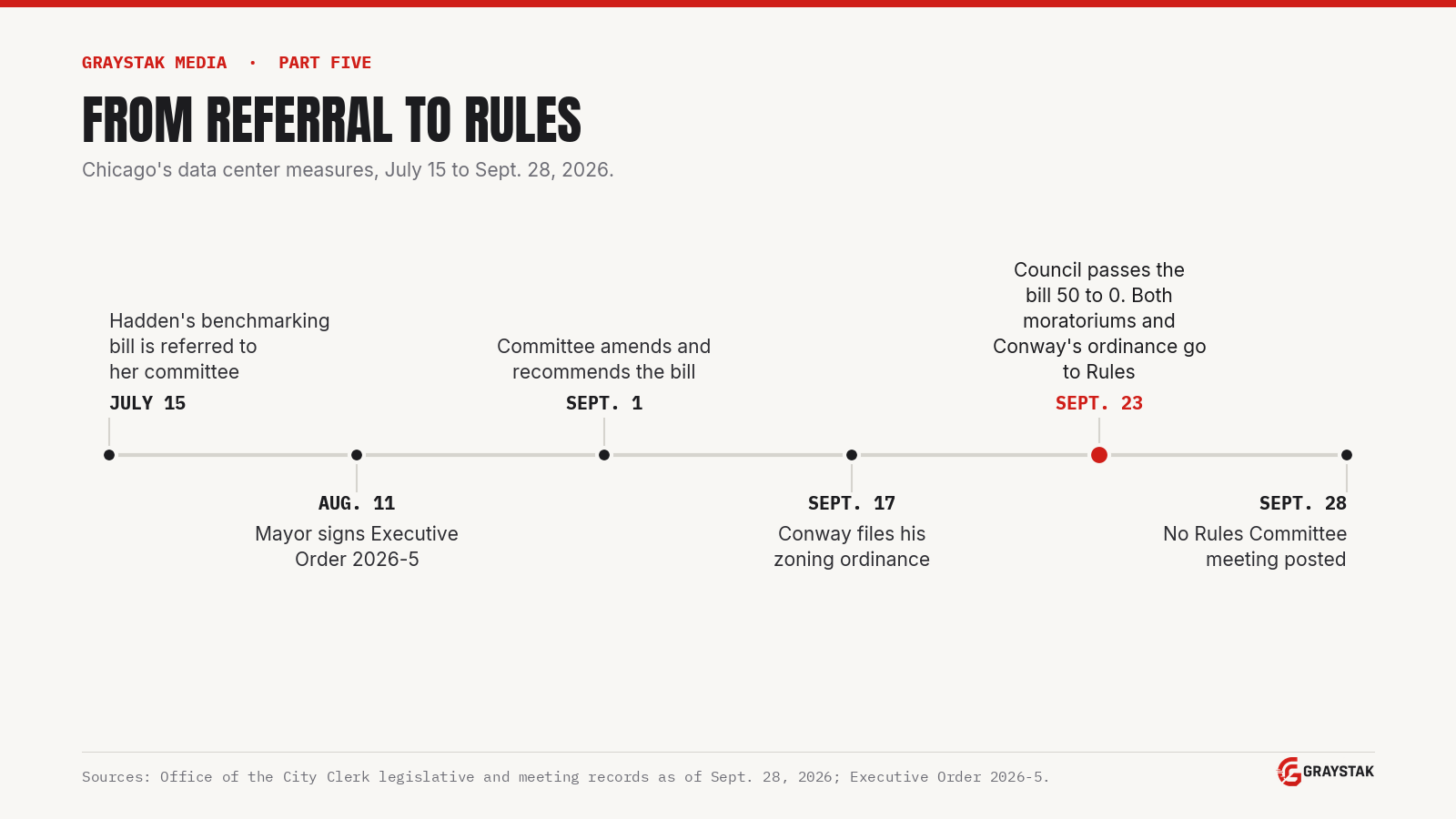
From referral to Rules: Chicago’s data center measures, July 15 to Sept. 28, 2026. Source: City Clerk legislative and meeting records; Executive Order 2026-5. Graphic: GrayStak Media.
Conway filed his ordinance on Sept. 17 for referral to Zoning, which is how the Clerk’s record listed it when GrayStak’s Sept. 22 piece ran. The Clerk’s record still listed Zoning on the afternoon of Sept. 23; by that evening it showed the matter referred to the Committee on Committees and Rules, with Conway as sole sponsor. The office of Ald. Gilbert Villegas, the Zoning chair, wrote to GrayStak that afternoon: “The matter was referred to Rules Committee so it is not coming to Zoning Committee at this time.”
Villegas’s office wrote: “Chairman Villegas was not consulted before its filing. It is too early at this time to say favorable or unfavorable toward it.” It wrote: “Chairman Villegas does support a moratorium at this time for the hyperscalers. We are not aware of any other ordinances being prepared.” The office did not define “hyperscalers” and did not respond by the Sept. 25 deadline to a follow-up asking how he defines the term; the mayor’s text has no megawatt threshold. On projects already in review: “Chairman Villegas believes that projects already in progress or under reviews should be grandfathered in and able to move forward with their development.”
“Chairman Villegas does support a moratorium at this time for the hyperscalers.”
Office of Ald. Gilbert Villegas (36th), chairman of the Committee on Zoning, Landmarks and Building Standards, email to GrayStak, Sept. 23
Conway’s release on Sept. 22 said the ordinance closes what he called the “Johnson Gap” “effective immediately.” Section 6 of the filing puts it in effect upon passage and publication. Asked whether the Mayor’s Office, Planning and Development or the Department of Environment was consulted before Conway filed, the Mayor’s Press Office spokesperson did not say. The statement read: “The administration is calling for a full moratorium at this time. We plan to work with any alder who is supportive of addressing environmental and community protections related to the growth of this industry.” Conway’s office did not respond by the Sept. 25 deadline to questions sent Sept. 21 and Sept. 23 on the Rules referral.
Asked whether the administration has asked Rules to schedule a hearing or re-refer the ordinance, the Mayor’s Press Office spokesperson wrote: “The moratorium ordinance was introduced on September 23. The administration will work with our City Council partners as the ordinance moves through the legislative process.” The office of Ald. Michelle Harris (8th), who chairs the Committee on Committees and Rules, did not respond by the Sept. 25 deadline to questions sent Sept. 23 on when the four matters will be heard.
How GrayStak’s forward calls held up
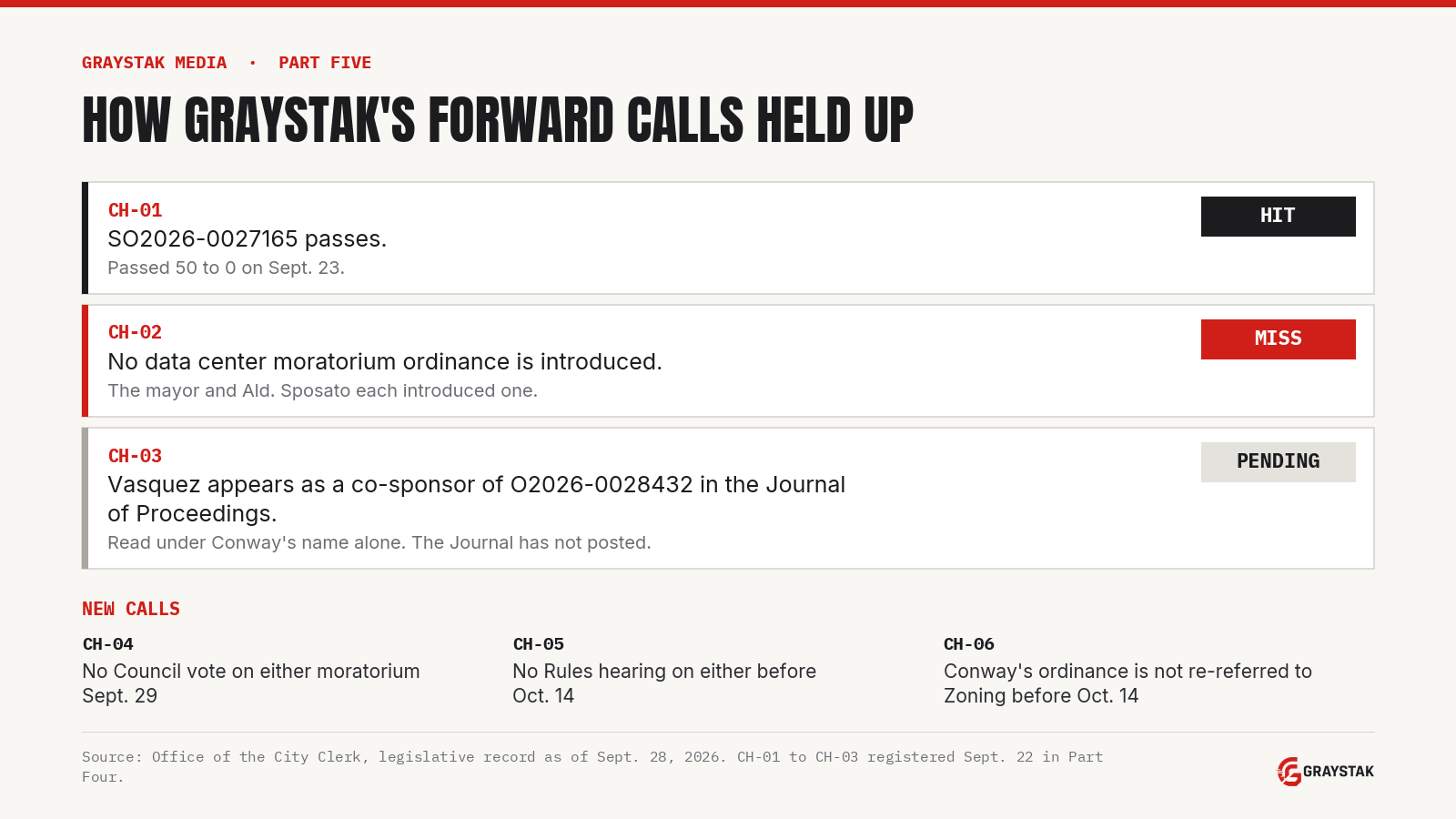
GrayStak’s forward calls from Part Four, scored against the Clerk’s record as of Sept. 28, and the three new calls registered with this piece. Source: City Clerk. Graphic: GrayStak Media.
GrayStak registered three calls in Part Four, the night before the meeting, and scores them against the Clerk’s record as of Sept. 28.
CH-01: SO2026-0027165 passes. Hit. The Clerk’s record shows “Passed as Substitute,” with 50 yeas.
CH-02: no data center moratorium ordinance is introduced. Miss. The mayor introduced one and Sposato introduced another. The call rested on the Clerk’s record through Sept. 22 and a council member’s report of an ordinance in preparation with no date. It missed because the administration filed the same day.
CH-03: Vasquez appears as a co-sponsor of O2026-0028432 in the Journal of Proceedings. Pending. Asked Sept. 22 whether he would add his name as a co-sponsor, Vasquez wrote in an email to GrayStak: “Sure I don’t have a problem co-sponsoring.” The Clerk read the ordinance under Conway’s name alone, and the Clerk’s record still lists Conway as sole sponsor. Vasquez’s office did not respond by the Sept. 25 deadline to a Sept. 23 question on his co-sponsor status. The Journal of Proceedings for Sept. 23 has not posted; GrayStak will score the call when it does.
GrayStak registers three new calls with this piece, listed in the Archive below with their scoring terms.
Hadden also asked the General Assembly to pass the POWER Act
Hadden introduced R2026-0028728, a resolution calling on the General Assembly to pass the POWER Act, House Bill 5513, referred to her own committee. Villegas filed a resolution on the same state bill in May, R2026-0025263, which remains in committee.
The Clerk’s office also reported Executive Order 2026-5 as filed.
Tuesday’s agenda carries no data center item
The Sept. 29 agenda carries four Rule 41 notices to call deferred items up for a vote: the parking meter ordinance, SO2026-0025407, which the Committee on Finance passed Sept. 24 and the Council deferred and published at the Sept. 25 special meeting; Ald. Marty Quinn’s O2026-0026270, requiring a three-fifths vote for ordinances authorizing debt; SO2026-0027202, on residential building standards; and SO2026-0026554, the landlord-tenant amendment. None concerns a data center measure. No Rules Committee meeting is posted as of Sept. 28. The Committee on Environmental Protection and Energy, which Hadden chairs, posted notice on the afternoon of Sept. 28 of a meeting on Oct. 8 in the Council chamber. The notice names no subject and says “votes may be taken”; its agenda had not been posted by 4:30 p.m. The four data center matters are in Rules, not in her committee.
The next dates run from Tuesday’s meeting to the March task force report
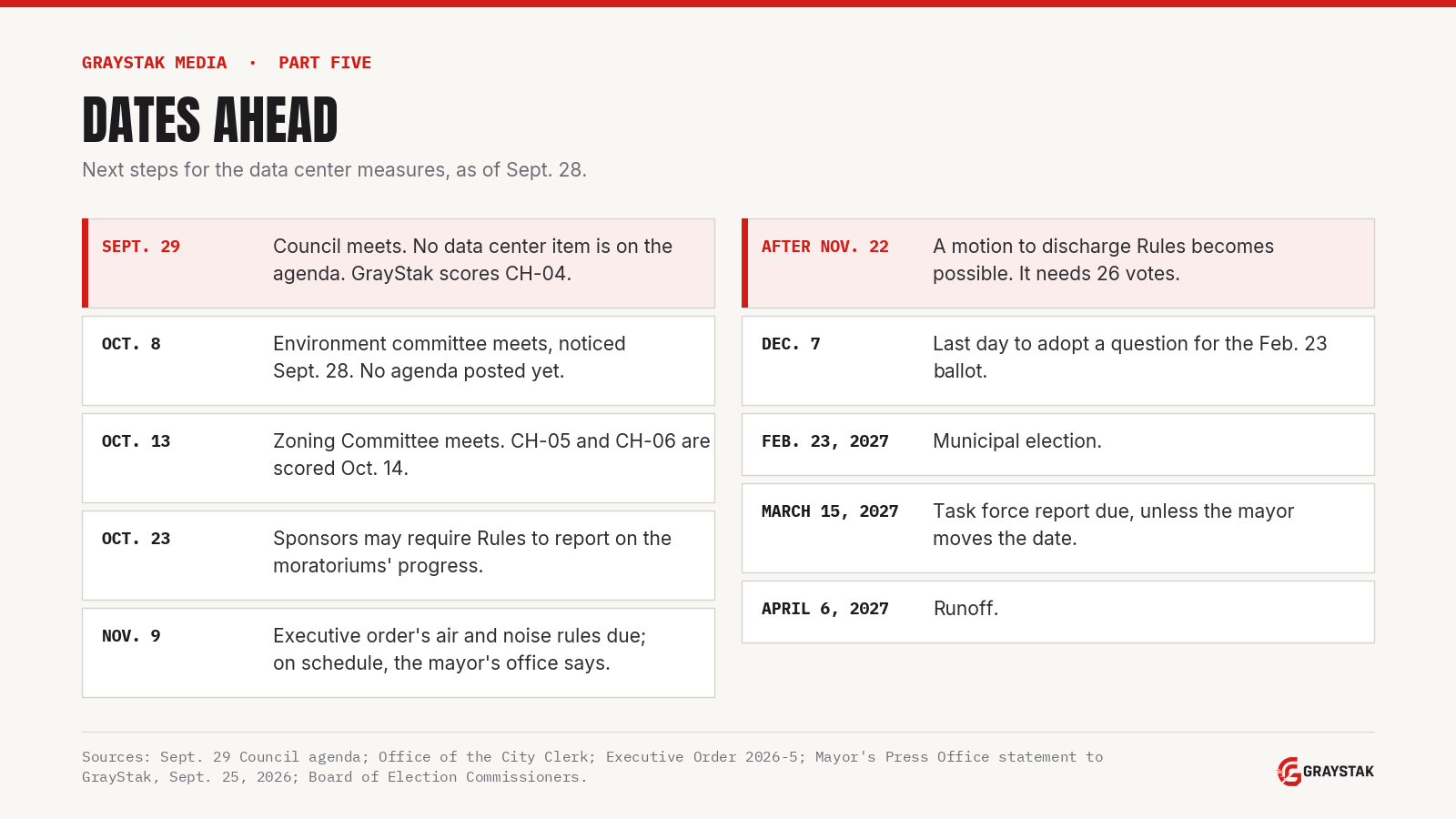
Dates ahead for the data center measures, as of Sept. 28, 2026. The Nov. 9 status is from the Mayor’s Press Office statement to GrayStak, Sept. 25. Sources: Sept. 29 Council agenda; City Clerk; Executive Order 2026-5; Board of Election Commissioners. Graphic: GrayStak Media.
ASSESSMENT
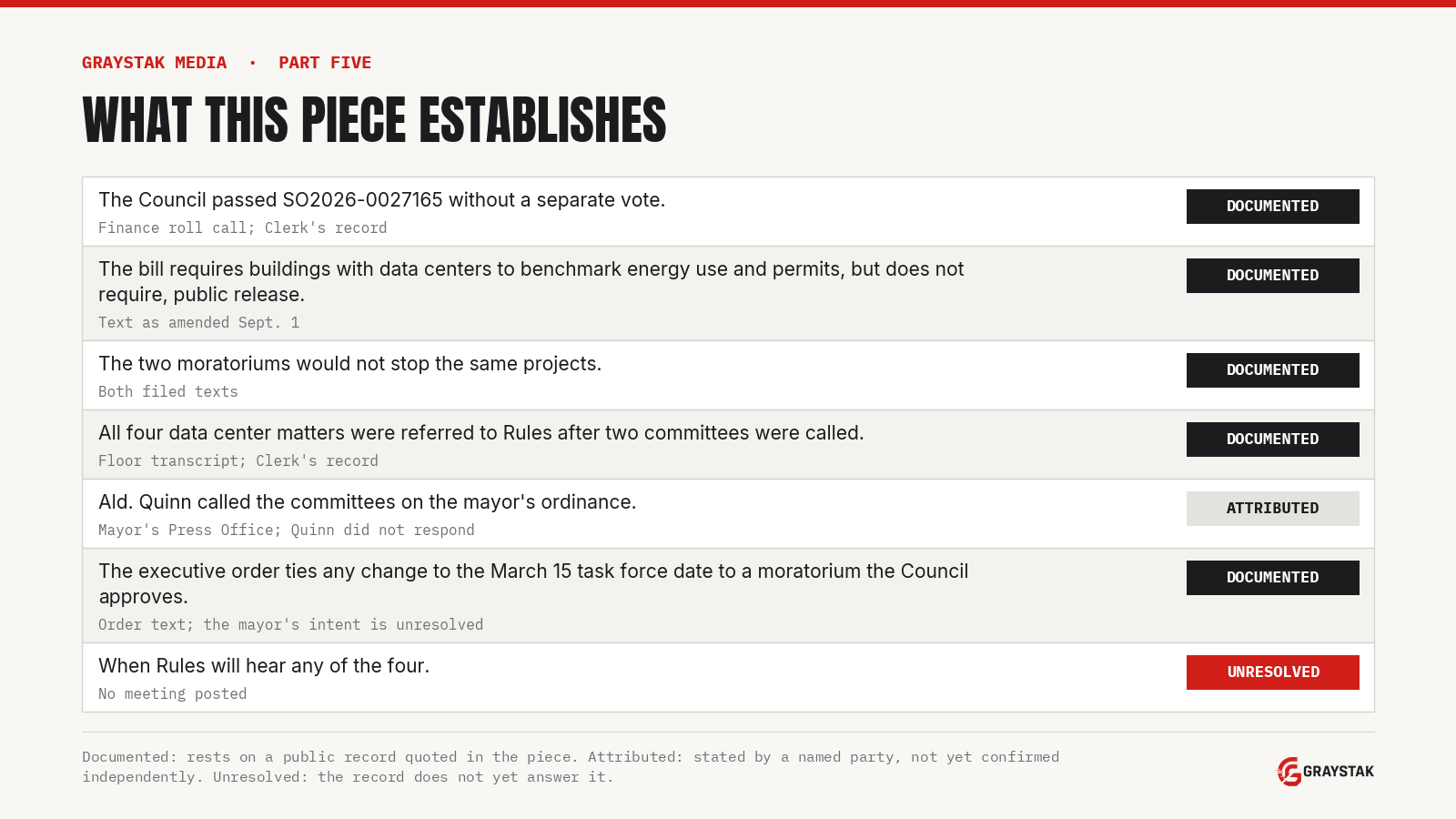
What this piece establishes, and how firmly. Documented: rests on a public record quoted in the piece. Attributed: stated by a named party, not yet confirmed independently. Unresolved: the record does not yet answer it. Graphic: GrayStak Media.
WHAT WOULD SHOW THIS WRONG
The Journal records SO2026-0027165 by a separate roll call or a different tally.
The Clerk’s record shows any of the four matters re-referred out of Rules.
The complete Section 6 of Sposato’s ordinance exempts the projects its other sections cover.
A Rules Committee meeting notice dated on or before Sept. 28.
The text the Council passed differs from the committee-amended version GrayStak read.
IMPLICATIONS
Developers with projects in city review face two different exemption lines. Under the mayor’s, a project without an issued building permit on the effective date would wait a year. Under Sposato’s, a project that filed any permit application before the ordinance’s introduction on Sept. 23 would proceed. 300 W. Adams, with an interior demolition permit and a ComEd vault permit already issued, would appear to be exempt under Sposato's text; under the mayor's, it depends on whether the Sept. 16 permit counts, and the city has not said.
On the Council floor, neither moratorium can come to a vote until Rules reports it or the Council removes it from the committee, and no Rules meeting is posted. The Sept. 29 agenda states the rule for removing a matter from committee: under Miscellaneous Business, “any alderman may motion to discharge a committee from further consideration of a matter which has been pending in committee for more than 60 days,” and the motion “requires a majority vote of all alderpersons (26 votes are required).” For ordinances referred Sept. 23, 60 days runs through Nov. 22, so the first Council meeting after that date is the earliest a discharge motion could come. The Clerk’s office describes a second provision: after 30 days, which for these ordinances is Oct. 23, the sponsor may require the chair to report on the matter’s progress.
Residents and ratepayers will see data center energy figures only if the Chief Sustainability Officer publishes them. The ordinance requires buildings with data centers to report their energy use to the city; it does not require the city to release it, and the Mayor’s Press Office did not say whether the Department of Environment will.
HOW THIS WAS REPORTED
GrayStak reported the Sept. 23 meeting from the press area of the City Council chamber. Floor quotations are checked against a transcript of the Council’s livestream. GrayStak covered the mayor’s press availability in Room 201A remotely; his quotes and Commissioner Tovar’s are from GrayStak’s recording of it, and the questions put to them there were asked by other reporters. Legislative status, sponsors, votes and meeting notices are from the Clerk’s legislative record, checked from Sept. 22 through Sept. 28. Both moratorium texts are the Clerk’s filed PDFs; SO2026-0027165 is quoted from the version amended in committee Sept. 1. The Rule 41 notices and the discharge rule are from the Sept. 29 agenda. Permit history for 300 W. Adams is from the city’s building permit dataset, current through Sept. 22. Statements from the Mayor’s Press Office and aldermanic offices are from their written replies to GrayStak.
WHAT IS NOT YET IN THE RECORD
The Journal of Proceedings for Sept. 23, which scores CH-03. The complete Section 6 of Sposato’s ordinance. A Rules meeting date. The city’s answer on whether 300 W. Adams specifically would be covered.
COMMENT
GrayStak sent questions on Sept. 23 to the Mayor’s Press Office, including questions for Commissioner Tovar, and to the offices of Alds. Conway, Hadden, Harris, Quinn, Sposato, Vasquez and Villegas, with a deadline of 5 p.m. Central on Sept. 25. The Mayor’s Press Office answered in writing on Sept. 23 and Sept. 25. Villegas’s office answered an earlier request on Sept. 23 and did not respond to the follow-up. The offices of Alds. Conway, Hadden, Harris, Quinn, Sposato and Vasquez did not respond by the deadline. Replies received later will be added here with the date received.
CORRECTIONS
None in this piece.
Part Four accurately reported the Clerk’s record as of Sept. 22, which listed Conway’s ordinance for referral to Zoning; the Sept. 23 referral to Rules is reported in this piece as a later development, not a correction.
GrayStak corrects errors on the record and marks the change. Send corrections to christopher@graystak.com.
UPDATES
Responses received after publication, and the outcome of the Sept. 29 meeting, will be added here and dated. The original text stays intact.
Update, Sept. 29, 2026: At the Council's Sept. 29 meeting, neither moratorium came to a vote and no member raised either one, so GrayStak's CH-04 call is scored a hit. The Journal of Proceedings for Sept. 23 was not approved, so CH-03 remains pending. The Council passed the parking meter transfer, 46 to 3, and Ald. Quinn's ordinance requiring a three-fifths vote on debt, 32 to 15; the two tenant ordinances were not called. The next regular meeting is Wednesday, Oct. 14, at 10 a.m.
DISCLOSURES
GrayStak holds no position in any company named in this analysis, and neither does the author. GrayStak has approached data center operators and developers about its analytics products; none is a client. GrayStak uses commercially available artificial intelligence tools, including Anthropic products, in its research and production workflow, and holds no financial interest in any of their makers.
ARCHIVE ENTRY
Forward calls. CH-01 to CH-03, entered Sept. 22 in Part Four, are scored above. Three new calls, entered Sept. 24 and published with this piece:
CH-04: No data center moratorium receives a Council vote on Sept. 29. Neither O2026-0028856 nor O2026-0028838 is voted on at the Sept. 29 regular meeting. Scored on the Clerk’s record and the meeting video. A near-certain call: both sit in Rules with no hearing, and a floor vote would require either a discharge motion, which the rules allow only for matters pending more than 60 days, or a two-thirds vote to suspend the rules.
CH-05: The Rules Committee holds no hearing on either moratorium before Oct. 14. No Committee on Committees and Rules meeting with O2026-0028856 or O2026-0028838 on its agenda takes place on or before Oct. 13. Scored on the Clerk’s meeting records.
CH-06: O2026-0028432 is not re-referred to Zoning before Oct. 14. The Clerk’s record shows no re-referral of Conway’s ordinance from Rules to the Committee on Zoning, Landmarks and Building Standards on or before Oct. 13, when Zoning next meets. Scored on the Clerk’s record.
CH-04 is scored in the Tuesday item on Sept. 29, with a dated line in this piece’s Updates block. CH-05 and CH-06 are scored when they resolve or on Oct. 14, whichever comes first.