

Update, August 18, 2026. Alderman Maria Hadden's office responded after publication. Her ordinance was drafted to reach data centers, is being rewritten with city departments, and comes up for a vote in her committee on September 1. Details below.
What happened. Johnson signed Executive Order 2026-5 on August 11, tightening city review of data centers and asking the City Council to pass a temporary moratorium he cannot impose himself.
Why it matters. The Department of Planning and Development says the order does not reach data centers the zoning code already permits. The mayor’s office says existing facilities are not affected.
What is pending. The Council returns September 23 with no ordinance drafted. City rules are due November 9. A task force reports in March 2027. State regulators decide ComEd’s $15.3 billion grid plan in December.
A data center is a building full of computers. It employs few people, runs cooling equipment twenty-four hours a day, tests diesel generators monthly, and consumes electricity and water in quantities large enough to raise what other customers pay. Chicago has about thirty-nine of them, most downtown or along the utility corridors that feed downtown.
ComEd’s chief executive, Gil Quiniones, told the Sun-Times editorial board in June that the utility was holding roughly a hundred data center applications totaling 33,000 megawatts, about one and a half times the highest demand the system has ever recorded, and that residential bills have risen about $12 a month since 2022. The Sustainable Data Centers Report says a typical data center uses 300,000 gallons of water a day, and the largest use five million. One in five Chicago households already spends more than six percent of its income on gas and electricity.
Johnson signed the order at Northerly Island, and the Clerk stamped it in at 11:10 that morning. It is titled “Protecting Chicagoans’ Clean Water, Clean Air, Energy Affordability, and Quality of Life,” and the words data center do not appear in it. The order concedes its own limit in the recitals, stating that the City Council holds “the exclusive legislative authority to enact a temporary moratorium on new data center development and material expansions.” Section 5 describes the document as “intended solely to provide interim executive direction pending legislative action by the City Council.”
The Council does not meet in regular session until September 23. Asked on August 17 whether an ordinance had been drafted and who would sponsor it, the Mayor’s Press Office said the administration “will be working with our partners in City Council to finalize language for the ordinance and plan to introduce it at an upcoming City Council meeting.” It named neither a sponsor nor a date.
The order does not reach data centers the code already permits
The order applies to Planned Developments, the negotiated zoning approval that large projects go through before the Plan Commission and the City Council. Most Chicago data centers never go through it.
The Department of Planning and Development said so on August 17, in answers relayed by the Mayor’s Press Office. “Data centers that are allowed as-of-right, including within previously approved PDs, are not subject to the executive order,” the department said. That covers two groups: data centers permitted outright under the zoning code, and data centers inside planned developments the Council approved years ago, where the use is already allowed.
“Data centers that are allowed as-of-right, including within previously approved PDs, are not subject to the executive order.”
Department of Planning and Development, August 17
A data center enters the Planned Development process for reasons unrelated to what it is. The Sustainable Data Centers Report, completed July 9, lists the triggers as lot size, building size, proximity to the river, or the presence of other uses in the same building. Being a data center is not one of them. Figure 4 of the report sorts all thirty-nine facilities by the path each took. Ten stand alone: two in Planned Developments, seven downtown, and one in a manufacturing district. Twenty-nine occupy mixed-use buildings: nineteen in Planned Developments, eight downtown, and two in manufacturing.
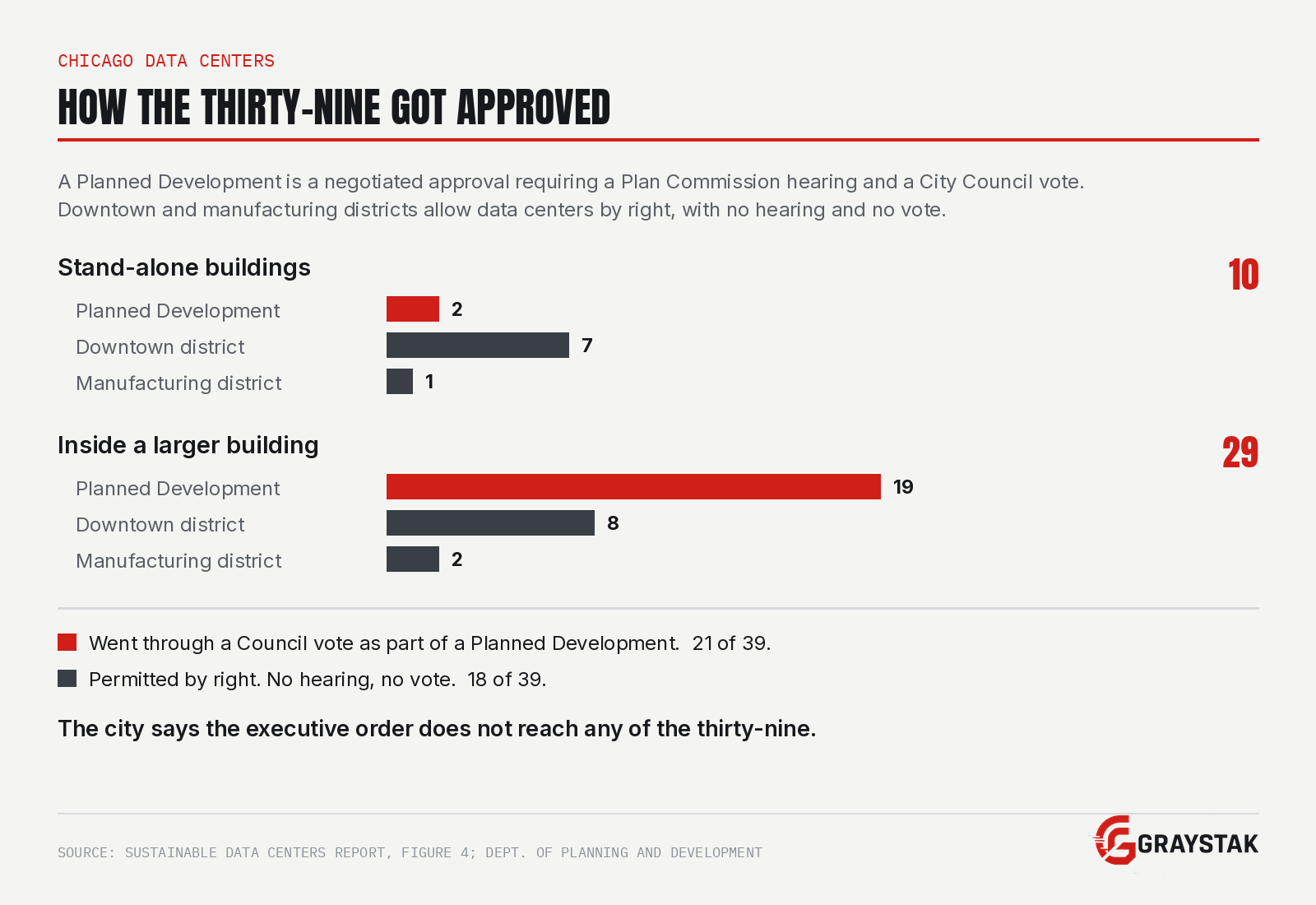
Only Planned Developments require a Council vote. Source: Sustainable Data Centers Report, Figure 4; Department of Planning and Development.
The press office added that an existing facility planning to expand would be subject to the standards the order produces. It did not explain how that applies to an expansion the code already allows without review. The department also said one application is pending. Planned Development 675 has carried an amendment application since 2022 that includes a proposed data center use. The department did not say where that site is or who filed it.
Sections 1 and 2 are not limited to new construction, but neither has produced a rule yet. Section 1 touches existing operations once, requiring compliance with the new conditions to be shown in applications for annual certificates of operation under Section 11-4-660. It applies only “to the extent that a data center is required to apply.” The Sustainable Data Centers Report says emergency and standby generators are exempt from that annual requirement.
Commercial trackers count far more than thirty-nine because they measure the metropolitan market rather than the city. Datacentermap lists 152 facilities under Chicago and 240 across Illinois; Datacenters.com lists 166; and Baxtel lists 212, while ranking Chicago the seventh-largest market in the country and naming Microsoft’s 158-megawatt Northlake facility the largest in it. Northlake is a suburb in western Cook County. Chicago counted only inside its own boundaries, using building permit records supplemented by one directory, and put the greater region above 200.
Chicago’s zoning code classifies a data center as an office
Section 17-17-0104 of the zoning ordinance covers the Commercial Use Group, which the code describes as uses that provide a business service or involve selling, leasing or renting merchandise to the general public. Subsection U is Office: “Professional, governmental, executive, management or administrative offices of private organizations or government agencies. Typical uses include government offices, administrative offices, legal offices, and architectural firms. Also includes electronic data storage centers and high-technology offices.”
One line down sits the only definition the code carries: “Electronic Data Storage Center. A work site used as a facility for the storage of and the operation of computer hardware, equipment for processing, storage and/or routing of electronic data, or other high technology uses.” That is the entire treatment.
The use tables show the city already knows the difference. Every use in the code is assigned a parking group, which determines how many spaces a building must provide. In Table 17-3-0207, which governs the business and commercial districts, the Office row carries parking group 17-10-0207-L. The Electronic Data Storage Center line beneath it carries a different one, 17-10-0207-U. Chapter 17-10 titles that group “Commercial Garden or Greenhouse, Electronic Data Storage Centers, Industrial.” Its other occupants are manufacturing at every intensity, all six classes of recycling facility, warehousing, freight terminals, and every waste-related use through hazardous materials storage.
Group L sets parking by floor area, while Group U sets it at one space per four employees, which means the code already treats a data center as a building with a large floor area and very few people in it. Chicago classifies the use as an office and applies the industrial parking standard to it.
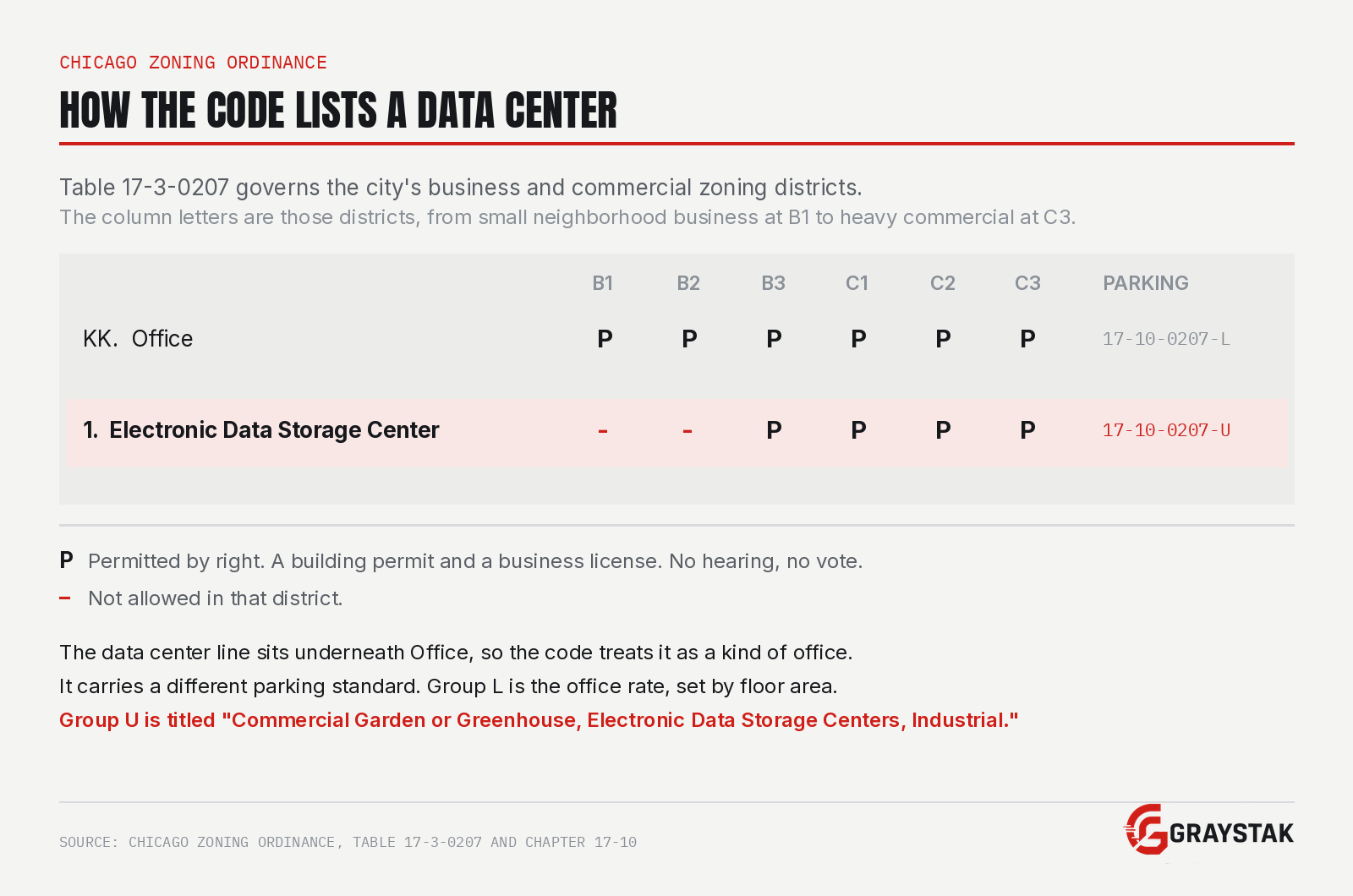
The code lists data centers as a subcategory of Office and assigns them the industrial parking standard. Source: Chicago Zoning Ordinance, Table 17-3-0207 and Chapter 17-10.
The manufacturing districts go further. In Table 17-5-0207, the Office row reads “In M2 and M3, max GFA: 9,000 sq ft or accessory use to allowed industrial use.” The Electronic Data Storage Center line directly beneath it carries no use standard at all. Inside a manufacturing district, a data center faces fewer limits than an insurance office.
Downtown, the code does not break them out at all. Table 17-4-0207 carries a single Office row, permitted by-right in the downtown core, mixed-use and service districts, and barred from downtown residential. No Electronic Data Storage Center line runs beneath it, and it has no separate parking standard. Fifteen of the city’s thirty-nine data centers sit in those districts.
Data centers are permitted by-right in every manufacturing district; in B3, C1, C2, and C3; in the planned manufacturing districts; and in the downtown core, mixed-use, and service districts. The exclusions are B1, B2, and downtown residential. A facility that clears zoning by-right takes a building permit from the Department of Buildings and a Limited Business License from Business Affairs and Consumer Protection. No hearing. No conditions. No vote.
Section 17-17-0104 has been amended repeatedly since 2004, most recently in December 2025. The Council did not touch it in September 2024, when it passed the ordinance that created the working group.
The ordinance that ordered the study also paid to attract data centers
That ordinance did something else at the same time. SO2024-0008201, sponsored by Aldermen Gilbert Villegas and Brian Hopkins and passed September 18, 2024, added Section 2-68-050 to the Municipal Code, requiring city data to be processed and stored within the United States and giving vendors a 2 percent bid credit for keeping it in Illinois and 4 percent for keeping it inside Chicago.
Villegas described it at the time as a tool to bring in new revenue, good jobs, and economic development to communities that need it most, and said data centers need wide swaths of land that the South and West Sides have. The Chicagoland Chamber of Commerce opposed it, saying the residency rules would give data centers a reason to cross Chicago off their list.
A single ordinance created a procurement incentive to bring data centers to Chicago and commissioned the study of what they do once they arrive.
Villegas now chairs the Zoning Committee, and the day after the order was signed, he described the buildings plainly. “At the end of the day, a data center is a warehouse with servers in there,” he said. The code calls it an office. He also said the mayor should have introduced an ordinance rather than signing one, calling the order “just another political stunt by the mayor to say that he did something, given the fact that data centers right now are unpopular.”
“At the end of the day, a data center is a warehouse with servers in there.”
Ald. Gilbert Villegas, chair of the Zoning Committee
The order sets three deadlines and the mayor can extend all three
Section 1 tells the Chief Sustainability Officer to impose conditions on air pollution control permits for regulated equipment at data centers under Code Section 11-4-630, and to promulgate rules for those permits under 2-31-070. The rules are due “within ninety (90) days of the effective date of this Executive Order (subject to further extension authorized by the Mayor).”
That authority is new to her department. The Mayor’s Press Office said the Department of Public Health participated in the working group through its Environmental Permitting and Inspection office, and that the office transferred to the Department of Environment on May 1.
Section 2 tells her to review the existing noise framework at 8-32-090 as it applies to mechanical equipment at data centers, and to publish rules for administering and enforcing that section. It carries the same ninety days and the same extension clause.
Section 4 creates the Interdepartmental Data Center Environment and Community Protection Task Force, co-chaired by the Chief Sustainability Officer and the Mayor’s Chief of Policy, with Buildings, Environment, Planning and Development, Technology and Innovation, and Water Management. It is to deliver recommendations and draft code amendments “on or before March 15, 2027, or such other date approved by the Mayor that is consistent with the timing and duration of any data center development moratorium approved by the City Council.”
The order sets three deadlines and gives the Mayor the power to extend each of them. Sections 1 and 2 are due within ninety days of August 11, which is November 9, and both say “subject to further extension authorized by the Mayor.” The task force date of March 15, 2027 can be replaced by “such other date approved by the Mayor.” Nobody outside the fifth floor has to agree.
Asked whether the administration expects to meet the November 9 date, the Mayor’s Press Office said the Chief Sustainability Officer plans to meet it.
Johnson’s January order carried a 30-day deadline and ran five months past it
Executive Order 2026-01 gave the Police Department thirty days to issue guidance and establish procedures for documenting federal immigration agents. It contained no extension clause. On July 17 the Committee on Immigrant and Refugee Rights took the order up, and police officials said the department had finalized internal procedures nearly five months after the deadline. They would not say why it took that long.
“It is long past time for accountability to the public,” said Alderman Andre Vasquez, the committee chair. Counsel to the mayor Sheila Bedi told the same committee that the January order “did not invent” the Police Department’s authority to document and investigate criminal activity. A lawyer for the administration was describing an executive order as a restatement of powers the city already held.
The January order “did not invent” the Police Department’s authority to document and investigate criminal activity.
Sheila Bedi, counsel to the mayor, July 17
The August order works the same ground. Air pollution control permits for diesel generators already exist under 11-4-620. Stationary mechanical equipment is already limited under 8-32-090 to 55 decibels measured at 100 feet between 8 p.m. and 8 a.m. Enforcing that section requires an inspector on site during the regulated hours, proof of the source, and proof of each separate day of violation. Fines run from $1,000 to $5,000.
The order’s only zoning provision cancels itself
Section 3 is the only part that touches development approvals. It directs the Planning and Development Commissioner to give enhanced review to every proposed Planned Development that includes a data center, weighing projected electricity demand, water consumption, backup generation, air emissions, noise, cumulative environmental impacts, transportation, emergency response capacity and neighborhood effects.
On receiving such an application, the commissioner notifies Buildings, Business Affairs and Consumer Protection, Environment and Water Management. Each has 60 days, or another period the commissioners arrange, to return written recommendations. Any conditions they identify go into the proposed ordinance.
The last paragraph of the order rescinds it. Section 3 “shall be automatically rescinded upon the effective date of an ordinance enacted by the City Council establishing a temporary moratorium on the approval of new Data Centers or the material expansion of existing Data Centers.”
The working group asked for three ordinances and got a task force
Every recommendation in the report requires the City Council. The report asks the Council to authorize an environmental permitting program specific to data centers, administered by the Department of Environment, with impact studies, air and sound monitoring, a fee structure covering the full cost of the program and a fine structure for violations.
It asks for a zoning amendment requiring most Electronic Data Storage Centers to undergo Planned Development review with Council approval. And it asks the Council to remove the exemption barring public release of energy and water data for buildings containing data centers.
The order routes all three to the task force, which is to draft proposed amendments by March 15, 2027, or later. Asked whether the administration would introduce ordinances implementing the recommendations instead, the Mayor’s Press Office said the recommendations will be routed through the task force.
The Council has heard the report once. On July 13 the Committee on Environmental Protection and Energy took it up as a subject matter hearing, which is a briefing with no legislation attached, and the minutes record no vote.
Commissioner Angela Tovar presented with First Deputy Commissioner Jared Policicchio and Jared Patton, and Bradley Roback from Planning and Development attended to answer questions on zoning and land use. Sarah Moskowitz of the Citizens Utility Board, Andrew Rehn of Prairie Rivers Network, Kavi Chintam of Vote Solar and Craig Huffman of MetroEdge also presented. Metro Edge is one of the five Chicago data centers holding a state tax credit, at $257 million committed against $16 million in benefits and 20 jobs. Five people spoke in public comment, and the meeting ran two hours and forty-four minutes.
Section 2 of SO2024-0008201 required that report, and it went to two committees. The Committee on Economic, Capital and Technology Development, which Villegas chaired when he sponsored the ordinance and which Alderman Derrick Curtis has chaired since May, filed no Rule 45 report for July, the monthly summary of proceedings each committee owes the Clerk. Seven other committees did.
The disclosure rule can be lifted without the Council
The third recommendation does not require an ordinance at all. Chicago requires large buildings to report how much energy and water they use, and publishes the results address by address. Municipal Code 18-14-102.3 suspends that publication for buildings where a data center, television studio and trading floor together exceed 10 percent of gross square footage. The suspension runs “until the Chief Sustainability Officer determines that the benchmarking tool can make adequate adjustments for such facilities.” The code then requires her to report that determination to the Mayor and the City Council.
Angela Tovar holds that power. She convened the working group under Council Ordinance SO2024-0008201. She is quoted in the release announcing it. She co-chairs the task force the order creates, and Sections 1 and 2 assign the rulemaking to her.
Whether she has evaluated the question is a matter of record, because the code requires a report when she answers it. No such report appears in the public file.
The one ordinance on file does something else. Alderman Maria Hadden introduced O2026-0027165 two days after that hearing, on July 15, and it sits in her own committee. It runs two sentences. It amends the definition of a covered building at 18-14-101.3 by striking a single letter from the list of occupancy classifications that disqualify a building from coverage.Buildings where more than a tenth of the floor area is classified as Group A-5, F, H or U stay outside the ordinance. Group A-5 is one of five assembly subgroups under Section 14B-3-302 and covers outdoor assembly. Assembly uses in the other four subgroups remain covered. Storage, which the building code calls Group S, comes in.
That widens the set of buildings covered by the reporting requirement, but it leaves Section 18-14-102.3 untouched, so the bar on releasing the numbers stands whether it passes or not.
Hadden’s office said on August 18 that the ordinance was drafted to reach data centers, which “had not been contemplated in the initial benchmarking ordinance.” The office said it is rewriting the ordinance with city departments to produce substitute language aimed at increasing transparency around electricity and water use by data centers, and that the substitute comes up for a vote in the Committee on Environmental Protection and Energy on September 1. It said no other data center legislation is pending before the committee.
Asked whether the Council has received any determination from the Chief Sustainability Officer under Section 18-14-102.3, the office said the Department of Environment is working with it on the language. It did not say whether a determination has been made.
The office also said Hadden will likely co-sponsor a moratorium ordinance and is in communication with other Council members and the mayor’s office, and that the March 2027 task force deadline is acceptable to her committee.
Twenty-one members co-sponsored it, and the list crosses the Council’s factions. Lopez, Sposato, Conway, Knudsen, Tabares and Lee signed alongside Fuentes, Taylor, Ramirez, Quezada, Clay and Vasquez. So did Villegas.
The Council he is asking filled its ballot slots three weeks earlier
On July 22 the Council placed six referendum questions on two ballots and used every available slot. Illinois allows three public questions per government per election, and the first three validly initiated take the ballot. November 3 carries gunshot detection restart, festival and event space, and Midway Blitz federal compensation. February 23 carries a music and arts monument, independent council counsel, and sister-agency debt enforcement.
The mayor’s millionaire tax question made neither ballot. The November version needed adoption by August 16 against a slate already full. Cook County commissioners then placed a parallel millionaire tax question on the same November ballot, which every Chicago voter will see.
Three weeks later he asked that same Council for a moratorium.
Aurora defined the term before it wrote the rules
Aurora, 40 miles west, had the same classification problem. Its code treated data centers as a type of warehouse, and city officials say the facilities looked like warehouses anyway. All ten of its existing data centers were reviewed through warehouse zoning.
“We had to have some more specific regulations for these,” said Tracey Vacek, Aurora’s planning and zoning director. The City Council there enacted a 180-day moratorium on new data centers and warehouses on September 25. It expired March 24, and the Council adopted the replacement rules the same day. New facilities now need conditional use approval, which carries a public hearing, notice to nearby residents and a Council vote. Applicants file water use studies, energy management plans and sound assessments. Maximum sound levels came down. Every data center facility in the city files an annual report with the city by April 1.
The first thing the ordinance does is define the term. Alison Lindburg, Aurora’s sustainability director, said the rules cover zoning and also create a definition for a data center to address transparency and building permits. Before, when a data center could apply as a warehouse, the permit process was quick.
The report records what Chicago residents told the city at a May 19 meeting at the Arturo Velasquez Institute, where about 75 people attended. “Data centers shouldn’t be by-right,” one wrote. “Should have a process that involves community.” Another asked for air, water and health protections citywide, “not just permit-by-right for data centers.”
The report calls the largest data centers unlikely here. One was announced in 2025
The report states that Chicago is unlikely to see development of the largest hyperscale AI training campuses because of land and infrastructure constraints. The order repeats the framing, reciting that the working group found continued growth likely “notwithstanding Chicago’s land and infrastructure constraints.”
Related Digital announced a one-gigawatt data center for the South Side in March 2025, at the north end of the Quantum Shore development on the former U.S. Steel South Works site. That is ten to twenty times the report’s own working definition of hyperscale.
The Council approved the Planned Development in December 2024, covering more than 400 acres between 79th Street and the Calumet River at 8080 S. DuSable Lake Shore Drive. The zoning reclassification, SO2024-0012887, was introduced on October 9 and passed as a substitute on December 11. The Clerk’s record classifies it as routine.
The Plan Commission had cleared it the month before after a hearing at Harold Washington College that ran close to six hours, with more than 70 people signed up to speak and most of them opposed. Community groups asked for a community benefits agreement, and neither the developers nor the mayor committed to one.
At that November hearing, Related Midwest said it was in conversations with a major employer for the north end of the site, separate from the quantum campus. Four months later, Related Digital announced the data center for the north end.
The site permits data centers across most of its area. The exception runs west of DuSable Lake Shore Drive between 83rd and 87th streets. Planning officials said in early August that the developers have not expressed an intention to move forward.
A spokesperson for the Department of Environment said in early August that the report “responds to the realities of modern data centers in Chicago, not one specific project.”
The city is already fighting over data center costs at the commission
The order addresses the buildings, while Chicago households' costs are decided in a separate proceeding that concludes months earlier.
ComEd filed its multi-year integrated grid plan for 2028 through 2031 with the Illinois Commerce Commission on January 16, docket P2026-0047, at $15.3 billion and more than 800 pages. A grid plan is the four-year investment program state law requires the commission to review before the company builds and bills for it.
The filing proposes three new substations in Chicago and two elsewhere in northern Illinois, with added capacity at more than seventy existing ones. The filing tells the commission that load growth is localized primarily across 55 substations, that the company is tracking new load additions exceeding 1,900 megawatts, and that data center load accounts for over 47 percent of that growth. If approved in full, ComEd expects residential customers to pay $2.50 to $3 more per month starting in 2028.
The City of Chicago is an intervenor and party of record. Dori McDonald, chief assistant corporation counsel in the Department of Law, appears for the city, alongside Natalie Karas of Duncan & Allen in Washington. The service list runs to 112 entries and includes the Citizens Utility Board, the attorney general’s Public Utilities Bureau, the Illinois EPA, the Natural Resources Defense Council, the Environmental Law and Policy Center, Vote Solar, the Union of Concerned Scientists, the Environmental Defense Fund, the Building Owners and Managers Association of Chicago, and the Village of Dolton.
Two of those organizations were in Council chambers on July 13. Sarah Moskowitz presented for the Citizens Utility Board and Kavi Chintam for Vote Solar. Both groups are also litigating the cost question at the commission.
The city has filed seven times since entering its appearance on January 28. It put on three witnesses. Samantha Bingham, clean transportation program director at the Department of Transportation, testified about multifamily housing strategy and a curbside electric vehicle charging pilot. Taylor Mayes, a project manager at the Department of Environment, testified about aligning the grid plan with the city’s Climate Action Plan, joint gas and electric planning with Peoples Gas, workforce metrics and a multifamily solar pilot.
Mayes filed her rebuttal on July 16. Three days earlier her commissioner told the City Council that data center growth is driving up electricity prices for Chicagoans.
The third witness addressed the plan's largest sum. Joseph McHugh, assistant commissioner for GIS and utilities at the Department of Aviation, challenged Chapter 7 of the grid plan, which covers what ComEd calls its New Business: Unique Commercial and Industrial Program. That is the money the company spends connecting large new customers to the grid. Table 7-2 puts it at $1,160.3 million in capital investment and $4.8 million in operations and maintenance.
McHugh’s direct testimony describes what that money buys. Quoting the grid plan, he says the program covers customer-driven projects over $100,000 that install new electric service, upgrade existing service and extend circuits to new load centers. Then his own sentence: “This category includes the construction and expansion of data centers and also other high-density load projects.”
“This category includes the construction and expansion of data centers and also other high-density load projects.”
Joseph McHugh, Chicago Department of Aviation, testifying for the city
His rebuttal goes further. The process ComEd describes in Chapter 7, he says, “never even mentions the Cluster Study process, which is an important phase that all data center projects must undertake.” A cluster study is the engineering review the utility runs before it agrees to connect a large new load. He asks for protocols written into the tariff, with firm timelines for the utility’s actions and a dispute resolution mechanism customers can use. The chapter as written, he says, contains none of those safeguards.
ComEd moved on June 18 to define the scope of the docket and put that testimony outside it, arguing the issues belonged to a rate design investigation that has already closed. The city answered a week later through Corporation Counsel Mary B. Richardson-Lowry, saying the motion “would in effect foreclose the City from raising these issues altogether,” and that the closed investigation “did not, and cannot, resolve the City’s concerns.” The attorney general, the Citizens Utility Board, Constellation Energy Generation, a coalition of environmental groups and an individual intervenor all opposed the motion the same week.
The administrative law judges denied it on July 2. The Public Utilities Act, they wrote, makes the grid plan a forum in which the commission, the utility and stakeholders must consider all related investments, planning processes, tariffs, rate design options, programs and other utility policies and plans. Striking a party’s arguments at that stage would run against the integrity of the fact-finding process.
The city’s testimony on data center connection costs stayed in the case, and the evidentiary hearings went ahead.
The commission decides in December. The task force reports in March
ComEd’s last round of written testimony was due July 31. The administrative law judges held a status hearing on August 10 and took evidence on August 11 and August 12. Written arguments are due September 3 and September 17, and each side files a proposed order on September 18. The judges issue their own proposed order on or about October 14. Objections to it are due October 28, with replies November 10. The commission must act by December 15, 2026, at 5 p.m.
The evidentiary hearing on August 11 was called for 10 a.m. That morning, the city filed a motion to admit its evidence. The Clerk stamped the executive order in at 11:10.
The task force created that morning reports by March 15, 2027. The administrative law judges issue a proposed order in October. The commission decides in December.
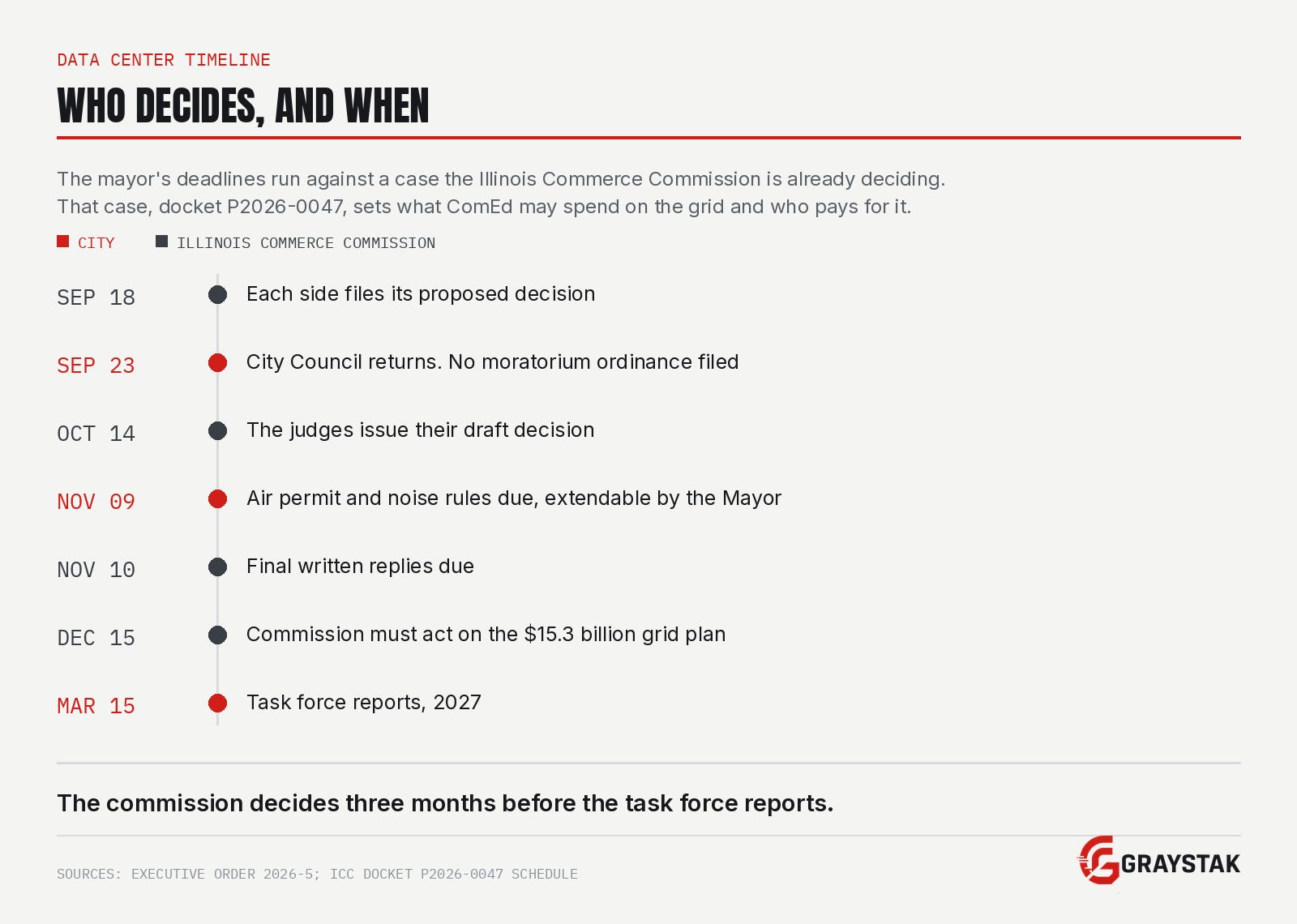
The mayor's deadlines against the commission's schedule. Sources: Executive Order 2026-5; ICC docket P2026-0047.
The Mayor’s Press Office said the city is a party to the docket and that the task force deadline was set separately. Asked whether the task force would coordinate with the case and whether the Department of Law or the Department of Aviation would participate, the office said the task force “will be closely monitoring the results of that docket given its impact on energy issues related to data centers.” Neither department was added to it.
Kristen Cabanban, director of news affairs at the Department of Law, said the department does not comment on pending litigation.
Sarah Moskowitz, executive director of the Citizens Utility Board, made the same point about the order the day it was signed. “If we’re just looking at the impacts that data centers have on our electricity costs, there’s not much the city of Chicago can do,” she told the Sun-Times and WBEZ. “When it comes to noise and local air quality and land use, of course that is all really important, and that is the kind of things that require transparency, but we’re going to need state action to address the electricity cost portion of the data center problem.”
Moskowitz has described the mechanism in earlier interviews. Developers apply to ComEd for service a project will need. When the project is built somewhere else, the utility has bought capacity nobody uses, and the cost moves to other customers. She has called those projects phantom data centers.
The Data Center Coalition, the industry’s membership association, said its members “strive to be good actors where we operate, which is why we are hopeful this directive from the Mayor will help separate those who are responsible water and energy stewards from those who are not.”
What has to happen next
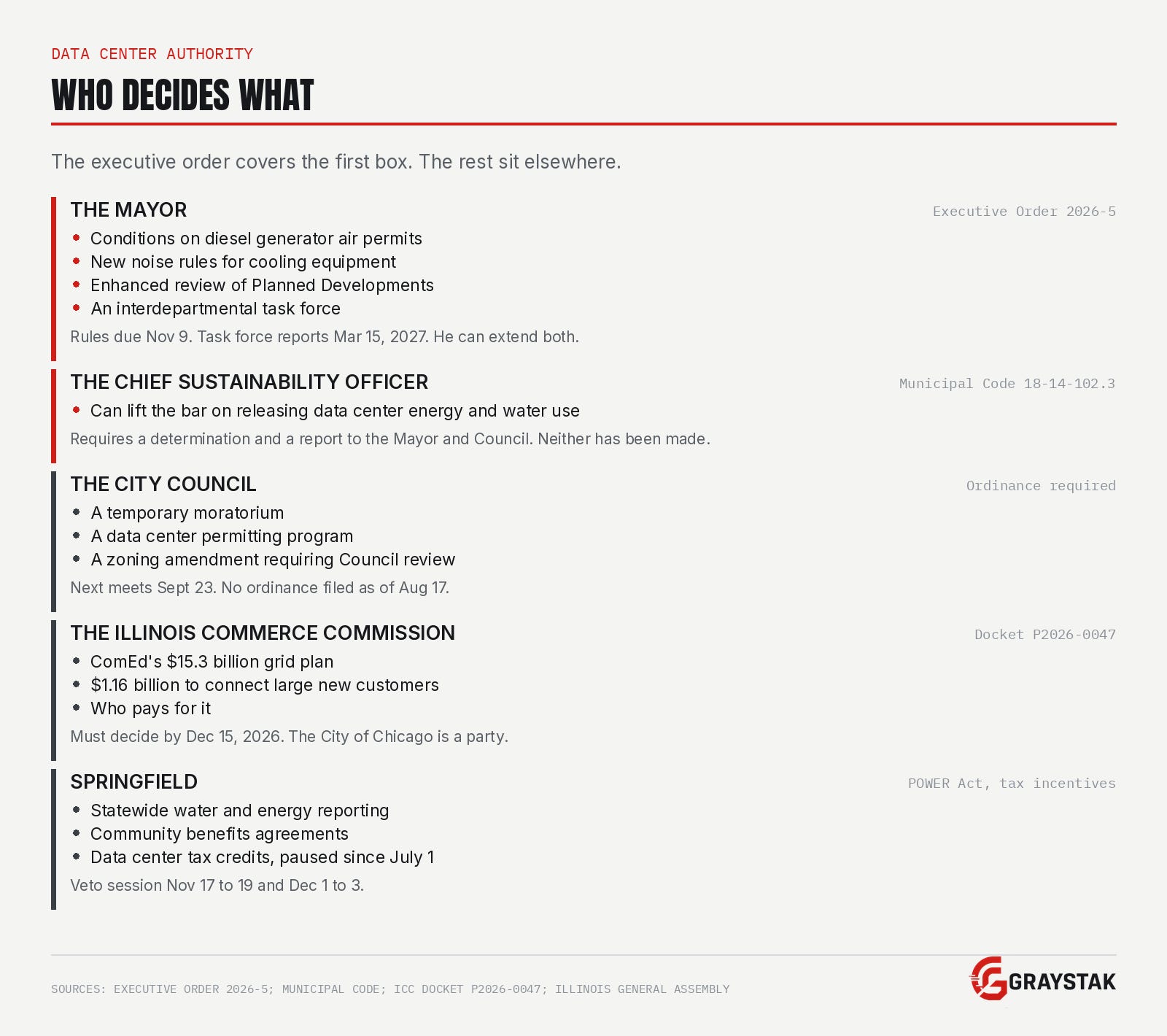
The order covers the first two boxes. Sources: Executive Order 2026-5; Municipal Code; ICC docket P2026-0047; Illinois General Assembly.
Three ordinances have to move through two committees. Hadden chairs Environmental Protection and Energy. Villegas chairs Zoning. The first opportunity is September 23.
Villegas said the day after the signing that industry wants stability, needs to know how and under what conditions it can build, and that he believes a proposal could be ready for a vote before the end of the year. He also said energy costs could have been addressed years ago through a new franchise agreement with ComEd.
The provisions covering ratepayers and water sit in Springfield, where the POWER Act failed in the spring and returns in the veto session running November 17 through 19 and December 1 through 3. Pritzker paused the state’s data center tax incentives on June 5 and issued a framework asking the General Assembly to require data centers to report their energy and water use, to post public notice when they apply for permits, and to stop signing nondisclosure agreements with local governments.
Climate Jobs Illinois and the Illinois AFL-CIO called the pause shortsighted and said it was issued to generate headlines instead of practical results. A separate bill strengthening local control over data centers never passed either chamber.
Water reuse sits with the Metropolitan Water Reclamation District, which received pilot authority under a state law signed last August.
Chicago also sells Lake Michigan water to suburbs hosting data centers it does not regulate. Aurora, West Chicago and Lake County have acted. Cook County and DuPage County, which hold most of the region’s facilities, have not.
Joliet shows what happens where the buildings are larger. Its City Council approved the annexation and rezoning of 795 acres for a 24-building, 1.8-gigawatt campus in March, on an 8-to-1 vote after seven hours of testimony that ran mostly against.
In May, three residents and a group called Joliet Residents for Responsible Growth sued in Will County Circuit Court to void the approvals, case 2026CH000108. The complaint says a Joliet staff memo acknowledged the mechanical equipment would be audible two miles away, and that the city approved the campus while spending more than a billion dollars to switch from a depleting aquifer to Lake Michigan water. Joliet is buying Chicago’s water.
Two dates will show whether any of this binds. The air permit and noise rules are due November 9, and the administration says the Chief Sustainability Officer plans to meet that date. The Council must introduce a moratorium ordinance before it can pass one. Six days after signing, the administration said it was still finalizing language and did not name a sponsor.
How this was reported
This piece is built from primary documents.
City records: Executive Order 2026-5, signed and filed with the City Clerk on August 11, 2026, at 11:10 a.m.; Executive Order 2026-01, filed February 28, 2026; the Sustainable Data Centers Report of the City of Chicago Sustainable Data Centers Working Group, dated July 9, 2026; the Monthly Rule 45 Report of the Committee on Environmental Protection and Energy for July 2026; ordinance O2026-0027165 and its signature page; ordinance SO2024-0008201; ordinance SO2024-0012887; and the Clerk’s council and committee report library.
Municipal Code: Chicago Zoning Ordinance Sections 17-17-0104 and 17-3-0200, Tables 17-3-0207 and 17-5-0207, and the off-street parking groups at 17-10-0207; Sections 18-14-101.3 and 18-14-102.3; Sections 11-4-620, 11-4-630 and 11-4-660; Section 8-32-090; and Chicago Building Code Sections 14B-3-302 and 14B-3-304, all as published in the current supplement.
Illinois Commerce Commission docket P2026-0047: the docket sheet, service list, and schedule; the city’s notice of appearance, direct and rebuttal testimony of Joseph McHugh, Taylor Mayes and Samantha Bingham, response of June 25 to ComEd’s motion to define scope, and motion to admit evidence of August 11; ComEd’s motion of June 18; and the administrative law judges’ ruling of July 2.
Legislative introductions were checked against the City Clerk’s electronic legislative management system through August 13, 2026.
Where other outlets reported it, we attributed it. The Chicago Sun-Times, WBEZ, WGN, and ABC7 reported quotations from the mayor and Alderman Villegas at and after the signing. Aurora’s regulations are drawn from statements by city officials to WGLT and NPR Illinois and from the City of Aurora’s published materials.
What is not yet in the record
Transcripts of the August 11 and 12 evidentiary hearings in docket P2026-0047 had not been posted as of August 17. The Committee on Economic, Capital and Technology Development had filed no Rule 45 report for July 2026. The Department of Buildings has been asked to classify the occupancy of a data center without routine human occupancy, but it has not yet provided the classification. Whether the Chief Sustainability Officer has made or reported a determination under Section 18-14-102.3 has been requested and not yet provided. The location and applicant of the pending amendment to Planned Development 675 were not provided.
Comment
Written requests for comment were sent on August 13, 2026, to the Mayor’s Press Office, the Department of Environment, the Department of Buildings, the Department of Law, the Department of Planning and Development, Alderman Gilbert Villegas, Alderman Derrick Curtis and Alderman Maria Hadden. The deadline was extended to August 17 at the request of the Mayor’s Press Office, which referred several questions to the Departments of Environment and Planning and Development. The Mayor’s Press Office answered on August 17 and relayed answers from the Department of Planning and Development the same day.
The Department of Law responded on August 14 that the matters raised are the subject of pending litigation and that the department does not comment on pending litigation. A separate request for the terms of the city’s engagement of Duncan & Allen and payments made to the firm was filed under the Freedom of Information Act on August 14 and is pending. The Department of Environment did not respond to questions about whether the Chief Sustainability Officer has made or reported a determination under Section 18-14-102.3. Alderman Hadden's office responded on August 18. The Department of Buildings, the Department of Planning and Development on its own behalf, Alderman Villegas and Alderman Curtis did not respond.
Corrections
August 26, 2026. An earlier version described the occupancy classifications excluded from coverage under Municipal Code 18-14-101.3 as "assembly, factory, high hazard or utility." The Code names Group A-5, which is one of five assembly subgroups under Chicago Building Code Section 14B-3-302, rather than assembly generally. Buildings more than ten percent A-1, A-2, A-3 or A-4 remain covered. The text has been corrected.
GrayStak corrects errors on the record and marks the change. Send corrections to christopher@graystak.com.
Updates
August 18, 2026. Added a response from Alderman Maria Hadden’s office received after publication, and updated the comment section to reflect it.
Disclosures
GrayStak holds no position in any company named in this analysis, and neither does the author. GrayStak uses commercially available artificial intelligence tools, including Anthropic products, in its research and production workflow, and holds no financial interest in any of their makers.
About the author
Christopher Sweat covers Chicago and Illinois government from the public record, reporting local social and political dynamics for a national and international audience. He also reports on national security policy, intelligence oversight, public finance, and the defense technology sector. He is an analyst working across finance, technology, and politics, and CEO and Co-Founder of GrayStak.
GrayStak is a media and political risk company. Our real-time Domestic Political Volatility Index (DPVI) measures the velocity and volatility of U.S. domestic politics. We cover political and institutional risk across the United States, centered in Washington, D.C., New York, and Chicago.