


CHRISTOPHER SWEAT, with reporting from New York by RYAN DAVID LAZARUS
Fourth in a series on Chicago's data center regulation. Previously: Chicago Zones Data Centers as Offices, Aug. 17; A Council Committee Votes September 1, Aug. 27; The Council Rewrote the Bill in the Room, Sept. 3.
QUESTION What data center legislation is before the City Council on Sept. 23, who wrote it, and how does it compare with what the mayor said the city would do?
What happened. Ald. Bill Conway (34th) filed an ordinance with the City Clerk on Sept. 17 that strikes by-right zoning for data centers from Chicago’s use tables and requires planned development approval, which carries a City Council vote, in the districts where it keeps them. Executive Order 2026-5, which Mayor Brandon Johnson signed on Aug. 11 after a city working group recommended the change, had sent that question to a task force reporting by March 15, 2027. The Clerk lists Conway as the only sponsor.
Why it matters. No moratorium ordinance is on file six weeks after Mayor Brandon Johnson asked the Council for one. On Monday he spoke about data centers at a policy seminar in New York and mentioned neither the ordinance nor the moratorium.
What is pending. The Council meets Wednesday at 10 a.m. Ald. Maria Hadden’s benchmarking substitute, SO2026-0027165, is up for passage with 23 sponsors. Conway’s ordinance and Ald. Andre Vasquez’s 40th Ward referendum resolution are set for introduction and referral; Vasquez said Tuesday he will co-sponsor Conway’s. No moratorium ordinance appeared in the Clerk’s record as of 4:12 p.m. Tuesday.
Conway ends by-right status in seven districts and adds a downtown row
The Clerk stamped O2026-0028432 at 10:55 a.m. on Sept. 17. In it Conway amends four use tables in Title 17 for Electronic Data Storage Centers, the zoning code’s term for data centers, and adds two sections to Chapter 17-8.
In business and commercial districts he strikes the “P,” for permitted by-right, in B3, C1, C2 and C3, and writes “PD,” for planned development approval, into C2 and C3. In manufacturing districts he strikes the “P” in M1, M2 and M3 and writes “PD” into M2 and M3. The downtown table today has no data center line, and the use falls under the general Office category; Conway adds one, marked not allowed in the DC, DX and DR districts and “PD” in DS. The city’s July report counts 15 of the 39 data centers downtown.
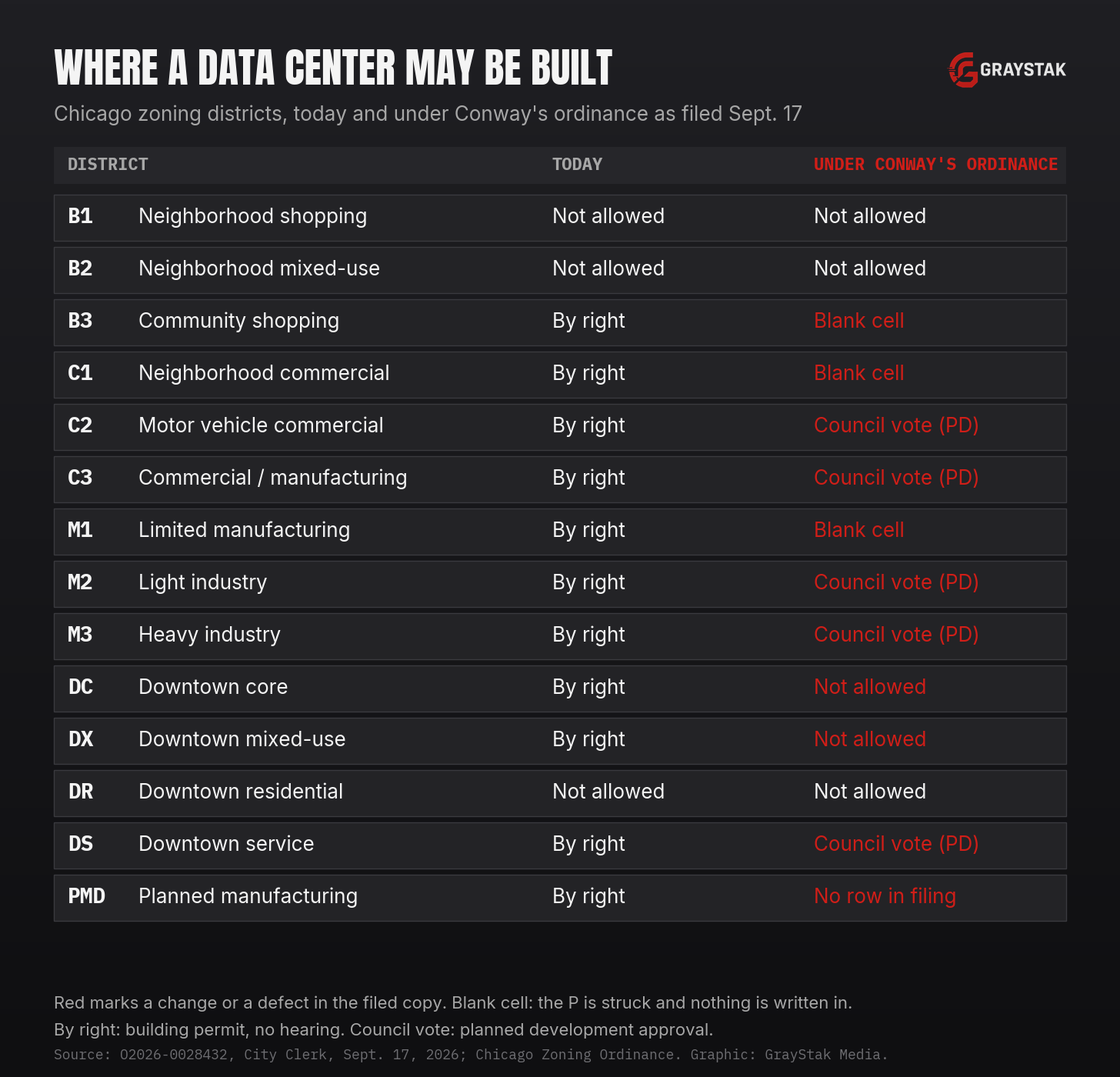
Where a data center may be built, today and under O2026-0028432 as filed. Red marks a change or a defect in the filed copy. Source: City Clerk; Chicago Zoning Ordinance. Graphic: GrayStak Media.
New Section 17-8-0516 makes any data center a mandatory planned development. That is the change the Sustainable Data Centers Working Group asked for in July, when it found that the code’s triggers turned on lot size, building size, river frontage and mixed uses, and never on the use itself. Under a new Section 17-8-0914, each applicant would submit a noise impact assessment and an air quality impact evaluation for the Chief Sustainability Officer’s review and would hold a community meeting in the ward at least two weeks before filing, with mailed notice to owners within 250 feet. Conway included no study of water or electricity demand and no provision for projects already under review.
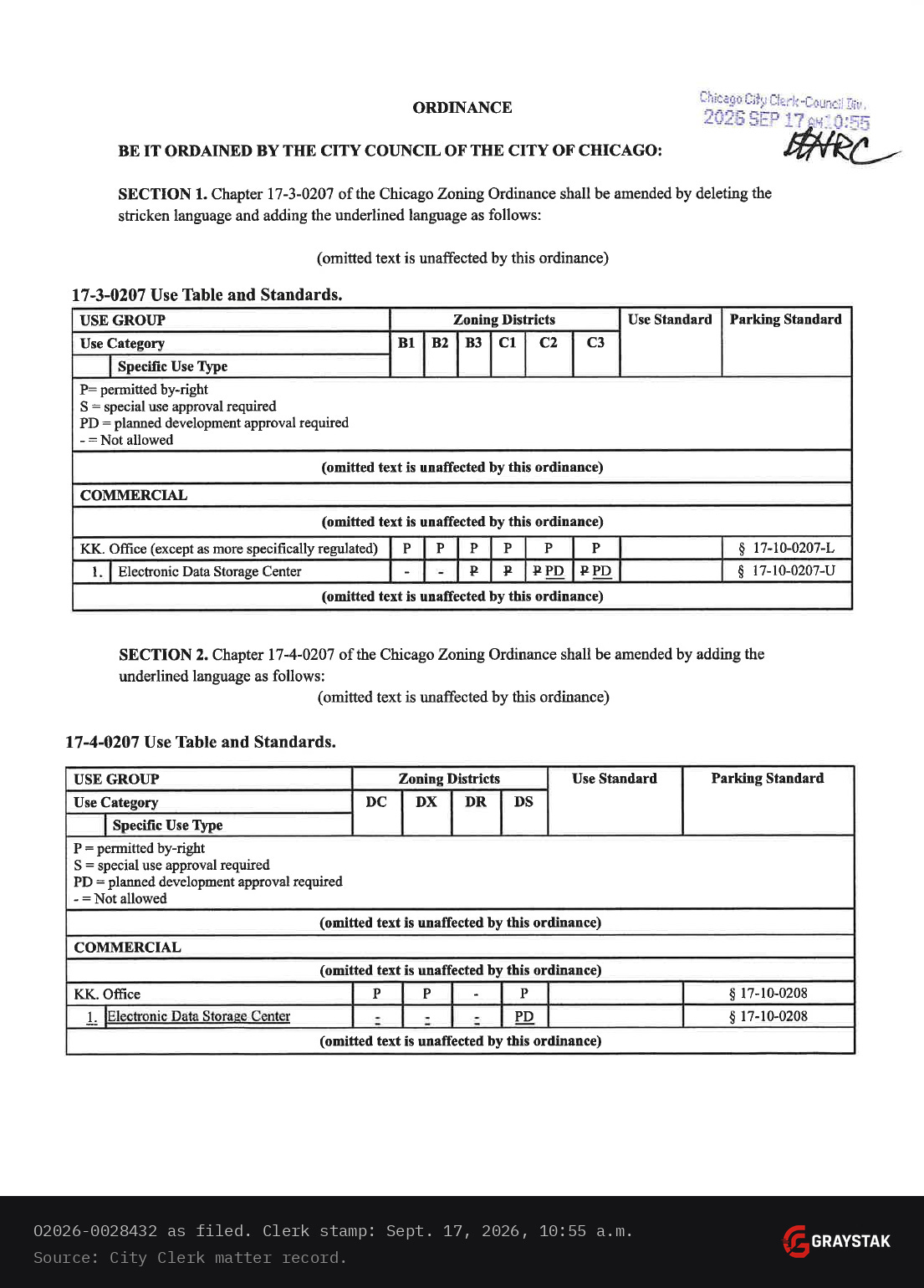
The first page of O2026-0028432 as filed, with the City Clerk’s stamp of Sept. 17, 2026, 10:55 a.m. Source: City Clerk matter record.
Three cells are blank in the filed copy, and one table has no data center row
The struck “P” in B3, C1 and M1 has no entry written in its place; the tables’ legend uses a dash for uses that are not allowed, and B1 and B2 carry that dash. Section 4 amends the table for planned manufacturing districts, and the scanned copy shows that table’s header with no data center row beneath it. The copy the Clerk attached to the matter record is the same three-page scan. GrayStak asked Conway’s office on Sept. 21 whether the blanks mean not allowed, whether a row is missing, and whether a corrected copy is coming, and why he filed now and whether the administration was consulted. His office did not respond by the 5 p.m. Tuesday deadline.
“I would still prefer that the public reporting of water usage be required rather than discretionary,” Conway said of Hadden’s bill in a statement his office provided on Sept. 3. His zoning ordinance carries no water provision.
The Committee on Zoning, Landmarks and Building Standards meets Tuesday, and its agenda carries no data center item, so the ordinance can go no further Wednesday than introduction and referral. Its chair, Ald. Gilbert Villegas (36th), told ABC7 on the day the mayor signed the order that “at the end of the day, a data center is a warehouse with servers in there,” that the centers produce property tax revenue and building trades jobs, “and so there has to be a delicate balance.” He said then that a proposal could be ready for a vote before the end of the year. GrayStak asked his office whether the committee will hear the ordinance, and when. His office did not respond by the deadline.
A Loop conversion approved in August sits in a district Conway would close
The Permit Review Committee of the Commission on Chicago Landmarks approved a plan on Aug. 6 to convert floors two through six of 300 W. Adams St. to a data center with a new ComEd vault and ten rooftop generators, the Chicago Sun-Times reported on Aug. 13; the full commission had yet to vote, and committee staff said Ald. Brendan Reilly (42nd) had reviewed the proposal without objection. The developer, Igor Gabal, told the committee the vault would be no more than 50 megawatts; the building’s marketing brochure advertises 20.4. Chicago Cityscape’s property report lists the parcel as zoned DC-16, a downtown core district, and the Department of Planning and Development told the Sun-Times the project is not subject to the order’s review because the building’s current zoning allows the use. A conversion inside an existing building in a district where the use is permitted by-right takes a building permit and a limited business license, with no hearing and no vote.
“Data centers that are allowed as-of-right, including within previously approved PDs, are not subject to the executive order.”
Department of Planning and Development, in the Mayor’s Press Office’s Aug. 17 email to GrayStak
GrayStak asked Conway, Villegas and the Mayor’s Press Office how the ordinance and the order each treat that project. None answered by the deadline.
Hadden’s bill reaches the floor with water publication discretionary and a title that says otherwise
SO2026-0027165, which the Committee on Environmental Protection and Energy advanced on Sept. 1, ends the exclusion of buildings with data centers from the city’s energy benchmarking rule and authorizes the Chief Sustainability Officer to request and publish water usage data. As reported in the Sept. 3 piece, the committee changed “may” to “shall” for transmitting the data and left “may” for publishing it. For energy benchmarking data and ratings, subsection (g) says she “is authorized” to make them public.
“The Chief Sustainability Officer may, pursuant to rules, select certain covered buildings and make public the water usage data of such covered buildings.”
SO2026-0027165 as amended in committee, Section 18-14-101.4(b), retrieved Sept. 21
“... now requiring public release of data center benchmarks and performance ratings by Chief Sustainability Officer.”
The Clerk’s title for the same matter, retrieved Sept. 21
Diana Martinez, the Clerk’s chief of communications, told GrayStak on Sept. 3 that her office creates or modifies matter titles as needed, and that the phrase was added when the title was modified after the substitute came in. She did not say what the phrase rests on. GrayStak asked Hadden’s office on Sept. 21 whether a floor amendment on publication is planned. Her office did not respond by the deadline to that question or to whether she will co-sponsor Conway’s ordinance.
The Department of Environment wrote to GrayStak on Sept. 9 that the officer has not requested water usage data from the Department of Water Management, a power the office has held under Municipal Code 18-14-101.4 since 2017, because the annual benchmarking report “has not historically reviewed water usage data.”
The bill carries 23 sponsors as of Sept. 21, unchanged since Sept. 2. Ald. Brendan Reilly (42nd) and Ald. Rossana Rodriguez Sanchez (33rd) sit on the committee that voted it out and have not signed. Passage takes 26 votes.
One question will go unanswered when the bill passes. Municipal Code 18-14-102.3 withholds benchmarking data for buildings with data centers until the Chief Sustainability Officer makes a finding and reports it:
“... until the Chief Sustainability Officer determines that the benchmarking tool can make adequate adjustments for such facilities. When the Chief Sustainability Officer determines that the benchmarking tool can make such adjustments, it shall report such determination to the Mayor and the City Council.”
Municipal Code 18-14-102.3, in force since Sept. 11, 2013
GrayStak first asked the department on Aug. 13 whether the determination has ever been made in the thirteen years since. The department has not answered. The mayor said on Aug. 25, “I can get back with you on that one,” and his office’s statement that evening did not address it. The substitute strikes the words “data center” from that section, so once it passes no determination is required for data centers, and whether one was ever made becomes a question about the past.
No moratorium ordinance is on file six weeks after the mayor asked for one
Searches of the Clerk’s legislative system for “moratorium” and “data center” on Monday morning, and again at 4:12 p.m. Tuesday, returned no moratorium ordinance. The Clerk’s system searches the title and nickname of each matter, and an ordinance captioned another way would not surface.
The Mayor’s Press Office wrote on Aug. 17 that the administration would “finalize language for the ordinance and plan to introduce it at an upcoming City Council meeting.” Eight days later he said the Council should act.
“City council has the authority to move on a moratorium. I am encouraging them to do that.”
Mayor Brandon Johnson, City Hall press availability, Aug. 25
Hadden’s office wrote on Aug. 20 that she was “coordinating with her colleagues to introduce a moratorium.” Vasquez wrote on Tuesday that he does not plan to introduce or co-sponsor one: “my understanding is that one of our colleagues is, but I don’t have much detail around that.” Asked which colleague, he wrote that he was “not at liberty to say as the information I received was hearsay,” and that “the Johnson administration might have more info.”
One moratorium proposal does sit in Wednesday’s file, and it concerns warehouses. A citizen submission from the Southside Flourish Movement, dated Aug. 17 and placed on file as an expression of opposition to the Ford City rezoning at 7400-7600 S. Kostner Ave., asks the Council for a 180-day pause on warehouse permits at the site.
The city’s task force on data centers reports by March 15, 2027, or a later date the mayor approves. That date falls three weeks after the Feb. 23 municipal election and before the April 6 runoff. Johnson announced on Sept. 13 that he will seek a second term.
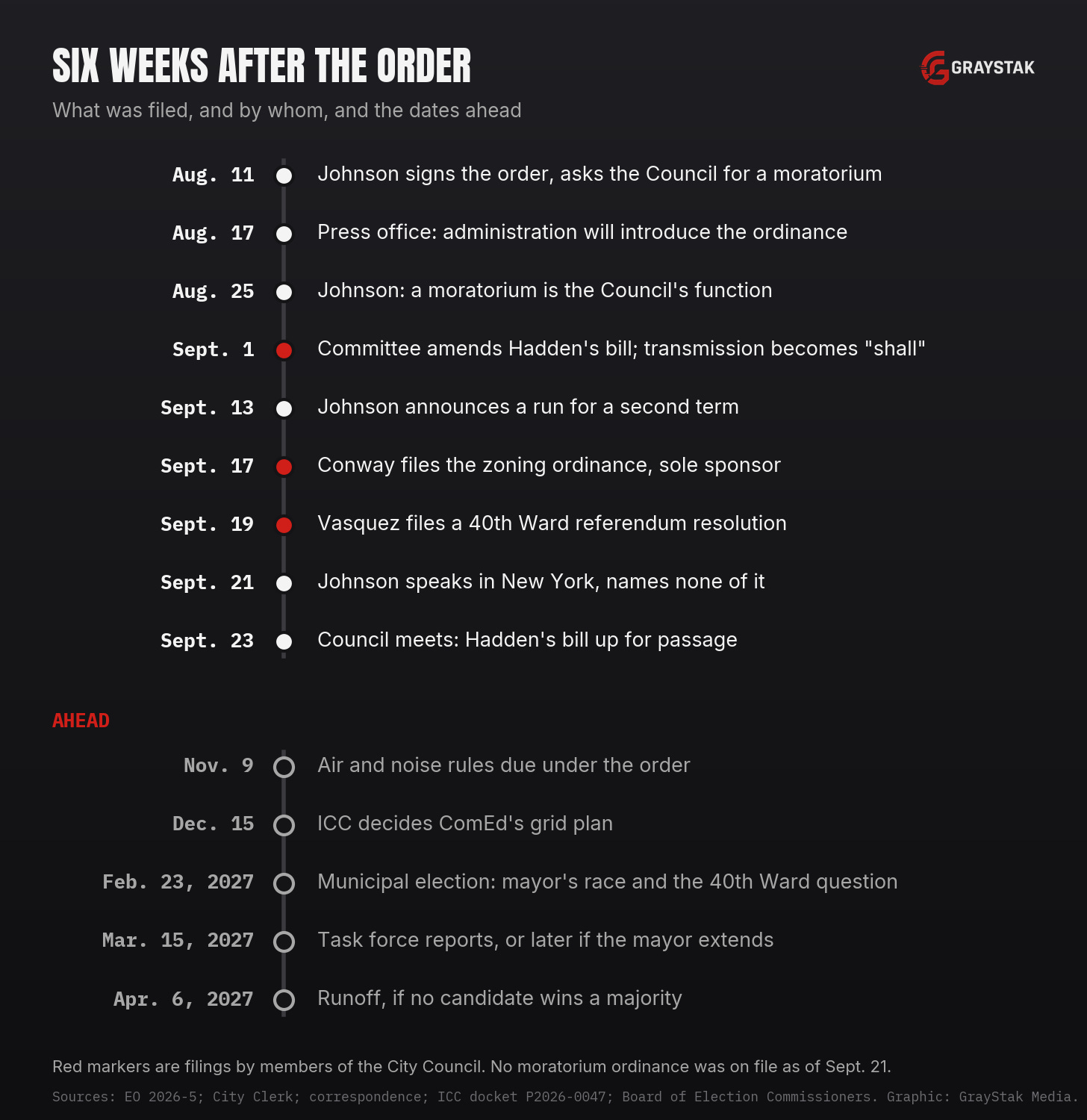
Six weeks after the order: filings by date, and the dates ahead, including the Feb. 23, 2027 election. Red markers are filings by members of the City Council. Sources: EO 2026-5; City Clerk; correspondence; ICC docket P2026-0047; Chicago Board of Election Commissioners. Graphic: GrayStak Media.
Vasquez asks one ward instead. Ald. Andre Vasquez (40th) filed R2026-0028519, and the Clerk created the matter on Sept. 19. It would put an advisory question to 40th Ward voters on Feb. 23, 2027, the ballot that also carries the mayor’s race: whether they “support a moratorium on the establishment, construction, or expansion of new data center facilities within the City of Chicago.” He filed two companion resolutions the same day, on ranked choice voting and on bus rapid transit along Western Avenue. All three go to the Rules Committee.
In July the Council filled the three citywide slots on the February ballot, and GrayStak reported then that the millionaire tax question had no city ballot left to reach. The Chicago Board of Election Commissioners’ guidelines for 2026 state that the three-question limit does not apply to a referendum in a ward, precinct or combination of precincts. The statute those guidelines cite, Section 28-6(b) of the Election Code, reaches a narrower class of question:
“... a public question exclusively concerning a contiguous territory included entirely within but not coextensive with the municipality.”
10 ILCS 5/28-6(b)
Vasquez wrote to GrayStak at noon Tuesday that a single-ward referendum “proceeds legally and will be included on the ballot, should the items pass out of the Rules Committee, and then City Council.” That reading came from the Council’s Legislative Reference Bureau, he wrote at 12:38 p.m., and his office “also checked with” the Department of Law; he did not mention the Board of Election Commissioners. He filed the ward questions “after the city ones had been exhausted,” he wrote, to learn “where our neighbors stand,” and the Mayor’s Office was not consulted. He will co-sponsor Conway’s ordinance, he wrote. A resolution naming the February election must be adopted 79 days before it, which under the Election Code’s rule for weekend deadlines falls on Monday, Dec. 7.
In New York the mayor called the restored department “fully staffed” and did not name the order
Johnson appeared Monday at “Powering Justice: Data Centers and Building a Just Digital Future,” presented by the NAACP Center for Environmental and Climate Justice and hosted by NRDC at its New York office. The Mayor’s Press Office listed him on his public schedule as a featured speaker, with remarks and b-roll. He answered two questions from the moderator, Abre’ Conner, the center’s director, and left after a group photograph. In neither answer did he mention the executive order, the moratorium he requested, the Council, or Conway’s filing. Conner’s introduction credited Chicago with releasing “the most protective recommendations as it relates to data center buildouts across the country.”
He said that because communities do not experience “air pollution, water demand, noise or energy impacts or infrastructure pressure in isolation, a comprehensive approach is paramount. Because we experience all of these things in a cumulative way.” He called the subject critical for Chicago because “20% of the world’s fresh water is in my front yard, of which 5% of it is in Lake Michigan.” The Environmental Protection Agency puts the Great Lakes at about 21 percent of the world’s surface fresh water, and Lake Michigan holds about a fifth of the lakes’ volume.
“One of the first things that I did when I became mayor is that I restored the Department of Environment in the city of Chicago and now we are in full compliance and it’s fully staffed.”
Mayor Brandon Johnson, NRDC, New York, Sept. 21
Asked how his office protects residents while the federal government withdraws pollution rules, Johnson said the restored department gave the city greater authority to “bring all of our agencies together to make sure that there’s some uniformity around regulatory practices, how we zone, how we provide permits.” He also said the city was “using the regulatory framework through executive authority” as “just another tool.” Environmental permitting and inspection staff moved into the department from the Department of Public Health on May 1, the Mayor’s Press Office told GrayStak in August. GrayStak has asked the press office what the compliance statement refers to and how many of the department’s budgeted positions are filled. The office did not answer by the deadline. The mayor’s 2026 budget proposal carried 79 positions for the department, up from 14 in 2025, by the Better Government Association’s analysis of the budget recommendations, and the Council adopted the appropriations largely as proposed.
New York paused state permits for data centers of 50 megawatts or more
Commissioner Amanda Lefton of the New York State Department of Environmental Conservation, in the seminar’s second session, said Gov. Kathy Hochul had directed her agency by executive order “to have a one year moratorium on issuing any permits for data centers of a certain size.” In Executive Order No. 62, signed July 14, Hochul directed the agency to hold in abeyance discretionary permit applications for data centers of 50 megawatts or more until the Department of Public Service completes a generic environmental impact statement on energy demand, water, air quality, noise and disadvantaged communities. Hochul set no end date; her office has said the statement will take up to a year. The order does not reach permits that local governments issue or applications the agency had already deemed complete. The 50-megawatt line is the ceiling Gabal gave the Landmarks committee for the vault at 300 W. Adams.
Hochul also directed Empire State Development to write a community investment framework for local governments. The agency released it on Sept. 15 and recommended that developers commit at least $1 million to the host community for every megawatt of utility demand. The framework is voluntary. Related Digital announced a one-gigawatt data center at the former South Works site in March 2025; at New York’s benchmark, a project of that size would carry a recommended $1 billion. The planned development the Council approved for the site in December 2024 includes no community benefits agreement. Neither the mayor’s order nor Conway’s ordinance sets a size threshold.
Mayor Mondale Robinson of Enfield, N.C., spoke of New York and Chicago together when he discussed moratoriums, saying at one point that “the decision from New York and Chicago for moratorium” did not conflict with his view that small towns should admit data centers on negotiated terms. Asked afterward what he understood Chicago to have adopted, Robinson wrote on Monday evening that he was referring to Johnson’s request for a temporary moratorium, “not an ordinance already adopted by the Chicago City Council.” He and Johnson have a good relationship, he wrote, “but we have not discussed data-center policy with each other or our staffs.”
Conner said she would put a question to Johnson “before he has to head to his next event.” He answered, saying he wished he “could stay longer to hear some of the other responses,” the panel posed for a photograph, and he left. The audience asked four questions in that session and three in the one that followed; none concerned Chicago. A GrayStak reporter in the front row did not reach the mayor on the way out.
ASSESSMENT
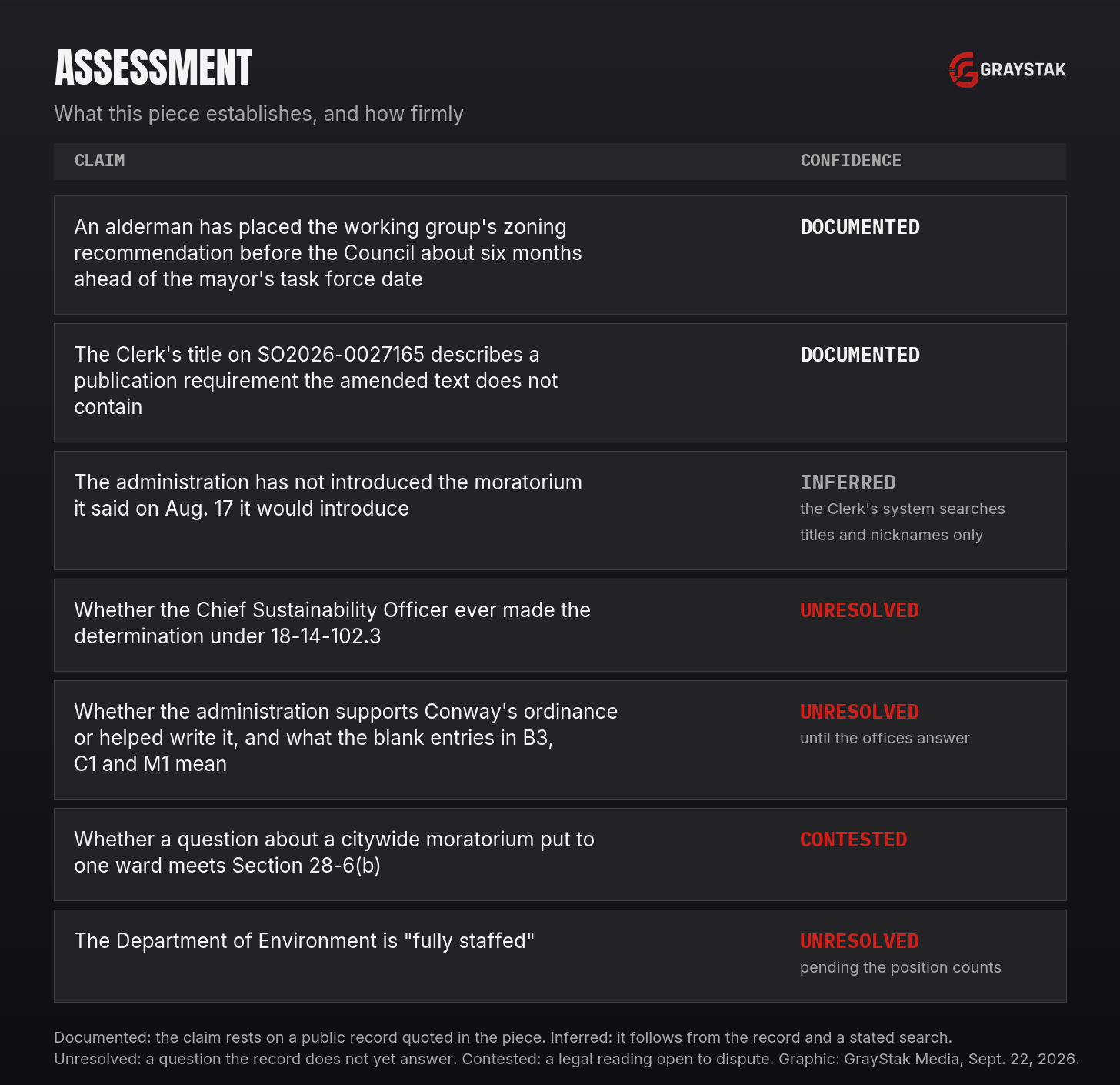
What this piece establishes, and how firmly. Documented: rests on a public record quoted in the piece. Inferred: follows from the record and a stated search. Unresolved: the record does not yet answer it. Contested: a legal reading open to dispute. Graphic: GrayStak Media.
WHAT WOULD SHOW THIS WRONG
A moratorium ordinance, under any caption, filed with the Clerk on or before Sept. 22, 2026.
A statement from the Mayor’s Office or from Conway that the administration helped draft O2026-0028432.
A substitute or amended copy, filed before the Sept. 23 meeting, that fills the blank cells or adds a planned manufacturing row.
A floor substitute on SO2026-0027165 that changes publication to “shall,” or a retitling by the Clerk before the vote.
A determination report under 18-14-102.3, dated.
A recording that shows the mayor said “moratorium” or named the ordinance on Sept. 21.
IMPLICATIONS
Owners and developers holding sites in C2, C3, M2, M3 and DS districts would need planned development approval and a Council vote for a new data center. Sites in the DC and DX districts would be closed to the use; DR is closed today. Conway’s ordinance is set for referral on Sept. 23 to the zoning committee, which Villegas chairs.
Conway wrote no provision for pending projects. Whether the ordinance, if adopted, would reach the applicant at 300 W. Adams St. or any developer with a permit in process is a question for Conway or the Department of Planning and Development, and neither has answered it. Any new data center that becomes a planned development would also go through the executive order’s Section 3 review until a moratorium ordinance rescinds that section. The air and noise rules under the order are due Nov. 9, and the Illinois Commerce Commission decides ComEd’s grid plan by Dec. 15. Both fall before the Feb. 23 election. The task force’s draft code amendments, due March 15 or later, would reach the Council in the final weeks of the current term or after the new term begins in May 2027.
HOW THIS WAS REPORTED
GrayStak covered the New York seminar in person and by the organizers’ livestream and recorded both. Quotations were checked against the livestream transcript and against GrayStak’s video from the room, where the room audio was clear enough to confirm them. The event’s billing follows the organizers’ event page and the Mayor’s Press Office public schedule dated Sept. 20, 2026. The Aug. 25 quotation is from GrayStak’s recording of the mayor’s City Hall press availability that day.
City records: O2026-0028432 and its attachment, a three-page scanned PDF without a text layer, read from rendered page images; R2026-0028519; SO2026-0027165 as amended in committee and its matter title; the Committee on Zoning agenda for Sept. 22. The matters were retrieved from the City Clerk’s eLMS on Sept. 21, 2026, and the two searches were run that morning and again at 4:12 p.m. Tuesday. 300 W. Adams St.: Chicago Sun-Times, Aug. 13, 2026, including the Department of Planning and Development statement it reported; Chicago Cityscape property report, map updated June 30, 2025. Great Lakes figures: U.S. Environmental Protection Agency, Great Lakes Facts and Figures. Election law: 10 ILCS 5/28-1, 28-6 and 1-6, and the Chicago Board of Election Commissioners’ 2026 Advisory Referenda Guidelines. Correspondence dates are taken from the message headers in GrayStak’s mail record. New York: Executive Order No. 62 and the governor’s announcements of July 14 and Sept. 15, 2026, at governor.ny.gov, retrieved Sept. 21; the Association of Towns of the State of New York summary of the order, dated July 14. The $1 billion figure is GrayStak’s arithmetic: 1,000 megawatts at $1 million each.
Verification: the use-table cells on pages 1 and 2 of the filed ordinance were read in nine optical character recognition passes at three resolutions and three page-segmentation settings, which agree on the commercial and downtown rows and find no data center row under Section 4; strikethrough and underline were read by eye.
GrayStak posted the first page of Conway’s filing on X on Sept. 21 at 12:31 p.m. Central and on Facebook at 12:32 p.m. At 1:07 p.m. Central, during the seminar, GrayStak emailed a Mayor’s Press Office staff member traveling with the mayor to offer to record a comment after his remarks. The staff member replied at 1:22 p.m. that he had just seen the message.
Where another outlet reported it, we attributed it: ABC7 published Ald. Villegas’s remarks on Aug. 11, the day of the signing. Excluded: a panelist’s unsourced polling figure; remarks by the mayor on housing finance and national politics beyond one sentence. Removed during verification: a characterization that a fellow panelist had credited Chicago with a moratorium, because his words admit a second reading; a quotation in which the state commissioner referred to “the mayor,” because the reference was to Mayor Robinson; an arrival time for Mayor Johnson drawn from another speaker’s remark.
WHAT IS NOT YET IN THE RECORD
Whether the administration supports Conway’s ordinance or was consulted on it. Whether a moratorium ordinance will be introduced, and by whom. What “full compliance” refers to, and the Department of Environment’s staffing against its budgeted positions. The 18-14-102.3 determination. The meaning of the blank cells and the absent row in the filed ordinance. Whether the zoning committee will hold a hearing. Which member is preparing the moratorium ordinance Vasquez described. Whether the Board of Election Commissioners has advised on a single-ward question about a citywide subject. Whether the full Commission on Chicago Landmarks has voted on 300 W. Adams St.
COMMENT
Written questions went on Sept. 21 between 4:02 and 4:04 p.m. Central to the Mayor’s Press Office, Ald. Conway’s office, Ald. Hadden’s office, Ald. Villegas’s office and Ald. Vasquez’s office, with responses requested by 5 p.m. Central on Sept. 22 because the piece publishes ahead of Wednesday’s meeting. A question for Mayor Robinson went at 4:12 p.m. to the press address of the Black Male Voter Project, the organization he leads, and to his address there, since the Town of Enfield publishes no email for the mayor; he answered by email at 6:30 p.m., and his answers appear above. The press office questions were forwarded at 4:55 p.m. to a second Mayor’s Press Office address, and a text message to the press secretary at 12:25 p.m. on Sept. 22 offered to narrow them or route them to the departments that could answer. Ald. Vasquez answered by email at 12:00 p.m. on Sept. 22, and his answers appear above; three follow-up questions went to him at 12:28 p.m. and he answered them at 12:38 p.m. Responses received after publication will be added below and dated. Ald. Conway’s, Ald. Hadden’s and Ald. Villegas’s offices and the Mayor’s Press Office had not responded as of 5 p.m. Central on Sept. 22.
CORRECTIONS
Sept. 22, 2026. The Millionaire Tax Ran Out of Ballots (July 23) and Chicago Zones Data Centers as Offices (Aug. 17) gave Aug. 16, 2026 as the last day the City Council could adopt a resolution placing a question on the Nov. 3 ballot. Aug. 16 was a Sunday. Under 10 ILCS 5/1-6, a deadline that falls on a Sunday extends through the next business day, and the Chicago Board of Election Commissioners’ 2026 guidelines set the adoption deadline at Monday, Aug. 17. The Council did not meet on either date, and the analysis is unchanged. The original pieces are being corrected and will carry dated entries.
Sept. 22, 2026. Chicago Zones Data Centers as Offices (Aug. 17) and A Council Committee Votes September 1 (Aug. 27) dated the 49th Ward office’s first written response to Aug. 18. The response was sent on Aug. 20 at 2:10 p.m. Central, and the Aug. 17 piece was updated that afternoon. The office’s later responses of Aug. 21 and Aug. 26 are dated correctly. The original pieces are being corrected and will carry dated entries.
Sept. 22, 2026. Chicago Zones Data Centers as Offices (Aug. 17) dated Ald. Villegas’s remarks on data centers, reported by ABC7 and the Chicago Sun-Times, to the day after the executive order was signed. Both outlets published them on Aug. 11, the day of the signing. The original piece is being corrected and will carry a dated entry.
GrayStak corrects errors on the record and marks the change. Send corrections to christopher@graystak.com.
UPDATES
Responses received after publication, and the outcome of the Sept. 23 votes, will be added here and dated. The original text stays intact.
DISCLOSURES
GrayStak holds no position in any company named in this analysis, and neither does the author. GrayStak has approached data center operators and developers about its analytics products; none is a client. GrayStak uses commercially available artificial intelligence tools, including Anthropic products, in its research and production workflow, and holds no financial interest in any of their makers.
ARCHIVE ENTRY
Forward calls. Entered Sept. 22, before the meeting, and scored on the Clerk’s record of Sept. 23. CH-01: SO2026-0027165 passes. Basis: 23 sponsors, 26 votes needed, a unanimous committee. CH-02: no data center moratorium ordinance is introduced. Basis: none in the Clerk’s record at 4:12 p.m. Sept. 22, and a member’s report of one being prepared with no date. CH-03: Vasquez appears as a co-sponsor of O2026-0028432 in the Journal of Proceedings. Basis: his email of 12:38 p.m. Sept. 22. These are the first calls GrayStak has registered on the City Hall beat; the outcome of each will be recorded in the session piece.