

Chicago, September 16, 2026, 10 a.m. Central, before the Federal Reserve's decision at 1 p.m. Prices are Tuesday's closes unless stated.
The question
The administration has made four long-horizon claims, each to justify a policy through the midterms. Which of them did the bond and oil markets reprice on September 14 and 15, and what does the repricing cost the people who built plans on them?
In brief
What happened. The ten-year Treasury yield closed at 5.00 percent on Tuesday by the Treasury’s official count, the first close at that level since 2007. Brent settled at $108.75 after Saudi Arabia shut the pipeline that bypasses Hormuz. Diesel set an all-time national record the same week U.S. crude output did. Futures put a Fed hike today at 93 percent, the first since 2023, after three weeks of public pressure from the White House for a cut; Brent is trading a little above $107 this morning. On Monday, the day the ten-year crossed 5 percent, Treasury designated Russia’s VTB Bank for Iranian sanctions evasion, the largest foreign bank yet sanctioned under the August 24 campaign.
Why it matters. Three of those claims no longer hold at this week's prices. Scott Bessent said the country would grow its way out of the debt. The White House said rates should fall before the election. Doug Burgum and Chris Wright said American production would keep the war away from the pump. None of that held this week. The shape of the move shows where the pressure is concentrated. The two-year rose more than the thirty-year, and since the war began, nearly all of the ten-year’s rise has come from the real yield rather than from expected inflation. That is a market pricing the Fed’s credibility. The week’s coverage called it a fiscal panic, and the curve does not support that. The same shock has already moved the ECB and the Bank of Japan, and both have said so.
Effects. Households are paying a fifteen-month high on mortgages and $6.27 for diesel, a record. Futures price two or three more quarter-point hikes within a year, and the sectors that take the cost first are named below, in the order they feel it: fuel, freight, feedstock, the cost of capital at the next refinancing, and then demand. Treasury must reconcile its August guidance with a 5 percent ten-year at the November 4 refunding. The largest unpriced claim is that the dollar absorbs all of this. The catalysts that would test it are named below.
What comes next. More scheduled unknowns fall inside the next ninety days than at any point since the war began: the Fed’s decisions today, on October 28 and on December 9; the Bank of Japan on Friday; the November 4 refunding; the election; the December 11 funding deadline; the pipeline repair; the Hormuz talks; and the clock on secondary sanctions against Iran’s trading partners, which Bessent started on August 24 without setting a date, while the secretary of war says the strikes resume whenever sanctions stop working and the secretary of state’s dates for a Hormuz deal have each passed. The fourth claim has not been tested: the president said on September 13 that the war ends “right after the midterms” and gasoline “drops like a rock.” The dates on which it will be tested are fixed and listed below, along with the conditions that would show this reading wrong.
The long arc is elegant and alluring. Anyone with ambition eventually attempts to anticipate it. Think tanks build narratives around it, policymakers signal their preferences inside it, and markets price some version of it into the curve. Yet the near term is where the arc is tested. A ten-year horizon reads as philosophy in a think tank; in a bond market it is material exposure. The path between today and that imagined future runs through interest rates, energy prices, capital costs, political decisions and the behavior of key actors forced to respond to changing conditions. The arc may survive intact while the path toward it changes completely.
On Monday, September 14, the path changed. The ten-year crossed 5 percent during the session for the first time since October 2023. On Tuesday, it touched 5.041 in the morning, a level last seen in July 2007, and Treasury’s official close was 5.00. The evidence is not the ten-year alone. It is that three prices moved together, in the same direction, in the same two sessions: the probability of a Fed hike, the yield on the ten-year, and the price of Brent. Each of those prices had been resting on a version of the same assumption, that the long arc would hold, and the three of them stopped resting on it at once.
A statement by an official is a speech act. It projects an intention into the market and asks the market to price it. It cannot compel the price. What it can do is set what the listener assumes, and then lead the listener to the policy that follows from that assumption. The story works for as long as no daily close can be held up against it. Then the policy is implemented, and the record shows over weeks and months whether the prices move toward the stated intention or away from it. That is the only test that counts, and it is why this piece runs on dated closes rather than quotations. This week, four such statements met a price. What follows is who made each one and what it has cost so far.
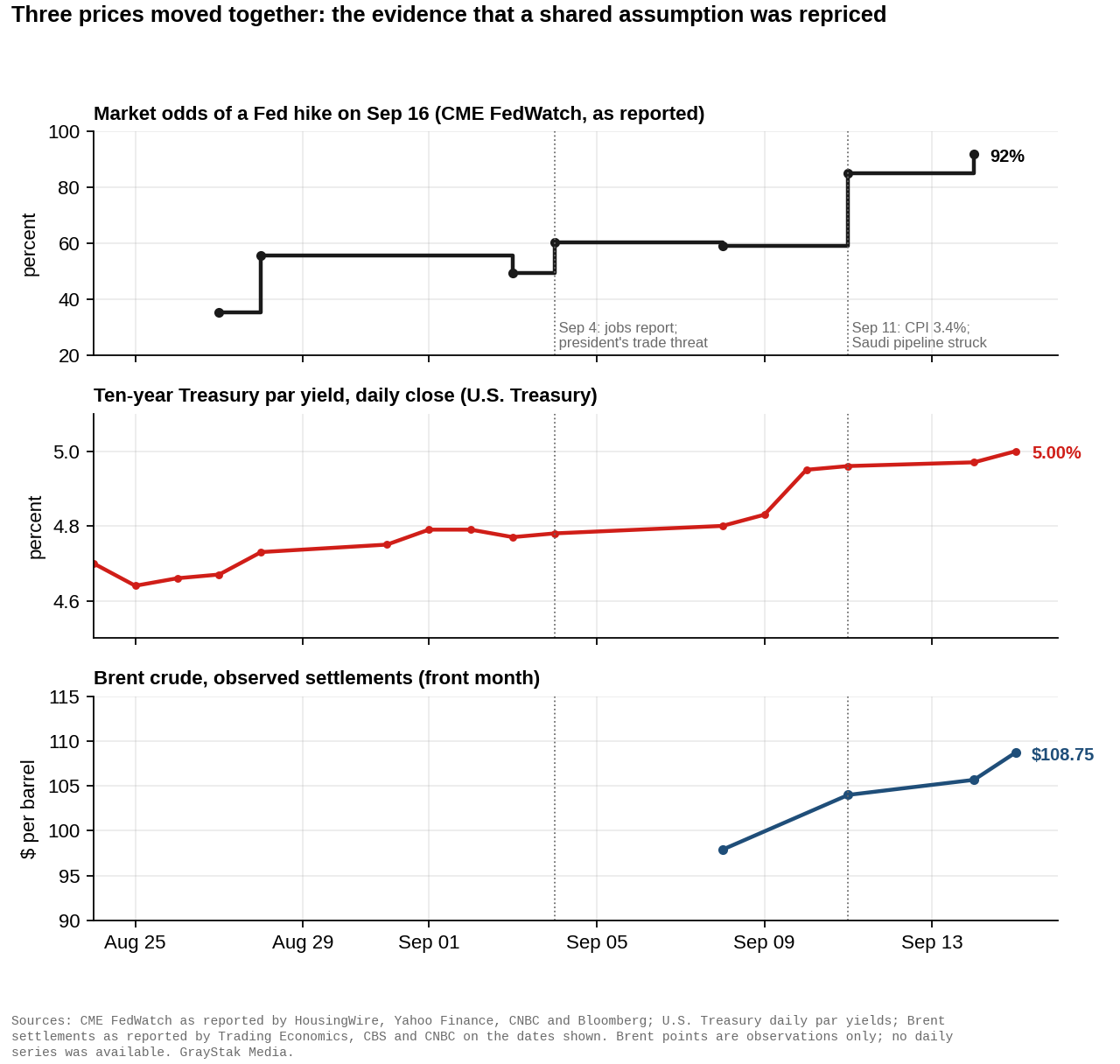
Figure 1. The probability of a September hike, the ten-year Treasury yield, and Brent crude from August 24 to September 15. Sources: CME FedWatch as reported; U.S. Treasury; Brent settlements as reported.
Findings
What the record shows, each tied to a document or a published series.
First. Treasury’s ten-year par yield closed at 5.00 percent on September 15. The two-year closed at 4.67 percent and the thirty-year at 5.36 percent. On September 9, with the ten-year at 4.8, CRFB wrote that yields already ran more than 60 basis points above what CBO’s baseline assumes. Basis: Treasury; CRFB.
Second. from the February 27 close, the day before the war, to September 15, the two-year rose 129 basis points, the ten-year 103 and the thirty-year 72. Of the ten-year’s rise through September 14, 88 basis points were in the real yield and 12 in inflation compensation. In the four sessions from September 9, the two-year rose 24, the ten-year 17, and the thirty-year 8. Basis: Treasury nominal and real par yield tables.
Third. the president, the vice president, the Treasury secretary and the National Economic Council director each publicly urged the Fed against a hike between September 1 and 13; the market-implied probability of a hike rose from 35 percent before Jackson Hole to 92 percent on September 14 and 93 percent on the morning of the decision. Basis: CNBC, September 5; Bloomberg, September 13; CME FedWatch as reported.
Fourth. EIA reported a weekly production record of 13.95 million barrels a day for the week of September 4. AAA’s national diesel average was $6.27 on September 15, a record. It was $6.23 on September 14 and $5.85 on September 4, the day it first passed the June 2022 high. Regular gasoline was $2.98 on the eve of the war and $4.33 on September 15. Real GDP grew 1.5 percent annualized in the second quarter. Basis: EIA; AAA; BEA second estimate, August 26.
Fifth. The president said on September 13 that the war would end “right after the midterms” and gasoline would “drop like a rock.” The Defense Department inspector general reported on September 14 that the war cost $33.4 billion through June 30. Basis: presidential remarks as reported; DoD IG.
Sixth. on August 24, Treasury designated about 60 entities, individuals, and vessels across the UAE, Hong Kong, China, Singapore, and Europe for moving Iranian oil and revenue, and Bessent said the United States would “sever every economic pipeline” to Iran, declined to rule out sanctions on Chinese banks, and set no timeline. Treasury has since designated a Turkish bank, Golden Global Bank, moved under Section 311 against the UAE branches of Egypt’s Banque Misr on August 28, and on September 14 designated Russia’s VTB Bank for correspondent relationships with sanctioned Iranian banks. No Chinese financial institution has been designated. That same day, Secretary of War Pete Hegseth said economic pressure “hurts them the most right now” and that “if we need to use kinetic strikes, we’ll use them.” On September 11, he said the United States was sending “tankers to the bottom of the ocean.” On August 4, Secretary of State Marco Rubio said a Hormuz agreement had “progress but not finality” and would come “very shortly”; on September 13, the talks were postponed. China’s foreign ministry replied to the sanctions that pressure “will only lead to escalation.” Basis: Treasury press releases of August 24, September 8 and September 14 and the OFAC Iran program page; NBC, NPR, CNN, Al Jazeera, August 24 and 25; The Hill, August 24; Pentagon remarks of September 11 as reported; State Department remarks of August 4 as reported by CBS and CNN.
Assessment
The government is paying roughly 80 basis points more to borrow for ten years than the federal budget baseline assumed. Confidence: inferred. The 4.2 percent baseline comes from CRFB’s statement rather than a CBO table, and the table would settle it.
The rise in yields came from the front end and from real rates, which is how a market behaves when it doubts the central bank. Confidence: documented on the decomposition, inferred on the reading.
The White House campaign for lower rates preceded, and did not prevent, the market’s repricing of a hike. Confidence: documented on the sequence. Whether any single statement moved the market is unresolved.
Record production did not deliver the “short-term disruption” the White House described in March. Confidence: documented.
The “after the midterms” promise will be checked on five scheduled dates inside ninety days. Confidence: documented on the calendar. No assessment is offered on the vote.
The dollar has not been tested by any of this, and the evidence available today does not show it weakening as a reserve asset. The path on which it would be tested is specific: secondary sanctions on Chinese financial institutions, which is the rung Bessent himself named as the one that would “blow up the global financial system.” Confidence: documented on the evidence, unresolved on the path.
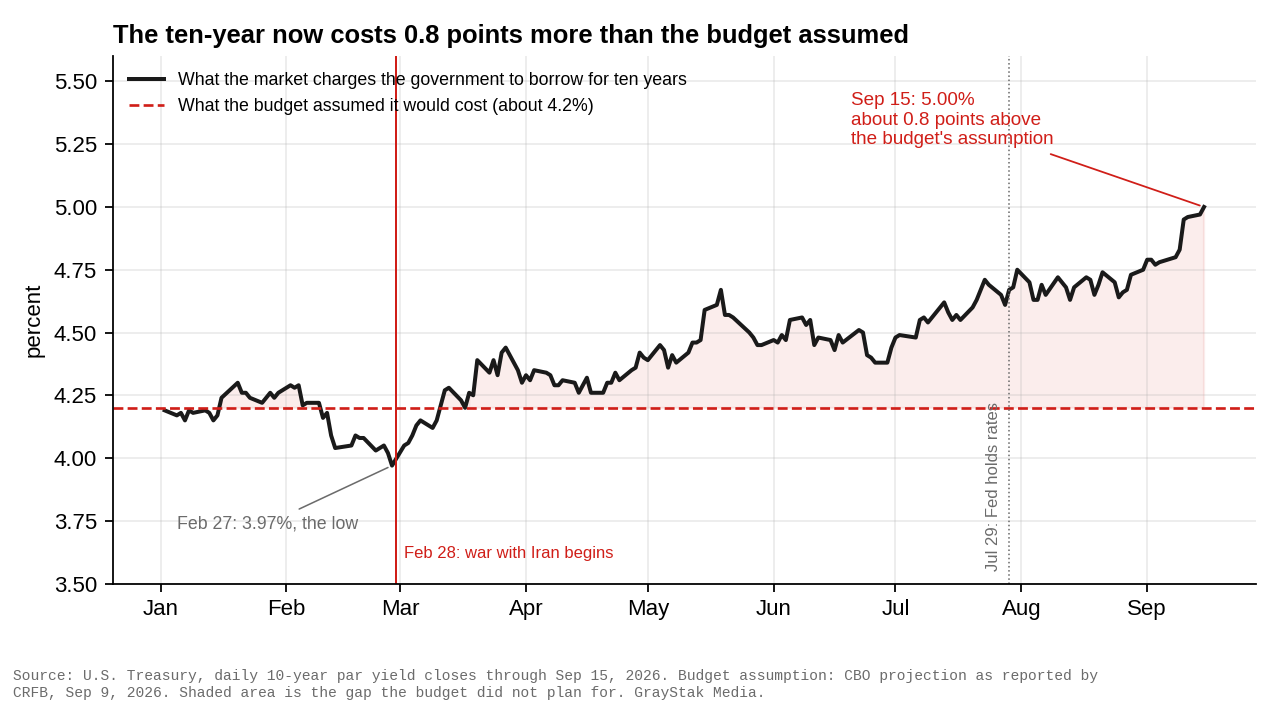
Figure 2. The ten-year Treasury par yield, daily closes through September 15, against the rate the budget baseline assumed. Sources: U.S. Treasury; CRFB.
“We can grow our way out of it”
The claim belongs to the president and the Treasury secretary. On August 20, Scott Bessent told CNBC there was “nothing magic about the $40 trillion number” and that the country could grow its way out of it. On August 21, the president said, “the way you take care of debt is with growth.” On September 8, at SMU’s Cox School, Bessent set the condition: 3 percent growth with spending restraint, since “we don’t have a revenue problem, we have a spending problem.” He added that interest rates had become more closely tied to energy prices than before and that he expected the link to break. The policy the claim justifies is the spending posture through the midterms, including the $1.3 trillion payout the president has proposed if Republicans hold Congress.
The condition is not met. Real GDP grew 1.5 percent annualized in the second quarter, 2.1 in the first, and 0.5 in the fourth quarter of 2025. The growth case rests on the artificial-intelligence capital-spending boom, which Wharton’s Kent Smetters calls transitory, “three to five-ish years.” The best evidence on Bessent’s side is in the same BEA release. Real final sales to private domestic purchasers, the measure that strips out government and inventories, grew 3.9 percent, and corporate profits rose $401 billion in the quarter. That is a private economy in good health. It is also running at half the growth rate his claim requires. The correlation he expects to break tightened this week, with Brent and the ten-year rising together on both days.
The measuring stick is the Congressional Budget Office baseline, which Congress uses to score every bill. It was built on a cheaper decade than the one being financed now. CRFB has run the arithmetic on a curve held 64 basis points above that baseline: $2.3 trillion more debt over ten years, with public debt reaching 125 percent of GDP by 2036. At Tuesday’s close, the gap is closer to 80. On a trillion dollars refinanced at that gap, the extra interest comes to about $8 billion a year, added to a bill that hit $970 billion in fiscal 2025. That was 3.2 percent of GDP, a record, and 19 cents of every dollar the government collected. Gross debt passed $40 trillion in August. CBO expects this year’s deficit to come in at $2.1 trillion, more than twice the 3 percent of GDP Bessent has set as his target.
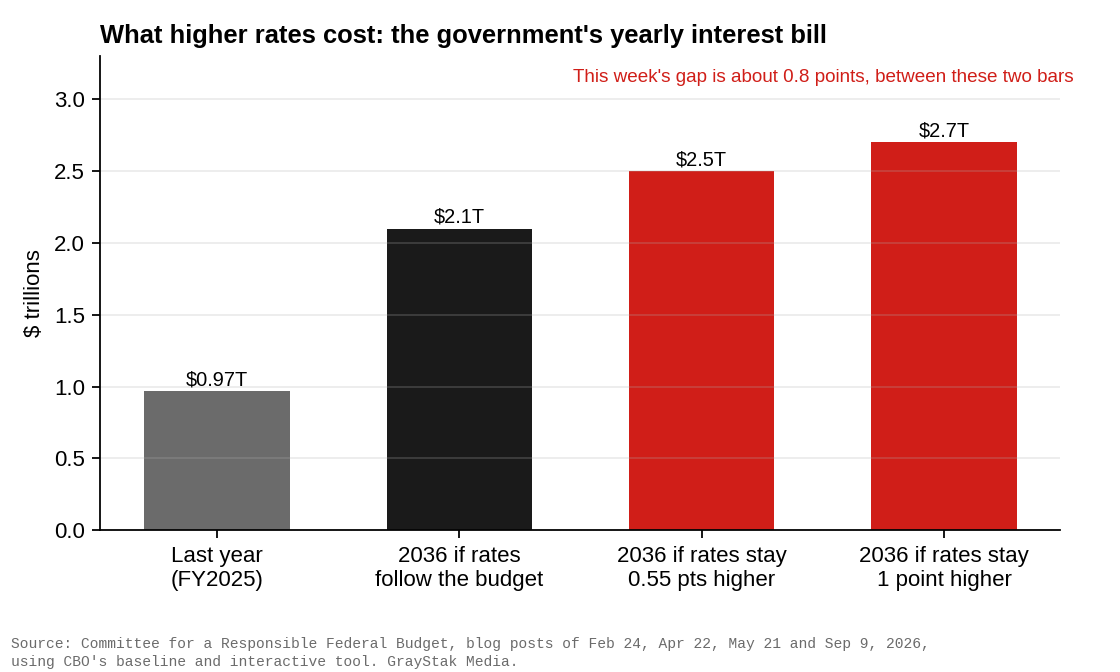
Figure 3. Net interest in fiscal 2036 under CBO’s baseline and two CRFB rate scenarios. Tuesday’s gap sits between the two right-hand bars. Source: CRFB.
Treasury was managing the long end before this week. Effective September 9, it at least doubled its liquidity-support buybacks in the 10-to-20 and 20-to-30 year sectors, from a $2 billion ceiling per operation, through November 4, the date of the next refunding statement. The auctions cut both ways. On August 13, Treasury sold thirty-year bonds at the highest yield in 25 years. The auction tailed, the bid-to-cover was 2.39, and dealers were left holding 11.5 percent, both weaker than the past year’s average. On September 9, the ten-year reopening went the other way, with a 2.71 bid-to-cover and indirect bidders taking 79.2 percent at a yield of 4.834. Demand was strong that afternoon. The yield still rose 17 basis points over the next four sessions. In August, Treasury said it expected to hold coupon sizes steady for at least several quarters; November 4 is the first test of that at 5 percent. Congress deferred the spending test to December 11, thirty-eight days after the election, by continuing resolution.
That is a private economy in good health. It is also running at half the growth rate his claim requires.
“Rates should come down”
The claim belongs to the president, the vice president, Bessent and Kevin Hassett of the National Economic Council. In the week ending September 5, each urged the Fed publicly not to raise rates, a campaign CNBC described as unusually broad even against the president’s long quarrel with the central bank. On September 4, after the August jobs report showed 162,000 hires and unemployment at 4.1 percent, the president wrote on Truth Social that the United States would halt trade with every country with which it runs a deficit unless the Fed cut. On September 11, after the inflation print, Hassett told Bloomberg that if the Fed hiked, “the president will have something to say about it,” then softened the line two days later. On Sunday, the president repeated that American borrowing costs should be the lowest in the world. The policy the claim justifies is a central bank that defers to the administration on the timing of the cycle.
The market answered with a probability. The implied odds of a September hike stood at 35 percent before Chair Kevin Warsh spoke at Jackson Hole, 56 percent after, 60 percent after the jobs report, 85 percent after August CPI printed 3.4 percent on September 11, and 92 percent on Monday, 93 percent on Wednesday morning, when futures also priced a 39 percent chance of a second hike in October. Each White House statement was followed by a higher number. The Wall Street Journal reported in August that the president had spoken to Warsh repeatedly; the president says once.
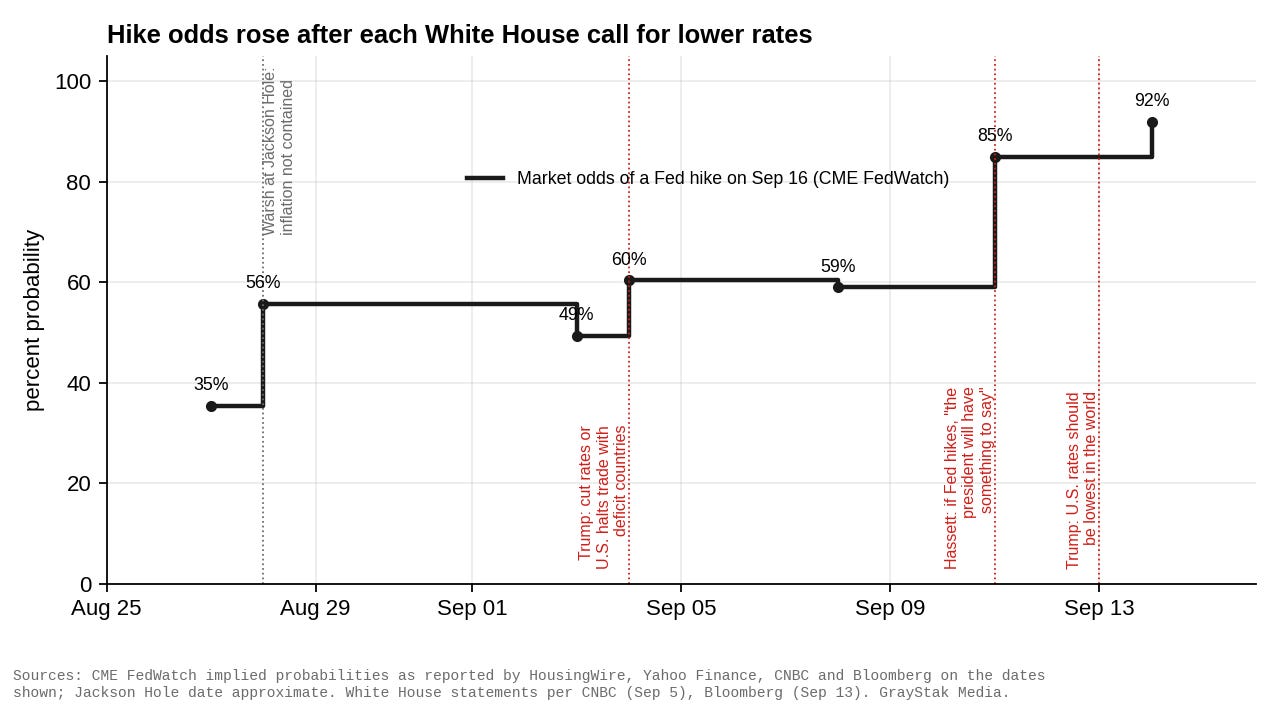
Figure 4. CME FedWatch implied probability of a quarter-point hike on September 16, against dated statements from the Fed chair and the White House. Sources: CME FedWatch as reported; CNBC; Bloomberg.
Warsh decides at 1 p.m. Central today, forty-eight days before the election, and again on October 28, six days before it. If he hikes, the market will read it as an admission that the July hold was a mistake; Warsh would say it is a response to a 3.4 percent inflation print, and both readings can be true. If he holds, he confirms the verdict the two-year has already delivered. Maurice Obstfeld of the Peterson Institute described the choice as the president’s wrath on one side and the Fed’s credibility on the other, with the cost of losing the second showing up later, in inflation. Households are already paying either way. Freddie Mac’s thirty-year mortgage averaged 6.76 percent on September 10, the highest in fifteen months. In late February, before the war, it was 5.98.
“It’s all about supply”
The claim belongs to the White House and the two cabinet secretaries who run the energy portfolio. Press Secretary Karoline Leavitt called the March price spike “a short-term disruption for the long-term gain” on March 8. Interior Secretary Doug Burgum, chair of the National Energy Dominance Council, called it a “temporary blip up” on March 24 and said, “it’s all about supply.” Energy Secretary Chris Wright said on March 15 that there were “no guarantees” on when gasoline would fall, while the EIA inside his department forecast that gasoline would not return to pre-war levels before the end of 2027. The policy the claim justifies is that the war is affordable and its domestic cost is contained.
Supply did what Burgum said it would. Weekly output reached 13.95 million barrels a day in the week of September 4, a record; EIA forecasts 13.8 million for the year and 14.3 million for 2027; refineries ran at 97.8 percent of capacity. The price did not follow. The United States and Israel struck Iran on February 28, and Iran closed Hormuz on March 2. A ceasefire took hold on April 8. The two sides signed a memorandum on June 17, and by July 8 it had collapsed. The sixty-day deadline it set for a final deal passed on August 17 with nothing signed. Saudi crude had been rerouted through the East-West pipeline to Yanbu. On September 11, drones launched from Iraq struck its pumping stations, and Riyadh shut it, putting more than 4 million barrels a day of exports at risk. Regional officials estimate three to five weeks to restore it. Iran’s Houthi allies hold Mokha and the Bab el-Mandeb approach and have declared a blockade of Saudi Red Sea ports. The Oman talks on a Hormuz shipping arrangement were postponed Sunday, and when asked about them, the president said he did not care. JPMorgan’s August scenario had Brent at $120 if the blockades persisted.
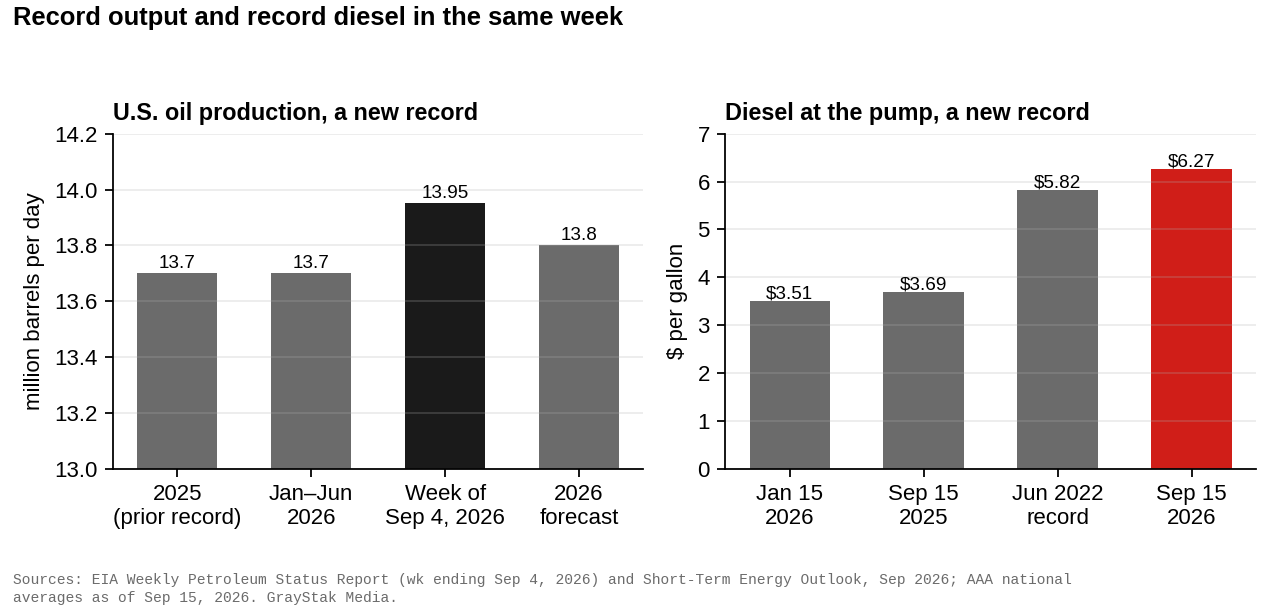
Figure 5. U.S. crude output and the national diesel average. Sources: EIA; AAA.
The pump is where the claim is checked first, because a household pays it weekly. Regular gasoline averaged $4.33 on Tuesday by AAA’s count, up 18 cents on the week and $1.15 above a year ago. Diesel averaged $6.27, the highest AAA has ever recorded, against $3.69 a year ago and $3.51 in January. The June 2022 record fell on September 4 and has been exceeded on every day since.
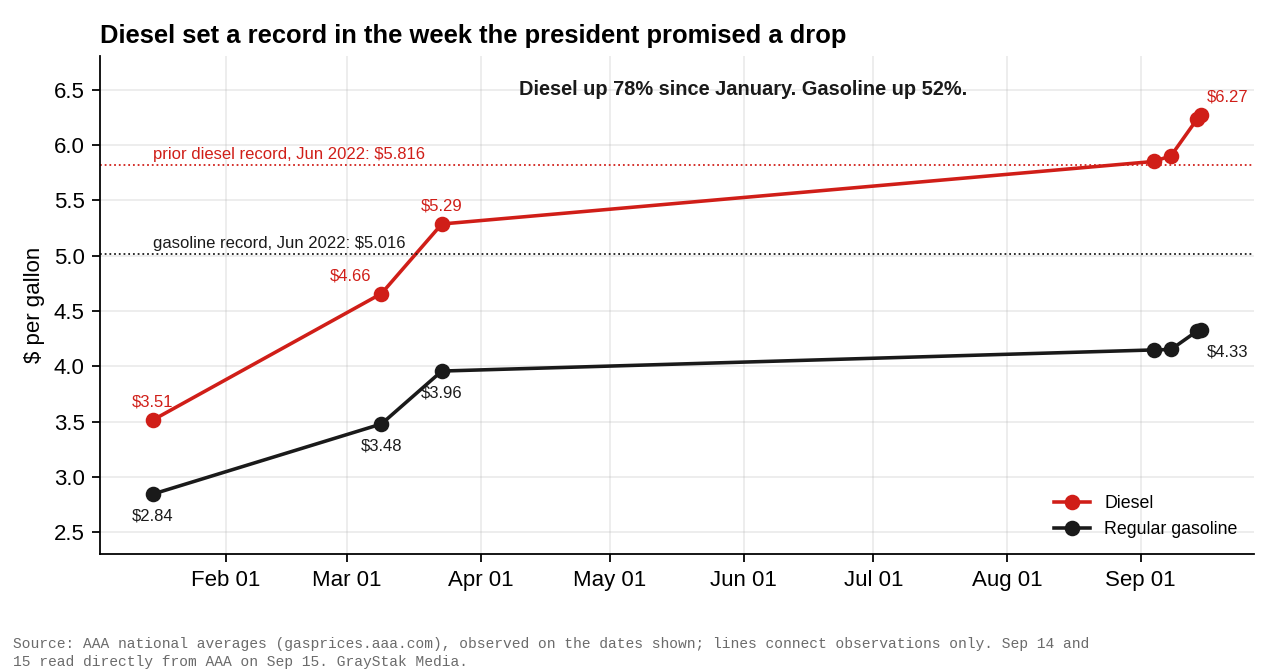
Figure 6. AAA national averages on the dates observed. Source: AAA.
The shape of the move locates the pressure point
The financial press read 5 percent as a verdict on the debt; CNBC’s Monday coverage paired the $40 trillion figure with the yield. Treasury’s daily yield tables say otherwise, in two ways.
First. the curve flattened as it rose. The day before the war, the ten-year yielded 59 basis points more than the two-year; on Tuesday, 33. The thirty-year’s premium over the ten-year fell from 67 to 36. A fiscal panic shows up at the long end first, as investors demand more to hold thirty-year paper against an uncertain path. This move ran the other way: the front end led, which is what a market does when it stops believing the central bank will wait. The July 29 hold produced the mirror image: the two-year down 4 basis points and the thirty-year up 11, the market charging for inflation risk at the long end. The hold raised the cost of long borrowing; the prospect of a hike has raised the cost of short borrowing.
Second. the move is real. Treasury’s real yield curve puts the ten-year TIPS yield at 1.72 percent on February 27 and 2.60 on September 14. Of the nominal ten-year’s 100 basis point rise over that period, 88 is real yield and 12 is inflation compensation; in the September 9 to 14 leg, the breakeven did not move at all. Investors are not pricing runaway inflation. They are pricing a higher real return for lending to the government while the central bank decides how much of the war’s inflation it will absorb. That makes today’s decision the inflection: a hike converts the front-end pressure into policy, and a hold converts it into a credibility discount the long end will then price. Equities have not joined them. The S&P 500 ended last week near 7,670, within reach of its high. The repricing has so far run through bonds, oil and the pump, and stocks have not yet been asked to pay it.
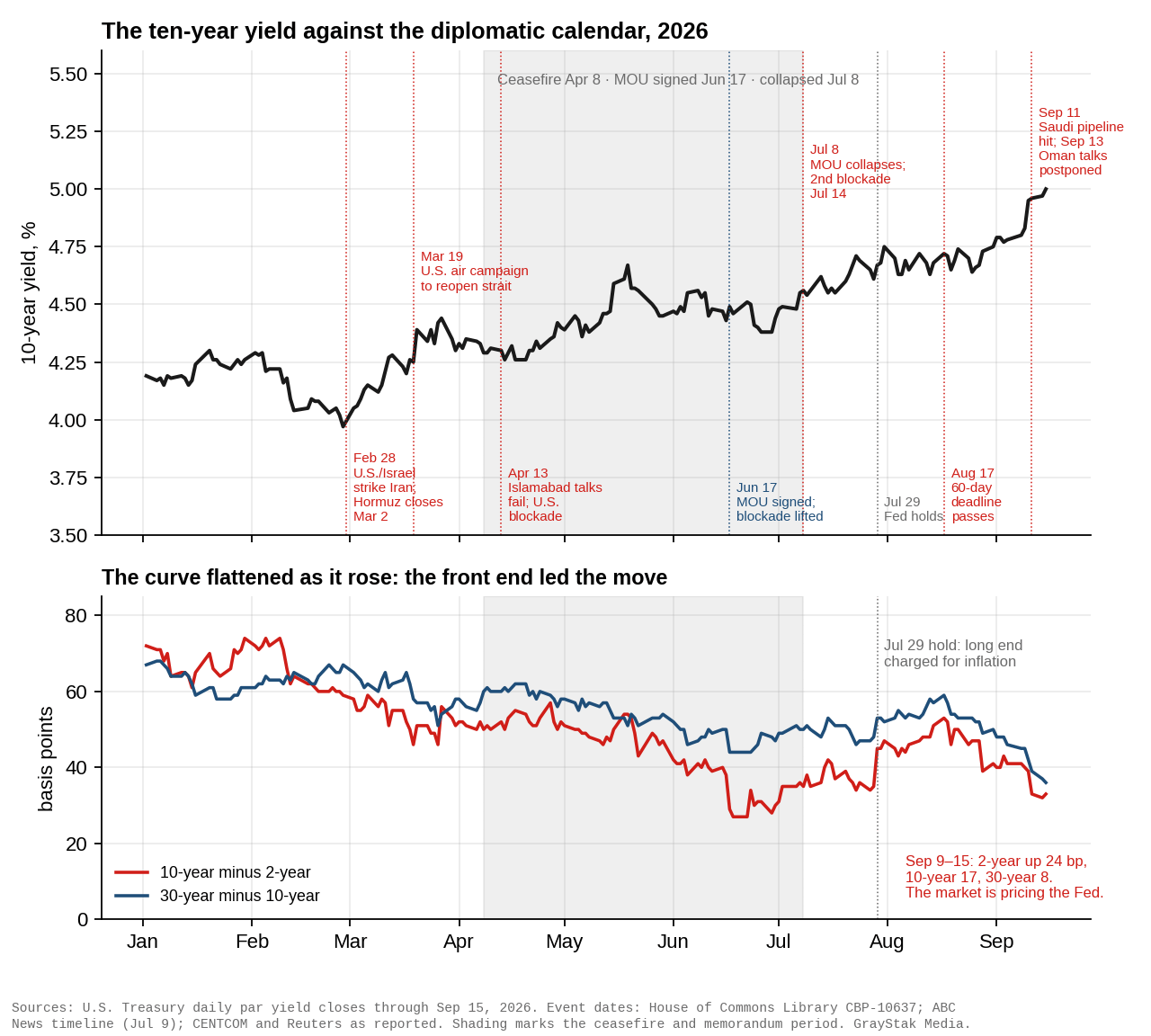
Figure 7. Above, the ten-year against the diplomatic calendar; below, the curve’s shape as the ten-year’s premium over the two-year and the thirty-year’s over the ten-year. Sources: U.S. Treasury; House of Commons Library; ABC News; CENTCOM.
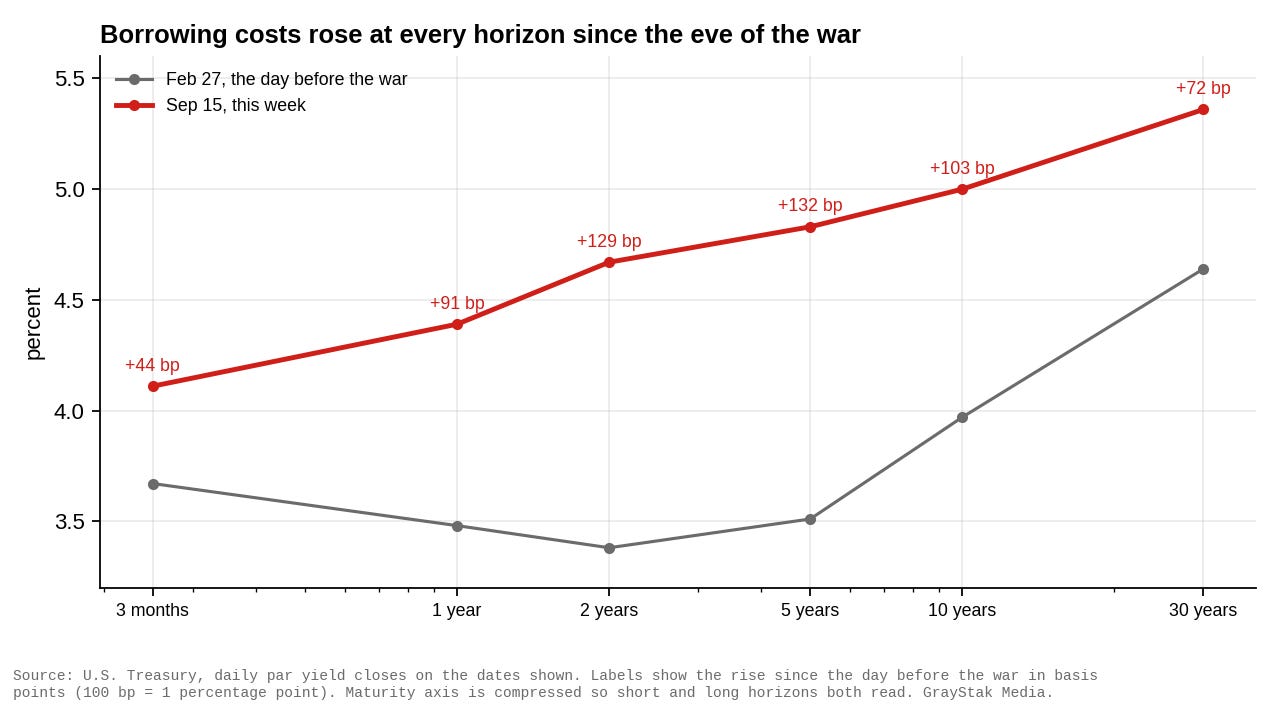
Figure 8. The Treasury par yield curve on February 27 and September 15. Source: U.S. Treasury.
Investors are not pricing runaway inflation. They are pricing a higher real return for lending to the government while the central bank decides how much of the war’s inflation it will absorb.
“Right after the midterms” will be checked on five dates
The claim belongs to the president alone. On Sunday, he said the war would end “right after the midterms,” and gasoline would “drop like a rock.” He attributed diesel shortages to Ukrainian strikes on Russian refineries, with no mention of the Gulf, and announced that Russia and Ukraine had agreed to halt attacks on energy infrastructure. Kyiv said on Tuesday that no such agreement exists. On Monday, the Pentagon’s inspector general published the first public accounting of the war’s cost: $33.4 billion through June 30, including $22.3 billion in munitions and $3.7 billion in equipment losses, and excluding facility repair. The report describes a munitions shortfall, which the Secretary of War denies.
The promise will be checked today, when the Fed decides; November 3, when the voters do; November 4, when Treasury prices the debt; December 9, when the Fed meets for the first time after the promise comes due; and December 11, when the continuing resolution expires. Each date produces a number to set against it. A story that can no longer be told to a market is over, even if the speaker keeps telling it.
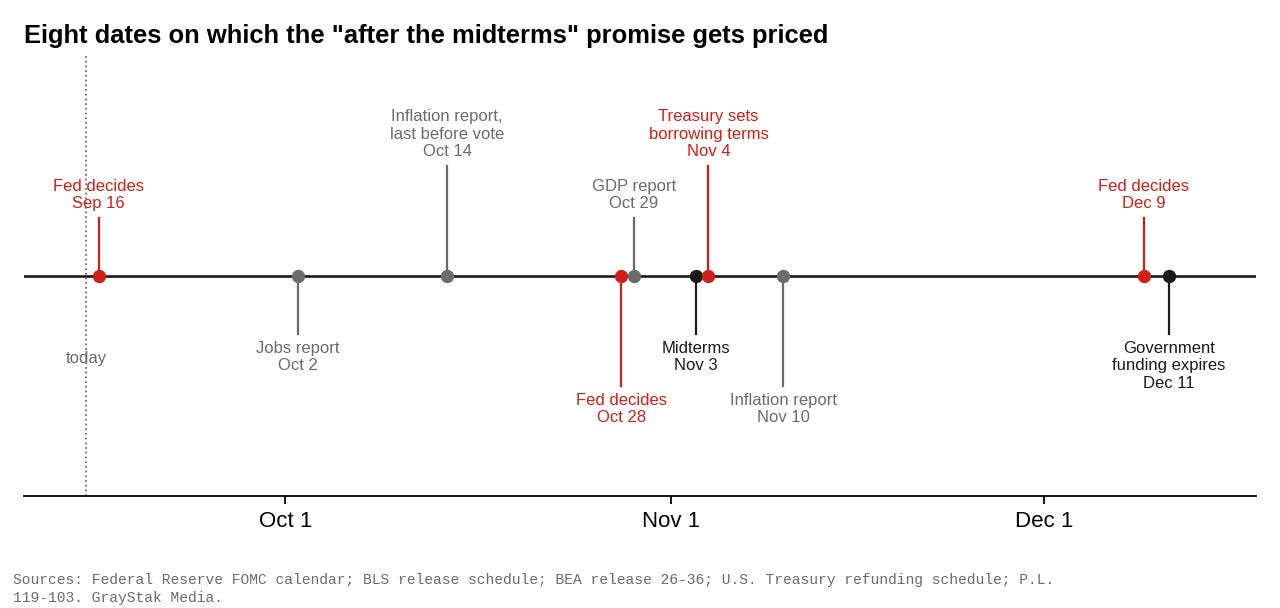
Figure 9. Scheduled dates on which the promise will be checked. Sources: Federal Reserve; BLS; BEA; U.S. Treasury; P.L. 119-103.
The direction of travel
The four claims above are being priced one at a time. What makes this week different from March, when oil first spiked, or July, when the memorandum collapsed, is that the administration has added a fifth instrument and a clock. On August 24, the Treasury secretary announced what he called an “economic D-Day”: about 60 designations of brokers, shipping agents, shadow-fleet vessels and financial facilitators across the UAE, Hong Kong, China, Singapore, Switzerland and Europe, described as the first step in an “economic onslaught” to “sever every economic pipeline” to Tehran “until Tehran stands alone.” The president was calling heads of government with “specific requests” to stop trading with Iran. Asked whether Chinese banks were in scope, Bessent would not say, and then said the line himself: “Why would I want to blow up the global financial system?” He added that patience was not infinite and set no date. The campaign has since reached banks outside China. On August 28, FinCEN moved to cut the UAE branches of Egypt’s state-owned Banque Misr from U.S. correspondent access; Treasury designated Golden Global Bank in Türkiye for offering correspondent services to Iranian institutions; and on September 14, it designated VTB, one of Russia’s largest banks, for the same conduct. OFAC’s April 28 alert states that China buys roughly 90 percent of Iran’s oil exports, mostly through independent refineries in Shandong. That is the rung that has not been taken. China’s foreign ministry answered that “sanctions and pressure tactics” would “only lead to escalation,” and Beijing has rejected the same demand on Russian oil since 2025. Eleven days later, the president tied trade itself to monetary policy, threatening to halt commerce with every deficit country unless the Fed cut.
The economic rung is one of three. The diplomatic and military rungs each carry dated claims. The diplomatic one belongs to Marco Rubio. On March 28 he said the war would end within weeks rather than months and required no ground troops; on March 30, that Hormuz would reopen “one way or another”; on July 21, that Iran was “not serious”; on August 4, that a Hormuz agreement had “progress but not finality” and would come “very shortly,” with the strait already “open,” and that “the denuclearization of Iran is the ultimate deal.” The president had canceled what he called the biggest attacks since the Second World War two days earlier to let the talks proceed. Six weeks later, the talks were postponed, Bahrain withdrew, and the president said he did not care. Rubio’s claim has a documented shape: each stated date has passed with nothing signed, which is the non-occurrence the record exists to capture.
The military rung belongs to Pete Hegseth. On August 24, hours after Bessent spoke, he said economic pressure “hurts them the most right now” and added, “if we need to use kinetic strikes, we’ll use them.” On September 11, at the Pentagon, he said the United States was still sending “tankers to the bottom of the ocean where they belong” and described a struggle that continues “until Judgment Day.” He told the Senate on July 21 that the war had cost $37.5 billion, a figure that ran through the end of the fiscal year and exceeds the inspector general’s $33.4 billion through June. On September 15 Representative Thomas Massie read eight articles of impeachment against him on the House floor, among them an alleged violation of the War Powers Resolution. The resolution’s prospects are not assessed here; its introduction makes the war’s legal footing a live question inside the Republican conference, seven weeks before the vote.
Sanctions carry no date. Diplomacy’s dates have passed. The military posture is that strikes resume when sanctions stop working. Each rung is a catalyst with a defined trigger: designating a Chinese financial institution, a Hormuz arrangement Washington either accepts or rejects, or a resumption of strikes on Iranian shipping at scale. The administration stands one rung below a Chinese financial institution with $40 trillion in debt, a 5 percent ten-year, a war costing $8 billion a month, and Brent above $100. The first four claims are being paid for in interest costs and diesel prices. The fifth would be paid for in the currency.
On the dollar, the record available today is narrower than the fear. Foreign private investors bought about $1.5 trillion of U.S. securities in 2025, and foreign ownership of the U.S. market reached its highest share in roughly a decade. Brad Setser at the Council on Foreign Relations wrote on September 3 that the world is moving its dollars from central bank reserves into state banks and pension funds, and that this is a change of holder rather than a departure from the currency. The dollar has been supported through this episode by the same 5 percent yield that the piece focuses on. What has changed is the talk, and one week of price. Convera notes that “debasement” resurfaced as a theme the week Treasury expanded its buybacks, because investors read the program as a sign policymakers were worried about borrowing costs, and the dollar recorded a weaker week. That is the strongest evidence against this paragraph’s reading, and it is one week.
The tripwires are observable. The monthly Treasury International Capital release will show whether foreign official holders sold into the September rise. The indirect share at the November 4 refunding auctions will show whether they kept buying at 5 percent. A designation of a major Chinese bank would be public the day it happened. Until one of those moves, the dollar claim is unresolved, and the piece says so rather than asserting an inflection the data do not yet show. Confidence: documented on the sanctions record and the flow data; unresolved on the dollar.
The first four claims are being paid for in interest costs and diesel prices. The fifth would be paid for in the currency.
The same test abroad, in the central banks’ words
The chain from the war to foreign policy rates need not be inferred; central banks have stated it. On March 19, three weeks into the conflict, Christine Lagarde said the war “has made the outlook significantly more uncertain” and would have “a material impact on near-term inflation,” and the ECB’s staff published scenarios in which energy disruption lifted euro-area inflation to 3.5 or 4.4 percent depending on how long it lasted. By March 20, money markets priced at least two ECB hikes for the year, whereas they had priced none before February 28. In July, Lagarde said the memorandum and ceasefire had pushed oil “sharply lower,” that the ceasefire “was broken several times,” and that “the full inflationary impact of the energy shock has yet to play out.” On September 10, the ECB raised its deposit rate a quarter point to 2.5 percent, and Lagarde said the conflict in the Middle East would keep headline inflation “well above target” for an extended period. The Bank of England held at 3.75 percent on March 19, citing the same oil and gas prices. In Tokyo, the ten-year JGB reached 2.37 percent on March 27, its highest since 1999, on what Trading Economics described as an oil-driven inflation shock linked to the conflict; the yen breached 160 to the dollar, and the Bank of Japan’s March summary recorded a member arguing for a larger hike in response to the Middle East. The Bank of Japan meets Thursday and Friday and is expected to raise its policy rate to 1.25 percent. Confidence: documented on every link in that chain; the piece does not assign a share of each decision to the war, because the banks did not.
The Federal Reserve is moving after the European Central Bank. Lagarde called the September 10 hike “a no-brainer” and warned that the return to 2 percent, expected by the end of 2027, could slip. The Bund reached 3.56 percent Tuesday, a 2009 high; the French ten-year passed 4.2, a 2008 high; gilts touched 5.25 on September 1, an eighteen-year high; Japan’s ten-year holds above 3 percent, from 2.37 in March, against debt above 200 percent of output. Europe’s version of the arc was that the cutting cycle would resume, and markets repriced it in the third week of March.
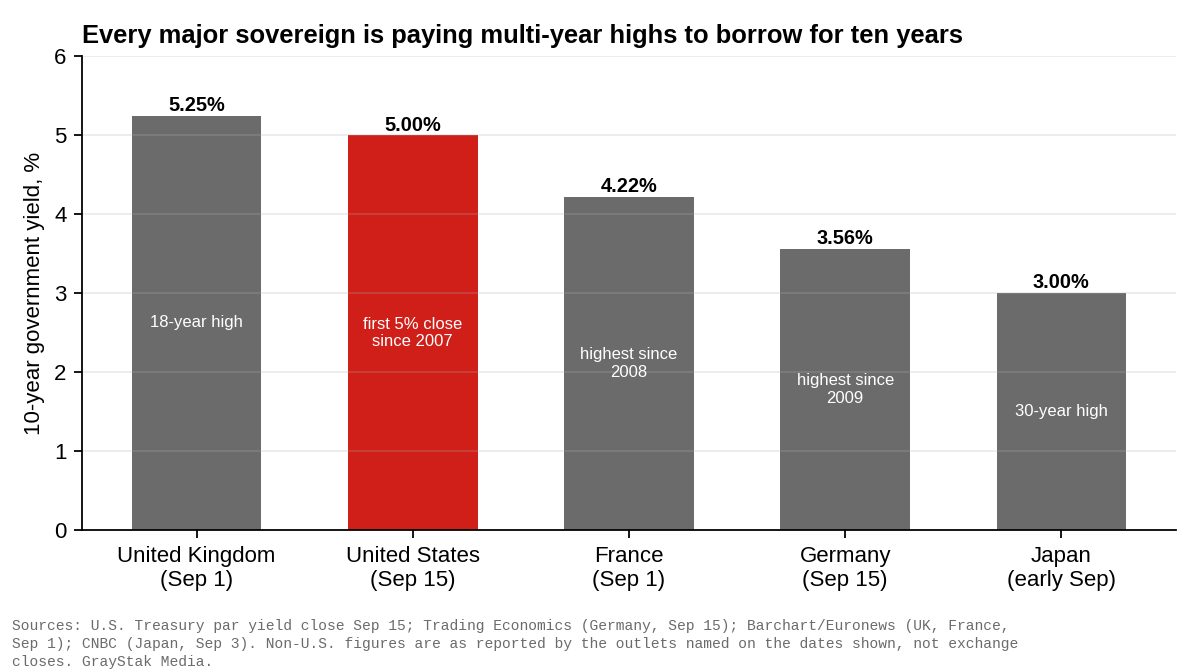
Figure 10. Ten-year government yields at their latest reported prints. Sources: U.S. Treasury; Trading Economics; Barchart; Euronews; CNBC.
Asia carries the supply exposure the United States does not. About 84 percent of the oil transiting Hormuz is bound for Asia. China draws 45 to 50 percent of its crude imports through the strait, ordered its refiners in March to stop exporting diesel and gasoline, and is drawing three to four months of stockpile. India lost more than 40 percent of its crude flows on a thirty-day buffer; the rupee set a record low in May, and growth forecasts fell to 6.7 percent from 7.7. New Delhi also made a long-horizon claim: that it could hold pump prices below cost until the war ended. That claim will be checked at the subsidy line in 2027.
For a manufacturer or multinational across these markets, four prices moved this week. The cost of capital for a ten-year program is now set against a 5 percent risk-free rate at home and multi-year highs abroad. Freight is set by diesel, at a record in the United States and rationed by export controls in China. Inputs are already in the survey data: the ISM manufacturing prices-paid index stood at 71.1 in August against a headline of 54.6, an expanding sector paying more for everything it buys. Currency exposure runs through the rupee and the Chinese stockpile draw. The United States is the only party to this repricing, producing record oil and paying record diesel at once. Confidence: documented in prices, inferred in transmission.
How much can the system absorb, and what further tightening looks like
Policy will tighten further; the futures curve says so. The question for a management team is how much absorptive capacity remains before the next turn of it reaches the operating line. The record shows the buffers have already been drawn.
The physical buffers first. The International Energy Agency’s 32 members agreed on March 11 to release 400 million barrels from emergency reserves, the largest collective action in the agency’s history and only the sixth since 1974; the United States committed 172 million of them from a Strategic Petroleum Reserve that held about 415 million. The EIA’s September outlook estimates global inventories have fallen by 400 million barrels so far this year and will keep falling through the end of 2026, puts Gulf production shut-ins at 6.7 million barrels a day in August, up from 5.0 million in July, and assumes Middle East flows stay constrained through the fourth quarter. American refineries ran at 97.8 percent of capacity the week of September 4, leaving no slack to convert a crude surplus into product. China is running down a three-to-four-month stockpile and has banned refined-product exports since March. Each of those is a buffer used once. Confidence: documented.
The financial buffers next. Treasury has already doubled its long-end buybacks. The Fed’s first hike, if it comes today, arrives with the two-year at 4.67 and futures pricing 4.1 percent on the funds rate by December and 4.6 by next September, which is the market’s estimate of what “further tightening” means: two or three more quarter points inside a year. On the corporate side, S&P Global counts $397 billion of speculative-grade debt to refinance in 2026 and $416 billion in 2027, about half of it floating-rate loans and revolvers that reprice at whatever short rate prevails; Fitch estimates each 25 basis point rise in SOFR adds about $3.5 billion a year in interest across the leveraged-loan universe. PitchBook counts $580 billion of leveraged loans and $625 billion of high-yield bonds maturing between 2027 and 2029. Covenant-lite structures make up more than 80 percent of the institutional loan market, so stress arrives late and as restructurings rather than early warnings. Confidence: documented on the counts; inferred on the timing.
What it looks like by sector, in the order prices reach it.
Air transport is already there. IATA’s latest weekly monitor puts the global jet fuel benchmark at $181 a barrel, up 6 percent for the week, up from $99 at the end of February; its 2026 average forecast is $152, about 70 percent above 2025. Fuel has moved from a quarter to more than 40 percent of operating cost at many carriers, surcharges are being reset every two weeks, and Cathay disclosed that its hedges cover about 30 percent of the crude component and none of the refining margin. Confidence: documented.
Trucking and distribution follow within weeks, because fuel surcharges are indexed to the Department of Energy’s weekly on-highway diesel series, which stood at $5.97 on September 9 against $3.81 on February 23. Every contract with a surcharge clause is repricing on that index now; every contract without one is a margin problem for the shipper. Confidence: documented on the index; inferred on the contract effects.
Chemicals, plastics and fertilizer are the next layer, and the least visible. Hormuz carried about 19 percent of world chemical trade and 35 percent of liquefied petroleum gas before the closure, by IATA’s count. Feedstock and process-heat costs move with those flows, and they reach consumers through packaging, construction materials, and food with a lag of one to two quarters. Confidence: documented on the flows; inferred on the pass-through.
Housing and construction take the rate channel rather than the fuel channel. The thirty-year mortgage at 6.76 percent is the household’s version of the five percent ten-year, and the Mortgage Bankers Association counts about $652 billion of commercial real estate loans maturing in 2027 that will be refinanced against the same curve. Confidence: documented.
Consumer discretionary, healthcare services, and legacy media are the sectors rating agencies have flagged for elevated downgrade and default risk into the 2027 maturities, where floating-rate exposure and demand exposure meet. Confidence: documented on the flags; the piece takes no view on any issuer.
The order matters more than the list. A management team can read its exposure off the sequence: fuel first, then freight, then feedstock, then the cost of capital at the next refinancing, and then demand. Each of those is a line on a budget, and each now has a public index to plan against.
Fuel first, then freight, then feedstock, then the cost of capital at the next refinancing, and then demand.
Effects
The Treasury holds the growth claim, the November 4 refunding, where it must either honor August’s guidance on coupon sizes or revise it with the ten-year at 5 percent, and the sanctions clock it started on August 24 without a date. Confidence: documented.
The Federal Reserve holds its credibility. Today’s decision is costly either way. UBS expects a second hike in December. Confidence: inferred on the bind; the December call is UBS’s and unresolved.
The White House holds the energy claim and the midterms promise. It does not control the Saudi pipeline, the Red Sea blockade, or the Oman talks. It is responsible for the diesel record because it told the country in March that the price spike would be short. Attributing diesel shortages to Ukraine, a claim Kyiv disputes, has the effect of moving the story after the price moved, whatever the intent. Confidence: documented on the facts. The piece takes no view on the president’s intent.
Congressional appropriators hold December 11, a lame-duck funding deadline that opens on a yield the baseline did not contemplate. Confidence: documented.
Households hold mortgages at 6.76 percent and diesel at $6.27. Confidence: documented.
Corporate borrowers with floating-rate debt or bonds maturing in 2027 hold the curve. The two-year is up 129 basis points since the eve of the war and the thirty-year is up 72, so no maturity has become cheaper to refinance. Confidence: documented. No view is offered on any security.
What would indicate this is wrong?
Six things would weaken this reading, and each can be dated. Brent settling below $95 with the ten-year back under 4.6 percent before November 4 would mean the move was a squeeze that unwound, and the administration’s claims would come through the window intact. A Hormuz corridor out of the Oman talks that Washington accepts would relieve the energy pressure before any other. A Fed hold today followed by a falling two-year would mean the credibility reading was overstated. The East-West pipeline coming back inside the three-to-five-week estimate, with Yanbu’s storage never running dry, would turn the Red Sea leg into a delay. Breakevens rising faster than real yields from here would reverse the decomposition and hand ground back to the debt reading. And a designation of a major Chinese bank followed by an undisturbed dollar index and continued foreign inflows in the TIC data would show the dollar leg is stronger than this piece allows. All six can be checked against published data on the day they resolve.
Method note
Sources, with dates of access. U.S. Treasury Daily Par Yield Curve and Par Real Yield Curve tables, 2026, downloaded September 15 after the close and September 15 through the prior day respectively; CRFB posts of February 24, April 22, May 21, August 14 and September 9; BEA GDP second estimate, August 26; EIA Weekly Petroleum Status Report for the week ending September 4 and the September Short-Term Energy Outlook; AAA national averages, read from gasprices.aaa.com on September 15; Freddie Mac PMMS, September 10; Defense Department Inspector General report of September 14, as reported by Bloomberg; TreasuryDirect auction results for August 13 and September 9, as compiled by CRFB and The Vault Report; CME FedWatch as reported by HousingWire, Yahoo Finance, CNBC and Bloomberg; House of Commons Library CBP-10637 and ABC News’s July 9 timeline for war dates; Trading Economics, Barchart, Euronews and CNBC for non-U.S. yields; CNBC (September 10), Euronews (March 19, March 25, July 23) and Trading Economics (March 20, 27 and 30) for the ECB, Bank of England and Bank of Japan statements and the Japanese yield; EIA, Kpler, Columbia’s Center on Global Energy Policy and Bruegel for Asian dependence; Treasury press releases of August 24, September 8 and September 14 (home.treasury.gov), the OFAC Iran program page and OFAC’s April 28 alert; Skadden, Paul Hastings, Sullivan & Cromwell and Orrick client memoranda of late August and September for the designation count and the Section 311 action; NBC, NPR, CNN and Al Jazeera for Bessent’s remarks; The Hill (August 24) and Pentagon remarks of September 11 as reported by OAN for Hegseth; CBS, CNN, the Jerusalem Post and Al Jazeera (March 30, July 21, August 4) for Rubio; Fox News and Reuters (September 15) for the Massie resolution; CNN (July 21) for Hegseth’s Senate testimony; Council on Foreign Relations (Setser, September 3), Convera (September outlook) and Investing.com (February 23) for dollar flow data; IATA Jet Fuel Price Monitor and Fuel Fact Sheet (June 2026); Department of Energy weekly on-highway diesel and USGC jet fuel series as reported in carrier surcharge notices; S&P Global and Fitch refinancing and interest-sensitivity estimates as reported; PitchBook LCD (June 22, 2026); the Mortgage Bankers Association as reported; Fortune (August 20 and 25), Yahoo Finance (September 8), Fox News (March 8 and 24), Axios (March 15) and the Christian Science Monitor (April 8) for the administration’s statements; the Fed calendar, BLS, BEA release 26-36, Treasury’s refunding schedule and P.L. 119-103 for dates.
Excluded. Non-U.S. yields are as reported, not exchange closes. The EIA’s Hormuz assumptions are from the September Short-Term Energy Outlook; the IEA figures are from the agency’s March 11 and March 19 releases. The date of IATA’s latest weekly monitor reading was not visible at the time of access. The real yield table ran through September 14 at the time of writing, so the decomposition ends there. The dollar index was not retrieved, and the currency discussion rests on the rupee alone. CBO’s quarterly ten-year path was not retrieved. The September 10 thirty-year auction result was not retrieved.
Transformations. Curve spreads are differences between Treasury par yields on the dates stated, in basis points. Breakevens are nominal par yield less real par yield on the same date. The 80 basis point gap is the September 15 close less a 4.2 percent baseline, itself CRFB’s “more than 60 basis points” subtracted from 4.8. Interest arithmetic is (ten-year less baseline) times $1 trillion. No figure was modeled.
Removed during verification. A Brent series, due to a lack of daily settlements. An August 3 Brent figure near $80, unanchored. A claim that the Houthis struck the East-West pipeline; the drones came from Iraq. The framing “a close above 5.02 would be the highest since 2007,” superseded by Tuesday’s print. A chart placing CRFB’s $2.3 trillion as a 2036 interest bill; it is added debt over the decade. EIA’s 14.3 million figure, corrected from 2026 to 2027. A section titled for field observation with no field observation in it.
Morning update. Checked at 9:50 a.m. Central on September 16 against CNBC’s live coverage and CME FedWatch as reported: hike odds 92.9 percent, October 39.1 percent; Brent and WTI down about 1 percent and above $100; no new Treasury designations, no change at the Saudi pipeline, the Hormuz talks still without a date. No figure in the body changed except the odds.
Requests for comment. None sent. The piece analyzes published statements and public data. A request to Treasury’s Office of Debt Management on whether the August coupon guidance holds at 5 percent would strengthen the refunding paragraph, but it was not made before publication.
Archive entries
Five forward assessments, proposed for the registry. Identifiers will be assigned on entry.
Treasury qualifies or revises its August guidance on coupon sizes at the November 4 refunding. Confidence: inferred. Resolves November 4, 2026.
No arrangement reopens Hormuz to commercial traffic before November 3. Confidence: inferred. Resolves November 3, 2026.
The East-West pipeline does not resume export flows within the three-to-five-week official estimate. Confidence: contested. Resolves October 16, 2026.
Between the September 15 close and December 9, the two-year rises more than the thirty-year, or falls less. Confidence: inferred. Resolves December 9, 2026.
Treasury does not designate a major Chinese bank under secondary sanctions before November 3. Confidence: inferred. Resolves November 3, 2026.
Resolution
Resolution, September 16, 1 p.m. Central. The Fed raised its target range a quarter point to 3.75–4.00 percent, 12–0, the first increase since July 2023. The statement says inflation "remains elevated" and the committee "will deliver price stability." The projections moved further than the decision: the year-end median went from 3.8 in June to 4.1, sixteen of eighteen participants see at least one more hike this year, and the 2027 median went from 3.6 to 4.1, which erases the cuts June had penciled in. The "rates should come down" claim tested in the piece is now closed by the Fed's own path. The two-year and thirty-year closes post at 4 p.m. Eastern and will be recorded against the curve entry in the registry.
Update, September 16, 3:00 p.m. Central. At Treasury's close the two-year rose 7 basis points to 4.74 percent and the thirty-year fell 1 to 5.35: the front end led, as the curve section above said it would. Registry entry FC-26-004 records the observation, and a full account of the day follows Thursday morning.
Disclosure
Christopher Sweat covers Chicago and Illinois government from the public record, reporting local social and political dynamics for a national and international audience. He also reports on national security policy, intelligence oversight, public finance, and the defense technology sector. He is an analyst working across finance, technology, and politics, and CEO and Co-Founder of GrayStak.
GrayStak Media is an independent press operation covering institutional politics, elections, immigration enforcement, and investigative work where politics meets the economy, centered in Washington, D.C., New York, and Chicago.
GrayStak holds no position in anything discussed here. This piece is not investment advice.