

Kalshi calls itself a financial exchange. A federal appeals court says it has a gambling problem. Illinois taxed the trades at the nation's highest rate, made unlicensed operation a crime, and put every challenge to the law before one judge in Chicago.
The law. In June, Illinois defined event-contract trading as an “exchange wager,” taxed it at the highest rate in the country, and left operating without a license chargeable as gambling under the state’s criminal code. Enforcement is paused while the courts decide whether the definition can stand.
The cases. Kalshi, the federal regulator that supervises it, and Coinbase have each sued Illinois. All three cases sit with one judge, Martha M. Pacold, in the Dirksen federal courthouse in the Loop, routed to her calendar by an Executive Committee order in July.
The stakes. Illinois collected nearly $612 million in sports wagering taxes last fiscal year. Kalshi handled roughly $33 billion in trades in June alone and, as of mid-August, is reportedly in funding talks at a valuation near $40 billion. Whichever way the definition goes, one of those numbers changes.
What to watch. The Ninth Circuit ruled against Kalshi on August 28 and split with the Third; New Jersey filed its Supreme Court petition September 2. A Sixth Circuit ruling is due any week, a penalty motion is pending in Nevada, and Judge Pacold has four fully briefed preliminary injunction motions, one under advisement since February.
Dan Dawson has been an Iowa state senator for ten years. In late July, at the National Conference of State Legislatures summit in Chicago, he stood at a floor microphone and described what happened after his subcommittee held one meeting on a filed bill to tax prediction markets. A lawsuit landed on his state in federal court within seven days.
“I have never had a lawsuit filed against my state ... never based upon what a meeting outcome is, or a bill that gets filed.”
Sen. Dan Dawson
The docket supports the timeline. KalshiEX sued Iowa’s attorney general and gaming commissioners in federal court on March 11, a pre-enforcement suit filed seven days after a March 4 meeting between the company’s state relations director and the attorney general’s office over the pending tax bill.
He also described his son’s high school class. The 18-year-olds had opened accounts on Kalshi, a federally designated derivatives exchange, and traded on the World Cup. His subcommittee asked the prediction market companies how many Iowans use them and how many had been offered problem-gambling services. He said it received no answers.
Under the law Illinois passed in June, offering those trades without a state license is gambling under the state’s criminal code, a Class A misdemeanor that rises to a Class 4 felony on a second conviction.
The industry Dawson was describing had flown its own representatives to the same conference, blocks from the courthouse where its lawsuits now sit.
Kalshi named Illinois as the state that went too far
Sara Slane, Kalshi’s head of corporate development, opened the panel by acknowledging that federal preemption “is not the most favorable” argument to bring into a room of state legislators.
Instead, the company brought a structural case. Kalshi describes itself as operating “like a stock exchange for events”: a neutral venue where traders set prices against each other and market makers rest orders on both sides of a contract. The company holds no position in any outcome and earns its revenue from trading fees. A sportsbook sets its own line and takes the other side of every bet; its margin is customer losses. The fee schedule reads as the argument in miniature; its maker and taker rates are the pricing grammar of an exchange. On the panel, when Mulvaney pressed that logic to its limit, two strangers and a roulette wheel instead of a ballgame, Slane drew the line at the definition. A swap, she said, has to carry “an economic consequence.”
Mick Mulvaney, the former OMB director who ran the federal consumer protection bureau and now runs Gambling Is Not Investing, a coalition opposing sports prediction markets, put the jurisdictional question in twenty dollars of Cubs money. Two strangers bet on the game. A middleman introduces them and takes 1%. “Changing how we get paid doesn’t change the nature of the underlying transaction.”
Michael Hoenig, vice president and associate general counsel for gaming at the Yuhaaviatam of San Manuel Nation, the tribe formerly known as the San Manuel Band of Mission Indians and a 16-year veteran of the National Indian Gaming Commission, told the room the product threatens “the most successful, the only, really, truly successful economic engine the tribes have ever had.”
The floor answered.
“I don’t think you’re fooling anyone. I think we all know that this is gambling.”
Rep. Tarik Khan, Democrat of Philadelphia
Every panelist told the room they expect the Supreme Court to settle the question. And Slane named the states that, in the industry’s view, went furthest. Illinois and Kentucky, she said, “took the taxation model too far.”
Nevada placed nine trades the day after Kalshi certified compliance
Industry trackers put Kalshi’s June volume at roughly $33 billion in notional trading, about two-thirds of all prediction market activity. TickerTracker and the analytics firm Artemis both land near that figure; Dune Analytics’ count, reported by CNBC, ran above $31 billion, with the company, as of mid-August, reportedly in talks to raise at a valuation near $40 billion and to pursue an initial public offering.
Three days before the panel, on July 24, Nevada’s Gaming Control Board announced an agreement that headed off a formal contempt finding. Carson City’s First Judicial District Court had barred Kalshi from offering sports, election, and entertainment contracts in Nevada on May 18. Board investigators kept entering the prohibited contracts anyway, at one point placing 20 trades during the NBA playoffs, and in the agreement the court entered on July 24, Kalshi admitted it had done so in violation of the order. The company committed to a geofencing solution from GeoComply by August 12 or a penalty of $120,000 per day, a figure the state set at its estimate of Kalshi’s daily Nevada profit.
Open conflict followed the deadline. Kalshi notified regulators on August 12 that geofencing was active. The next day, state investigators using standard iPhones placed nine trades on contracts the court had barred. On August 14 the Board asked the court to impose the daily penalty plus the state’s legal fees. “Kalshi may be working towards compliance in good faith, but the Court’s order required more than effort,” state attorneys wrote. Kalshi answered that the investigators had used accounts registered outside Nevada. A letter from its outside counsel, filed with the response, went further: the investigators misrepresented their residence in violation of federal law and, in at least one instance, “actively worked to circumvent” its restrictions. Its general counsel, Rick Heaslip, said publicly that Nevada’s investigators “used false information to hunt for loopholes” in the geofence. The penalty motion is pending. Michigan, running a parallel enforcement track, ordered the company to geofence the state by the same August 12 date, at $500,000 per day.
Four days after the panel, New York Attorney General Letitia James sued Kalshi for $36 billion. The suit followed a July 7 ruling in Manhattan federal court denying Kalshi’s bid to block New York’s regulators, in which Judge Analisa Torres held that the state’s gambling laws are not preempted as applied to sports contracts.
The federal government escalated in two steps. The CFTC went to court to stop New York’s case, and a federal judge denied its request for a restraining order in early August. On August 11, the commission invoked its emergency authority under the Commodity Exchange Act and ordered the exchange to continue operating under the Commodity Exchange Act’s core principles while the state case proceeds. “New York has no business regulating these interstate financial markets,” Chairman Michael Selig said in the announcement. Seventeen days later, the commission lost that jurisdictional argument in the Ninth Circuit. Its answer came the same day: the court misread the statute and its regulations, spokesperson Zach Fulton told The Block, and the split now “calls out for resolution by the Supreme Court.” “A derivative contract structured as a swap is a swap regardless of the underlying subject matter — the only exceptions in statute are onions and movie box office receipts,” Fulton said.
Ohio had already fined the company $5 million for unlicensed sports gaming. Kalshi sued the Ohio Casino Control Commission in state court at the end of June, arguing the regulator cannot impose the fine through an administrative process and noting the commission “does not explain how it arrived at this $5,000,000 figure.”
The states are winning in the district courts and now on appeal
Whether an event contract is a derivative or a bet decides who collects, and under whose rules.
A derivative answers to one federal rulebook, the CFTC’s: no state licenses, no state gaming taxes, no exclusion lists, no state consumer protections. A bet falls under fifty state regimes.
Kalshi’s theory rests on the Commodity Exchange Act, which grants the CFTC exclusive jurisdiction over designated contract markets and broadly defines the instruments they list. On that reading, a sports outcome traded on a federal exchange is a swap, and state gambling law never reaches it. The Third Circuit agreed on April 6, 2 to 1, in KalshiEX LLC v. Flaherty, affirming the preliminary injunction that bars New Jersey from enforcing its gambling laws against Kalshi. The ruling holds that Kalshi is likely to succeed, a preliminary standard, not a final merits judgment, and the case returns to the district court. For nearly five months it stood as the only federal appellate decision on the question. On the morning of August 28, the Ninth Circuit answered it.
The dissent tested the product directly. Judge Jane Roth, 90, wrote that she visited Kalshi’s own page for a January Panthers-Buccaneers game.
“I could have bet on the winner (game outcome). I could have also bet on whether I believed Tampa Bay would win by more than 2.5 points (point spread), whether the two teams would collectively score 45 or more points (game props), or whether former Tampa Bay wide receiver Mike Evans would score a touchdown (player props).”
Judge Jane Roth, dissenting in KalshiEX v. Flaherty
The states put the objection in their own brief. Sports gambling involves “billions of dollars” and affects “millions of people,” New Jersey, Ohio, 37 other states, and the District of Columbia told the Ninth Circuit; “Americans wagered almost $150 billion on sports in 2024.” If a Super Bowl contract is a derivative because someone will trade it, every bet ever placed can be relabeled as out-of-state jurisdiction, and gambling regulation is a core state police power. District courts have increasingly agreed. Maryland denied Kalshi’s injunction. Massachusetts won one for the state in January. Ohio’s federal court ruled in March that the Commodity Exchange Act does not preempt the state’s authority to decide what gambling is allowed within its borders. New York’s did the same in July. Utah denied Kalshi, and a Michigan federal judge ruled against the company in June. Wisconsin denied the CFTC itself, and the agency’s appeal now sits in the Seventh Circuit, in Chicago. In Nevada, the same federal judge who granted Kalshi’s early injunction reversed course in November, ruling that sports contracts are not swaps at all.
The Ninth Circuit affirmed him on August 28. Judge Ryan Nelson’s published opinion in KalshiEX v. Assad, joined by Judge Bridget Bade, holds that Kalshi’s sports event contracts are likely not swaps under the Commodity Exchange Act because they are sports bets. Judge Kenneth Lee concurred separately, writing that he largely agreed with the majority’s reading of the statute. The opinion opens with the company’s own advertising, “the first app for legal sports betting in all 50 states,” and notes that sports contracts produced over 90 percent of Kalshi’s trades in 2025 and 95 percent of its revenue. Nelson wrote that “Kalshi has a gambling problem” and called the company’s denial that its contracts are sports bets “disingenuous.” The panel quoted Kalshi’s 2024 brief to the D.C. Circuit, where the company argued that “gaming” covers any contract contingent on a game and that Congress did not want sports betting on derivatives markets. “We agree,” Nelson wrote.
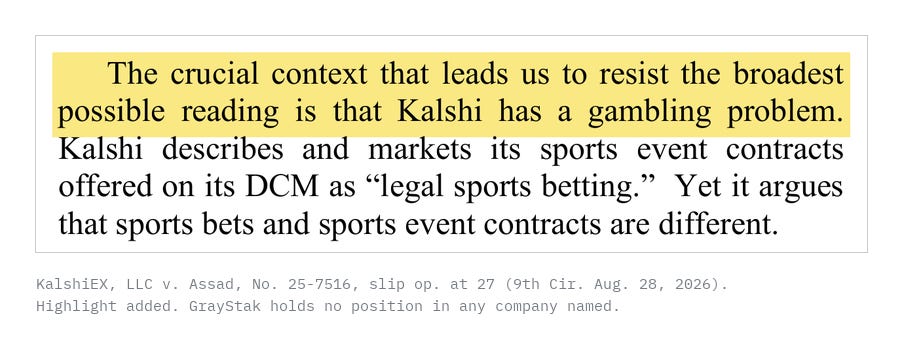
Page 27 of the slip opinion. The panel’s holding sits directly above the company’s own marketing language. Capture and highlight: GrayStak.
The opinion goes further than rejecting preemption: it concludes Kalshi’s self-certification and listing of the contracts was itself unlawful under the CFTC’s own regulation, 17 C.F.R. § 40.11, a rule the agency has never invoked against them. The CFTC argued the appeal as amicus in support of Kalshi on the jurisdictional question and lost. Illinois Attorney General Kwame Raoul, the lead defendant in Kalshi’s Chicago case, had joined a 39-state amicus brief backing Nevada. The panel remanded Kalshi’s election contracts for separate analysis and left them undecided. Judge Kenneth Lee concurred and flagged the next fight: the statute may leave the CFTC discretion over gaming contracts, and the current prohibition holds only because § 40.11 remains on the books. The commission has proposed amending that regulation. Its rulemaking is now the single lever that could move the entire analysis.
“The Ninth Circuit agreed with the Third Circuit on a fundamental point: Federal law prevents states from regulating trading on a federally licensed exchange, like Kalshi,” company spokeswoman Dani Lever said in a statement. “We will be seeking further review.” Nevada Gaming Control Board chair Mike Dreitzer said the ruling “completely vindicates what we have been saying all along. This is sports betting and needs to be properly regulated by the state.” Raoul’s office, the lead defendant in Chicago, made no public statement on the ruling in the days that followed, through September 8, and did not respond to GrayStak’s written questions by the August 28 window.
Kalshi holds wins in New Jersey, Tennessee, Minnesota, and Arizona. The split is genuine, and recent rulings have gone to the states, first in the district courts and now on appeal. Kalshi has appealed adverse New York and Connecticut rulings to the Second Circuit. On August 26, Connecticut also sued Kalshi in state court; Kalshi removed the case to federal court the same day. The decision creates the direct circuit conflict the Supreme Court looks for: two appeals courts reading the same definition to opposite conclusions, each in a published opinion. The Sixth Circuit heard Ohio and Tennessee on July 30, with the commission an active participant and 39 states plus the District of Columbia, led by Nevada and Utah, on an amicus brief supporting Ohio; the panel’s questioning pressed Kalshi’s counsel. The Fourth Circuit has the Maryland appeal.
New Jersey asked the Supreme Court for time before it had a split to cite. The request reached the Court on June 30, docketed as Flaherty v. KalshiEX, LLC, Application No. 25A1465. Justice Samuel Alito first gave the state less than it asked for: New Jersey sought a September 3 deadline to file its petition and got August 4. The state’s solicitor general had sought the extension on the ground that imminent rulings from the Fourth and Ninth Circuits and the Massachusetts Supreme Judicial Court could establish the split that strengthens the case for review. On July 22, the state asked again, and on July 24, Alito granted the full request and set the petition deadline at September 3. The Ninth Circuit delivered the split New Jersey had predicted six days before that deadline. The state filed on September 2, a day early. The question presented asks whether the 2010 Dodd-Frank Act preempted states from regulating sports bets placed within their borders when the bets are offered on CFTC-registered markets. The petition argues that “States have always maintained the primary police powers for health and safety matters, including for gambling,” and that nothing in the Commodity Exchange Act gives companies “a get-out-of-50-state-laws-free pass” through self-certification. New Jersey Attorney General Jennifer Davenport said in an emailed statement: “Companies like Kalshi claim to offer legal sports betting in all 50 States, but they refuse to follow the gambling laws of any State.” Kalshi spokeswoman Dani Lever answered the same day: “Kalshi is an open, nationwide financial exchange. It cannot be regulated by 50 different regulators.”
An Executive Committee order routed every case to one calendar
Illinois is the only state where all three versions of the fight sit in the same district, and since late July they have sat with the same judge. Kalshi’s case was randomly drawn, then landed with Judge John F. Kness, who noticed within three days that two apparently related actions were already pending before Judge Martha M. Pacold. He directed the parties to confer. They agreed the cases were related, and on July 24 the court’s Executive Committee reassigned Kalshi’s suit to Pacold, a 2019 Trump appointee. The consolidation was partly the state’s own work: Illinois had moved in June to send the federal government’s case to Pacold, who already held Coinbase’s. She now holds all three.
The same June order that raised reassignment also asked whether enforcement could be paused without a court fight. It could. In a June 29 joint filing, the state agreed to keep refraining from enforcement against Kalshi under the Sports Wagering Act and Illinois criminal gambling laws while the injunction motion is pending, and Kalshi withdrew its request for a temporary restraining order. The truce lasts exactly as long as the motion does. Whenever Pacold rules, it ends. Four preliminary injunction motions now sit with her. Coinbase’s was argued on February 24 and has been under advisement since. The government’s was fully briefed on July 22, Kalshi’s on July 24. The fourth comes from inside the federal case: the Coalition for Fair Markets, an industry group the court admitted as an intervenor plaintiff, briefed its own motion by the same date. In a July order setting a status conference across the cases, Pacold wrote that the motions present “substantial overlap in merits issues” and directed the parties to address the most efficient way to resolve them. Kalshi’s filings list Neal Katyal, the former acting solicitor general, among its counsel.
The CFTC and the Department of Justice sued Illinois on April 2, naming Gov. JB Pritzker, Attorney General Kwame Raoul, and the Illinois Gaming Board. Federal officials described it as the first direct preemption lawsuit the commission has ever brought against a state over event contracts. The commission has since filed a similar suit against Minnesota over a law making prediction-market operation a felony. After Illinois enacted its tax, the agency amended the suit to attack the new law and moved for a preliminary injunction.
Coinbase Financial Markets sued in December, days after announcing its prediction markets partnership with Kalshi. Its complaint, No. 1:25-cv-15406, names Raoul, Gaming Board Chair Dionne Hayden, three board members, and Administrator Marcus Fruchter. Since January 2025, the Gaming Board has issued 13 cease-and-desist letters to prediction market and crypto operators, asserting that unlicensed sports wagering violates the Sports Wagering Act and the state criminal code.
KalshiEX LLC filed the third case, No. 1:26-cv-07363, on June 23, six days after the tax became law. Its complaint does not undersell the stakes.
“Illinois apparently deems itself unencumbered by the Supremacy Clause and federal law such that it is free to impose its own regulatory regime on a 50-state federal derivatives exchange.”
KalshiEX LLC v. Raoul, complaint, June 23, 2026
The Gaming Board declined to comment on the litigation or on enforcement matters, saying through its communications director that it remains committed to addressing illegal, unlicensed gambling operators. “We continue to assess all available options,” Beth Kaufman said. The Board did not address a written question about whether any operator has applied for the license the statute created.
The statute taxes every wager and makes unlicensed operation a crime
The law arrived inside the state’s fiscal 2027 budget package. Senate Bill 3019, Article 130, amended the Sports Wagering Act to define an “exchange wager” as a transaction tied to a sporting contest that is “offered, traded, or executed on a prediction market or exchange” (230 ILCS 45/25-10), pulling federally listed event contracts inside the state’s licensing regime (230 ILCS 45/25-20). The criminal exposure comes from the state’s existing gambling statute. The Criminal Code exempts only sports wagering “conducted in accordance with the Sports Wagering Act” (720 ILCS 5/28-1(b)(15)); an operator outside that exemption commits gambling, a Class A misdemeanor that rises to a Class 4 felony on a second conviction (720 ILCS 5/28-1(c)). Public Act 104-468 amended the criminal statute and the wagering act together; the source line on Section 28-1 now reads “P.A. 104-468, eff. 6-16-26.” The tax, effective with the act, runs 1.75% on the first 5 million wagers per fiscal year and 3.5% after (230 ILCS 45/25-90(d-20)). The neighboring sportsbook taxes each carry their own July 1 start dates; the exchange-wager subsection carries none. The per-transaction structure followed the state’s own template: Illinois already charges its licensed sportsbooks 25 to 50 cents per online wager on top of graduated revenue taxes.
Kentucky enacted its own excise tax on prediction markets in April. Slane paired the two states from the stage. North Carolina taxed prediction markets at 6% of net revenue, a structure the industry treats as reasonable. New Jersey moved to tax the industry even as it petitions to regulate it as gambling. A bill taxing prediction market operators at 9% of gross income cleared committees in June after amendments stripped out a licensing regime, then stalled. The Assembly speaker has said it will return in the fall.
The tax floor equals Kalshi’s fee ceiling
The tax base is the entire disagreement.
Kalshi’s published fee schedule charges takers by a formula that peaks at 1.75 cents per contract for contracts priced at 50 cents. On its sports markets, resting maker orders pay a quarter of that rate; on most other markets they trade without fees. Per hundred dollars traded, the fee tops out at $1.75. The state’s tax starts at 1.75% of every wager and rises to 3.5%. The floor of the tax equals the ceiling of the fee, the upper tier doubles it, and the tax applies to every transaction regardless of price or order type. On that structure, the state’s take exceeds Kalshi’s gross revenue on the taxed activity. That is what “took the taxation model too far” means.
In March, Illinois sportsbooks took $1.39 billion in wagers, and the state collected a record $57 million in tax, about $4.10 per hundred dollars of handle under its graduated revenue rates and per-wager fees. An exchange-wager tax of $1.75 to $3.50 per hundred dollars sits at or below what the sportsbook rail already pays per dollar of customer activity. Illinois wrote parity by customer activity and applied it to a business model that cannot pay it.
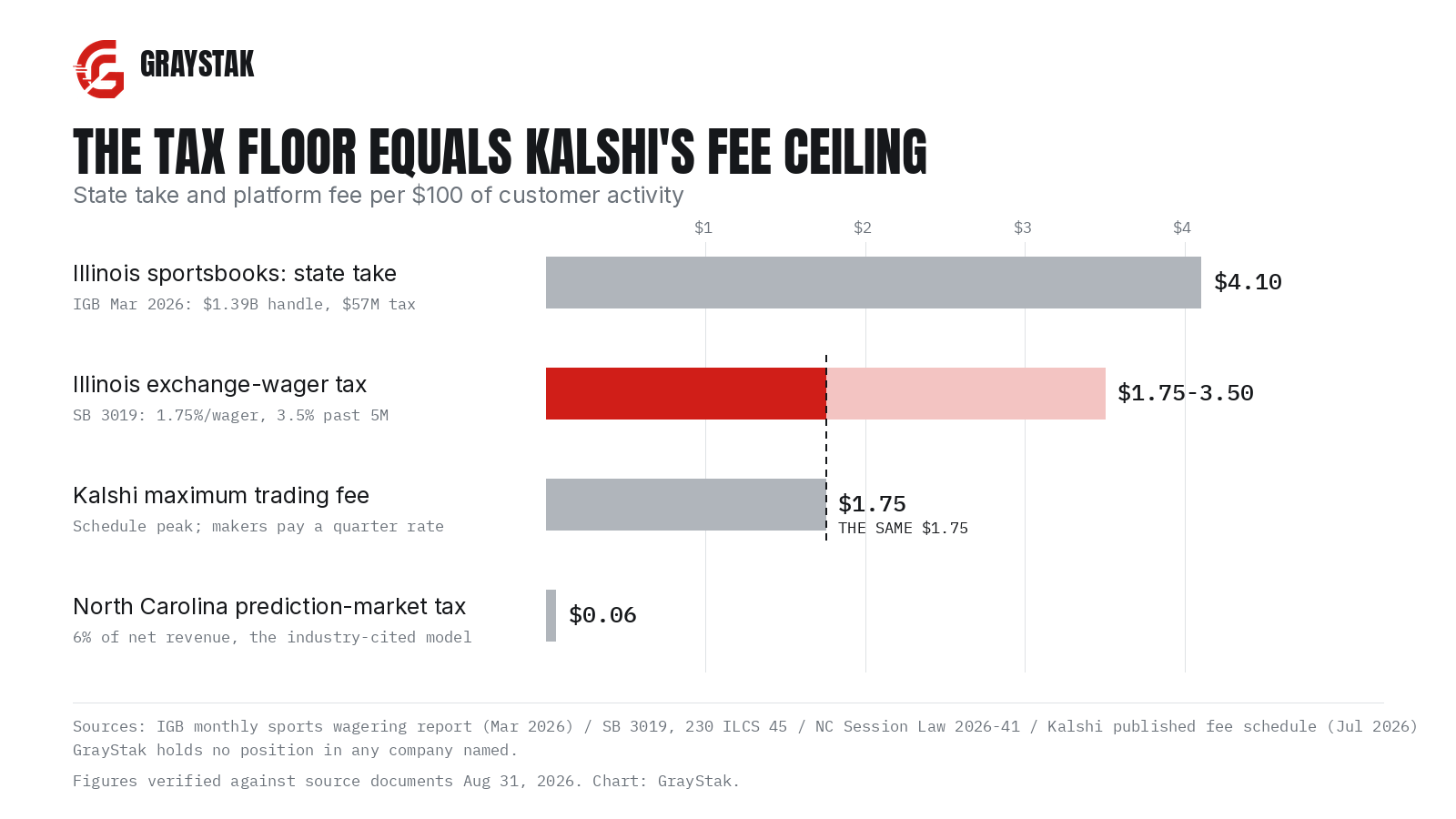
The hundred-dollar comparison. The exchange tax floor equals Kalshi’s fee ceiling and sits below the sportsbook rail’s per-dollar take. Chart: GrayStak.
Each figure is accurate on its own base. At North Carolina’s 6% of net, the state collects six cents per hundred dollars of activity. The same hundred dollars yields about $2.56 on a typical sportsbook rail, applying North Carolina’s 23% revenue tax to the 11.1% national hold the American Gaming Association’s Commercial Gaming Revenue Tracker reported for May, a lower basis than Illinois’ $4.10 actual, which includes the state’s per-wager fees.
Kalshi disputes the comparison: the company has said publicly it expects to pay a comparable amount under North Carolina’s structure because of how the tax is built. That forty-to-one gap is the arbitrage Mulvaney described from the stage: two tax structures on the same wagering dollar, and the money moves to the cheaper one. Illinois can price it. The state’s sports wagering tax collections rose from about $393 million in fiscal 2025 to nearly $612 million in fiscal 2026, flowing to the general revenue fund that pays for pensions, medical care, and human services. If flow migrates from the taxed rail to the untaxed one, that money goes with it. “You kiss the revenues goodbye,” Mulvaney said, “that you thought you were going to get by doing sports games.”
Prediction markets put tribal compact payments at risk
The tribes have entered the cases directly. A coalition of tribal nations and gaming associations, from the Seminole Tribe of Florida to the National Congress of American Indians, filed an amicus brief in the Coinbase case in February and a second in the federal government’s case on July 31. Hoenig appeared as counsel on the Chicago docket in January.
The industry has priced its grievance. The American Gaming Association, the commercial casino trade group, estimates that prediction markets have diverted more than $500 million in potential sports betting tax revenue to date, and says Kalshi alone handled nearly $15 billion in sports volume in May.
Tribal compacts commonly exchange revenue-share payments for exclusivity, Hoenig told the room, and the Department of the Interior must approve that exchange as lawful consideration. If prediction markets void exclusivity in practice, the payments states collect under those compacts become harder to justify.
Former Sen. Chris Dodd, Hoenig told the room, submitted comments to the CFTC’s rulemaking stating that the authors of Dodd-Frank never intended to strip states of jurisdiction over gambling.
Kalshi told the Ninth Circuit which tax it accepts
Asked what tax structure the company would accept from Illinois and whether its stated openness to taxation appears in any filing, Kalshi provided a statement attributed to spokesperson Elisabeth Diana: “We comply with all corporate tax laws and believe in responsible state taxation, even as a federally regulated derivatives exchange.”
The company’s litigation posture in Illinois seeks to enjoin the tax in full. Its complaint calls a preliminary injunction “necessary to restore the federal-state balance that the Constitution mandates.” The Illinois dockets contain no filing proposing a structure the company would accept.
The Ninth Circuit’s docket now does. On August 11, Kalshi sent the court a letter citing North Carolina’s new law, the 6%-of-net-revenue tax, in support of its preemption arguments. Nevada’s solicitor general’s office answered on August 20 that the reliance cuts against the company. The response, signed by Senior Deputy Attorney General Abigail Pace, calls Kalshi’s embrace of the North Carolina tax “a stunning about-face,” describes the company’s distinction between taxing and regulating as “purely a formalism,” and argues the concession means Kalshi cannot, “at a minimum,” escape Nevada’s own taxing provisions. Kalshi replied on August 24 that the distinction “is a bedrock legal principle,” citing the Supreme Court’s tariff ruling in Learning Resources v. Trump for the proposition that regulation is not usually understood to include taxation. Its reply draws the line in one sentence: “North Carolina taxes revenue, not on-DCM trading.” The exchange marks the boundary the company is defending in court. A tax on its fee revenue is consistent with federal preemption. A tax on the act of trading is not. Illinois wrote its levy on the trading side of that line. Four days after Kalshi’s reply, the same panel ruled against the company on the underlying question. If sports event contracts are not swaps, the preemption argument against the Illinois tax loses its foundation before the tax-versus-regulation line is ever reached. The Ninth Circuit does not bind the Seventh, and the Third Circuit’s contrary holding remains live authority for Kalshi in Chicago. The judge who chooses between them sits one floor below the court that will review her.
The next rulings come from one building on Dearborn Street
Nevada’s penalty motion is pending, with the state asking for a minimum of $720,000 plus $120,000 for each additional day out of compliance, and the same panel denied Kalshi’s motion to stay the state proceedings the morning it ruled. The circuit split gives New Jersey’s Supreme Court petition the posture every certiorari petitioner wants. The Fourth Circuit has the Maryland appeal; the Sixth heard Ohio and Tennessee in July and will now decide with a live split. Preliminary injunction briefing is complete in Chicago on all four motions. On the afternoon of the Ninth Circuit’s ruling, motions for leave to file landed in all three Chicago cases within a three-minute span. The filings came from the state’s side: in the Coinbase case, Raoul, the Gaming Board’s members, and its administrator moved to put the opinion before the court as supplemental authority. Pacold ruled on the motions September 1, again in all three cases at once. Until the Supreme Court takes the question, Kalshi, the states, and the commission all expect it to take, the most complete version of the fight anywhere in the country sits in the Northern District of Illinois, where a single judge holds the exchange, the regulator, and the crypto industry against one statute. All three cases will be argued in the Dirksen Federal Building on Dearborn Street. The Seventh Circuit, where the Commission’s Wisconsin appeal already sits, occupies the upper floors of the same courthouse.
Dawson told the panel what the fight looks like from a statehouse: a single meeting on a filed bill, then a federal lawsuit seven days later.
The statute is one sentence long where it matters. It calls the transaction a wager. A federal agency and a $40 billion company are in court to strike that sentence, and the judge who decides sits on Dearborn Street.
Christopher Sweat attended and recorded the NCSL session on July 27, 2026, and spoke with Slane following the panel. Kalshi’s communications team responded to written questions on July 30 and was offered a further response window. On August 21, the specific claims made about the company by Sen. Dawson were put to Kalshi in writing with a response window through August 28 at 5 p.m. Central. The company did not respond within the window. The Nevada sequence is reported from the Gaming Control Board’s July 24 release, the agreement the parties filed in Carson City’s First Judicial District Court, and each party’s filings and public statements as quoted in the record, with each party’s account drawn from its own filings. Material provided on background was not used; all figures derive from public statutes, regulator reports, and the company’s published fee schedule. Comment requests were submitted to the Illinois Gaming Board and the Office of the Attorney General on August 21, with responses invited by August 28. The Gaming Board responded on August 27; its statement appears above. The Attorney General’s office did not respond by the window’s close. The Ninth Circuit’s decision in KalshiEX v. Assad is reported from the slip opinion published by the court on August 28 (No. 25-7516). Post-ruling statements are as reported by CNN, CoinDesk, and The Hill (Kalshi, the Nevada Gaming Control Board) and The Block (the CFTC). The Supreme Court extension sequence in Flaherty v. KalshiEX is reported from the Court’s public docket, No. 25A1465, as of August 29. GrayStak holds no position in any company named.