

Chicago, September 21, 2026. Prices are the close of Friday, September 18, unless stated.
The series so far
Part one, September 16: Five Percent: The Near-Term Price of the Long Arc. With the ten-year Treasury yield at 5 percent, it tested the administration’s long-run economic claims against what they cost now. Four had a near-term price. A fifth, that foreign money keeps financing the U.S. deficit whatever the war does, was left open, and the piece named the test: whether foreigners keep buying Treasuries.
Part two, September 17: The Fed Moved. The Curve Answered.. The Federal Reserve raised rates 12 to 0 and signaled more to come. The dollar rose, the first reading on the open claim.
Part three, today. The largest foreign owner of Treasuries is Japan, and Japan imports nearly all of its oil, most of it through the Strait of Hormuz, which has been closed since March 2. The war reached Japan through its oil bill, and Japan’s response has run directly into the market for U.S. government debt. This piece follows that money.
The question
On July 31, during a cabinet meeting at Camp David, a Reuters photographer got a clear shot of the Treasury secretary’s notepad. Under the underlined words “To Do” it read: “Buy Japanese Yen (JPY) $5-10 bil.”
The day before, Japan had begun the largest yen-buying operation in its history, and that day the United States joined it, the first time the two countries had intervened together since 2011. Over four weeks Japan spent ¥15.4 trillion, about $99 billion. In August its foreign reserves fell a record $79.6 billion, and the securities inside them, held mostly in U.S. Treasuries, fell $87.8 billion.
Someone had to sell the bonds. Japan holds more U.S. government debt than any other country, and its holdings fell $135 billion between February and July.
It was not a decision to leave the dollar. Japan was buying back a currency the war had driven to a 40-year low. On Friday it tried its other tool and raised interest rates to the highest level since 1995. The yen fell anyway, and by midnight Tokyo time the Bank of Japan was calling dealers to ask where it was trading.
This piece asks how much of Japan’s war bill was paid in American debt, and where the rest of the answer will show up.
Someone had to sell the bonds.
In brief
What happened. Japan has spent about $170 billion this year defending the yen, and its holdings of U.S. Treasuries fell $135 billion between February and July. On Friday the Bank of Japan raised its policy rate a quarter point to 1.25 percent, a 31-year high, on a 7-2 vote. The yen fell 0.7 percent to 157.09 on a move meant to lift it.
Why it matters. Five Percent left one claim open: that foreign money keeps financing the U.S. deficit whatever the war does. Wednesday’s Fed hike lifted the dollar. Since February, the largest foreign holder of Treasuries has been selling, and four separate government ledgers show it.
Effects. Japan’s crude oil bill rose 58.7 percent in a year while the volume it bought rose 3.6 percent. The trade balance has been in deficit four months running. Consumer inflation is still below target only because the government pays part of the fuel bill, which moves the war’s cost out of the price index and into the budget of a government whose debt is more than twice the size of its economy.
What comes next. October 16, when Treasury’s data reach August and the largest month of selling appears. November 4, when the Treasury announces the size of its new ten-year and thirty-year bonds, which it auctions the following week, with the foreign share of the bidding published at each auction. December 19, when the Bank of Japan meets again.
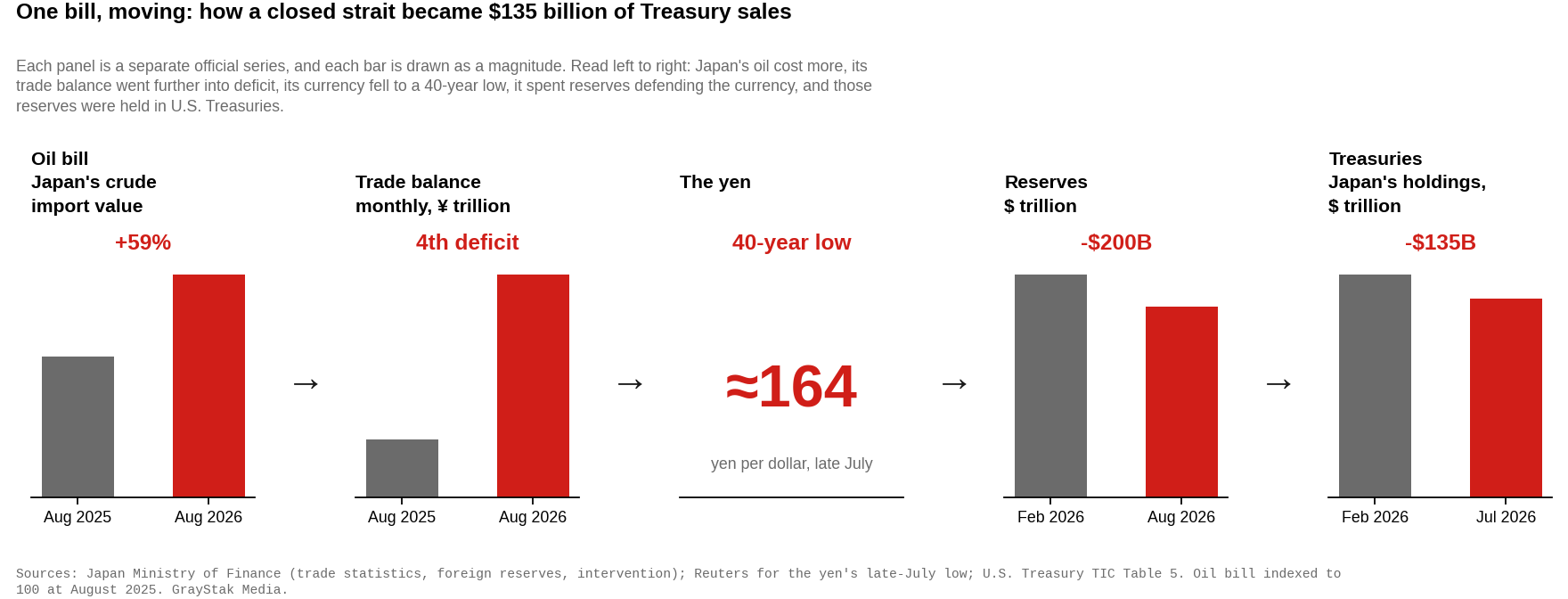
Figure 1. Each panel is a separate official series. Sources: Japan Ministry of Finance; U.S. Treasury.
Findings
Each finding rests on a document or a published series.
First. the Bank of Japan raised the uncollateralized overnight call rate to around 1.25 percent by a 7-2 vote, effective September 24, and raised the complementary deposit facility rate to 1.25 percent and the basic loan rate to 1.5 percent. Basis: Bank of Japan, Change in the Guideline for Money Market Operations, September 18.
Second. the Bank names the war first among its risks. Its reference document to the meeting lists them in this order:
The situation in the Middle East, Expansion in AI-related demand, Developments in foreign exchange rates.
The same document says Japan’s economy “has recovered moderately, despite the impact of the situation in the Middle East,” and that “there is a risk that underlying CPI inflation will deviate upward to a level above the price stability target of 2 percent.” Basis: Bank of Japan, reference document to the September 2026 meeting.
Third. the inflation number the Bank had in hand when it voted showed inflation falling. Japan’s core consumer price index rose 1.7 percent in August from a year earlier, down from 1.8 percent in July, under the 1.8 percent forecast, the first slowing in four months and the eighth straight month below the Bank’s 2 percent target. The index excluding fresh food and fuel rose 1.9 percent. Basis: Ministry of Internal Affairs and Communications, released the morning of the decision.
Fourth. Japan paid 58.7 percent more for crude oil in August than a year earlier and received 3.6 percent more of it. Total imports rose 28.0 percent, the fastest since November 2022, and the trade deficit reached ¥1.11 trillion, the fourth consecutive monthly deficit and nearly four times the deficit of a year earlier. Crude arriving from the Middle East fell 30.9 percent by volume, the fifth straight monthly decline, while crude from the United States rose about sevenfold. Basis: Japan Ministry of Finance, preliminary trade statistics, August, released September 16.
Fifth. Japan sold dollars to buy yen on April 30, May 4 and May 6, ¥11.7 trillion in total, and again between July 30 and August 26, ¥15.4 trillion, the largest single reporting period since records began in 1991. The year’s total is about ¥27 trillion, roughly $170 billion. Basis: Japan Ministry of Finance, foreign exchange intervention operations.
Sixth. Japan’s foreign reserves fell to $1.208 trillion at the end of August, down $79.6 billion in the month, the largest monthly decline on record. Foreign securities, about 70 percent of reserves and held mostly in U.S. Treasuries, fell $87.8 billion. The intervention over the same window cost $98.7 billion. Basis: Japan Ministry of Finance monthly reserves, as reported by Reuters.
Seventh. Japan’s holdings of U.S. Treasuries fell from $1,239.3 billion at the end of February to $1,103.9 billion at the end of July, a decline of $135.4 billion. Foreign official holdings fell $237 billion over the same period. Holdings are reported at market value and yields rose, so part of the decline is price. Basis: U.S. Treasury, TIC Table 5, July data released September 16.
Eighth. the Federal Reserve publishes weekly what foreign governments keep in its vaults. That line fell from $2,800.6 billion on February 11 to $2,590.1 billion on September 9, then rose $18.7 billion in the week of the Fed’s decision to $2,608.8 billion on September 16. It is down $191.8 billion from the peak. In the first three weeks of Japan’s record intervention it fell $70.5 billion, the sharpest three-week drop of the year. This series is reported at face value and runs a week behind. Basis: Federal Reserve H.4.1, custody holdings.
Ninth. while the administration asked the Federal Reserve to cut, its Treasury secretary spent the weeks before the Bank of Japan’s meeting saying publicly that he expected Tokyo to act. On July 31 the United States joined Japan’s yen-buying operation, the first U.S. intervention in the yen since 2011. On August 30 Scott Bessent told Reuters he expected Governor Ueda “to do the right thing” on monetary policy. The next day he told CNBC: “I have information that the market doesn’t have, and it’s my belief that the Japanese government and the BOJ will do the things that will lead to a stronger yen.” At the G20 in Asheville he met Ueda and Finance Minister Satsuki Katayama and called for further rate increases, according to Treasury undersecretary Erin Browne in an interview with NHK; Reuters could not independently confirm the meetings. Basis: Reuters, July 31, August 30 and August 31; CNBC, August 31 and September 1; NHK as reported by Reuters.
Assessment
The war moved from Japan’s oil bill to its currency to its reserves to the market for U.S. government debt. Every step is in a published government document. Confidence: documented.
Japan has not left the dollar. It has been spending dollars, and the market for Treasuries cannot tell the difference. Confidence: inferred.
Japan has now used every tool it has. It sold about $170 billion of dollars and raised rates twice. On Friday night it checked rates with dealers, the step that precedes intervention. The yen fell about 2 percent over the week. Confidence: documented.
Japanese consumers are not paying the war’s full price because the Japanese government is. That is the same bill moved from the price index to the budget, in a country whose government debt is more than twice the size of its economy. Confidence: documented on the subsidies; inferred on what they postpone.
Japan has not left the dollar. It has been spending dollars, and the market for Treasuries cannot tell the difference.
What the last two pieces got right, and what they missed
Held. The Fed Moved set three conditions that would have weakened its reading by Friday’s close, and none was met. On Thursday the two-year gave back its seven-basis-point rise as the whole curve rallied, but it finished the week nine basis points higher while the thirty-year fell two, and the gap between them narrowed from 69 basis points to 58. Brent settled at $103.83, above the $100 line. Futures priced an October hike at 50.9 percent, above the 40 percent line, and at least one more hike by year-end at 88.5 percent.
Missed. Japan’s August trade figures, published the morning of the Fed decision, showed the oil bill up 59 percent, and neither piece used them. The Fed Moved read the dollar’s strength on Wednesday as the whole dollar story while the Fed’s count of foreign official holdings had been falling since February.
Corrected. Five Percent said foreign ownership of U.S. securities stood at a decade high. That was true of 2025. Foreign holdings of Treasuries peaked in February 2026 and were down $239 billion by July. The correction is noted on the first piece.
Why Japan is selling
Japan produces almost no oil. Before the war it took roughly nine barrels in ten from the Gulf, most of them through the Strait of Hormuz, which has been closed since March 2. It now buys from Nigeria, Angola, South Sudan, Azerbaijan, Canada and the United States, further away and more expensive. In August crude arriving from the Middle East was down 30.9 percent by volume from a year earlier, and crude from the United States was up about sevenfold.
The bill followed. In August Japan paid 58.7 percent more for crude than a year earlier and received 3.6 percent more of it. Imports rose 28 percent, the fastest since November 2022. Exports rose 19.3 percent on demand for semiconductors and could not keep up, and the trade deficit reached ¥1.11 trillion, the fourth monthly deficit in a row. Daiwa’s Koki Akimoto notes that crude reaches Japanese ports about two months after it is priced, so the autumn bills will carry the summer’s prices.
A country paying more dollars for oil while earning the same yen from exports ends up with a weaker currency. By late July the yen was near 164 per dollar, a 40-year low. Japan answered with dollar sales, ¥11.7 trillion at the turn of April and May and ¥15.4 trillion from July 30, about $170 billion this year, and with rate increases in June and on Friday.
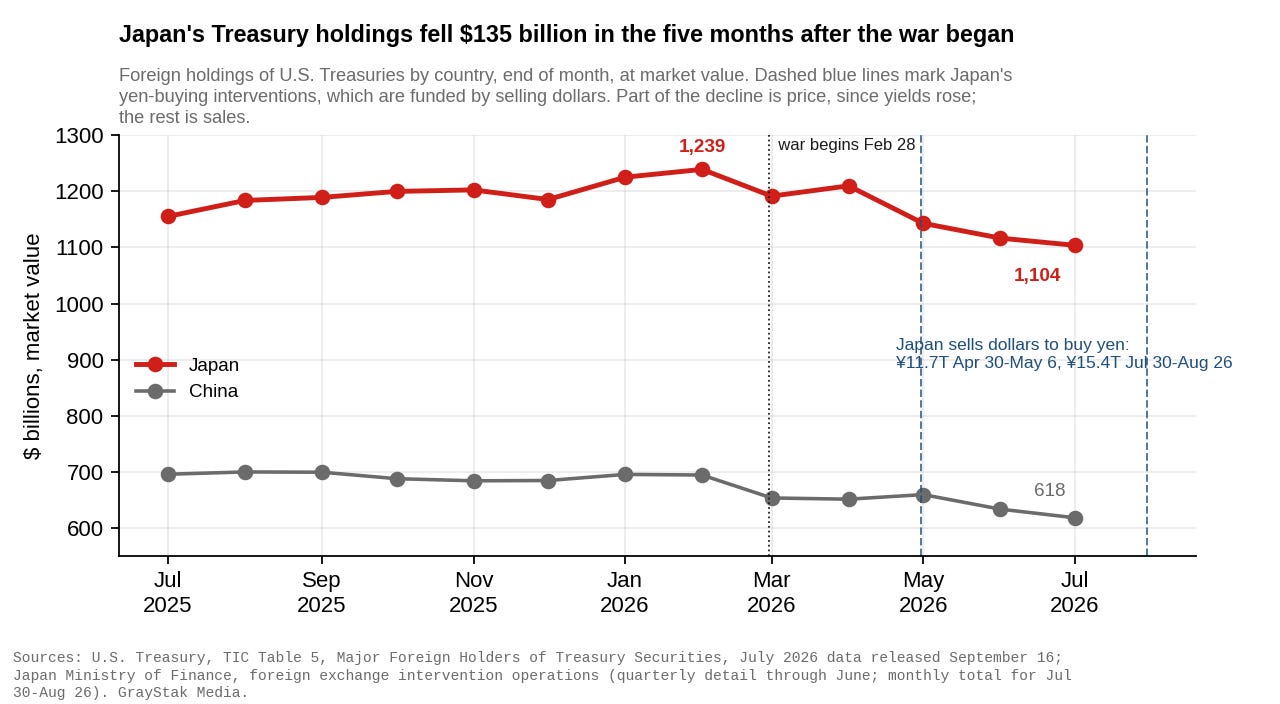
Figure 2. Foreign holdings of U.S. Treasuries by Japan and China, at market value, with Japan’s 2026 interventions marked. Sources: U.S. Treasury TIC; Japan Ministry of Finance.
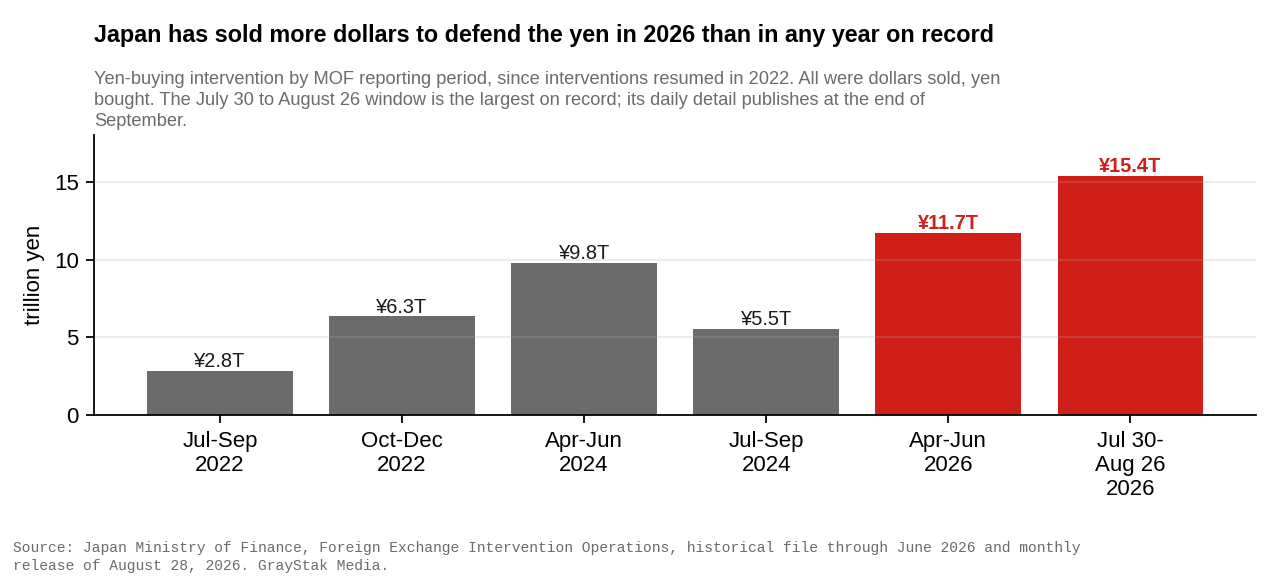
Figure 3. Yen-buying intervention by reporting period since 2022, trillion yen. Source: Japan Ministry of Finance.
The four ledgers
Four institutions keep the books on this, and all four point the same way.
Japan’s Ministry of Finance reports the ¥27 trillion it spent. The same ministry reports reserves down from $1.41 trillion in February to $1.208 trillion in August, about a seventh of the total. The U.S. Treasury’s monthly TIC series shows Japan’s Treasury holdings down $135 billion from February to July. The Federal Reserve’s weekly count of Treasuries held for foreign governments is down $192 billion from its February peak, after a small rise in the most recent week.
Treasury marks holdings to market, and between the end of February and the end of July yields rose between 0.6 and 0.9 of a point depending on maturity, enough to cut the value of an ordinary bond portfolio by roughly 4 to 5 percent. Japan’s holdings fell 10.9 percent. The Fed’s count is at face value, and it moved with the intervention, falling $70.5 billion in the operation’s first three weeks. Treasury’s data stop at July. The August report, due October 16, will carry the largest month.
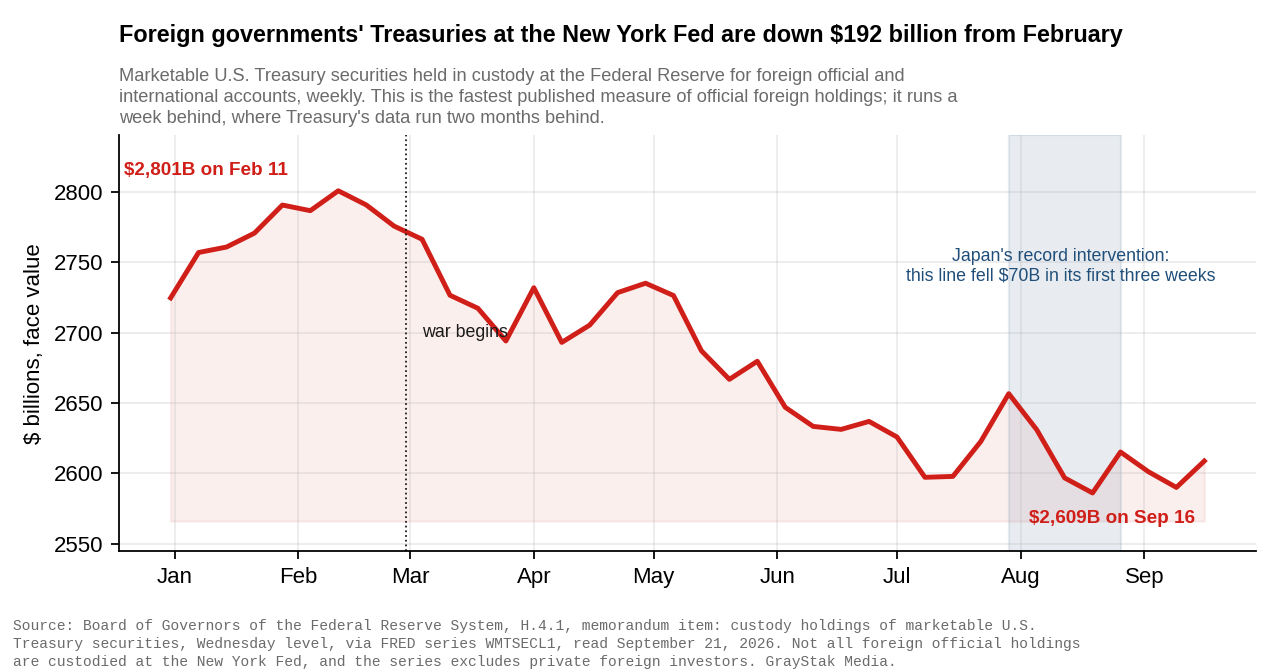
Figure 4. Marketable U.S. Treasury securities held in custody at the Federal Reserve for foreign official and international accounts, weekly. Source: Federal Reserve H.4.1.
What the Bank of Japan said
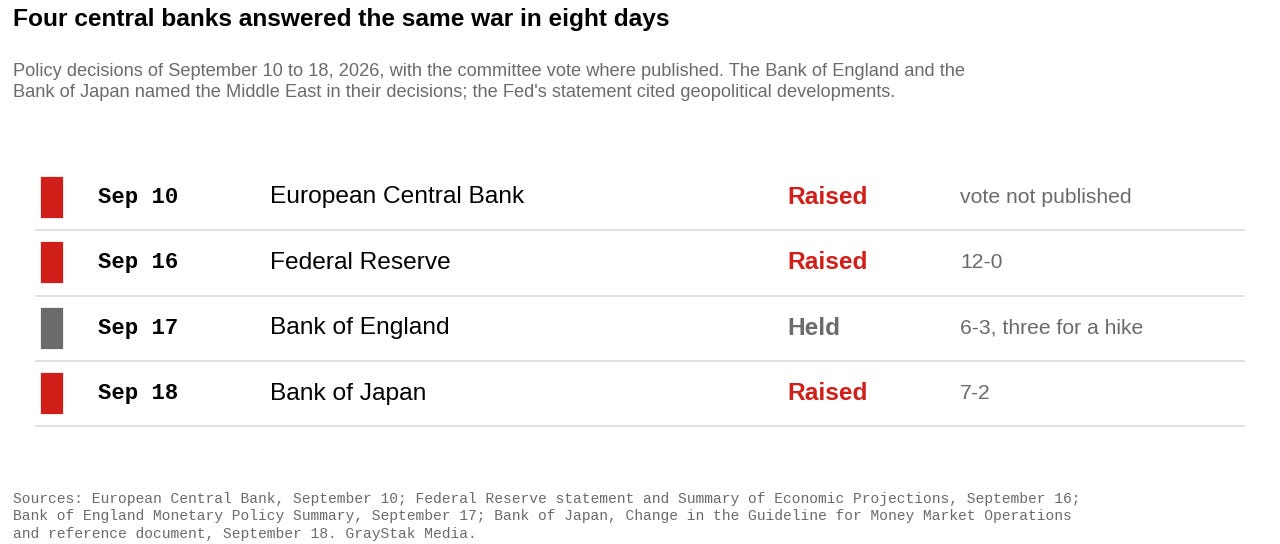
Figure 5. Policy decisions of September 10 to 18. Sources: ECB, Federal Reserve, Bank of England, Bank of Japan.
Four central banks answered the same shock in eight days. The European Central Bank raised rates on September 10 and the Fed on the 16th. The Bank of England held on the 17th with three of nine members voting to raise. The Bank of Japan raised on the 18th and listed the Middle East first among its risks.
Kevin Warsh had every vote on his committee. Kazuo Ueda had seven of nine. The two against, Toichiro Asada and Ayano Sato, were appointed this year by Prime Minister Sanae Takaichi, who has called for looser money. A central bank trying to support its currency needs the market to believe the next move is coming, and a split board makes that harder.
The Bank’s case was that the economy can take it. Second-quarter growth was revised up to 1.4 percent annualized, and real wages rose 2.4 percent in July. Against that, the inflation figure published that morning showed core prices up 1.7 percent, slower than July and below target for the eighth month. The Bank raised rates on its forecast rather than its data.
Ueda was asked whether a quarterly pace was now the plan:
As for the pace of future rate hikes, we don’t have any pre-set idea in mind such as once every three months. We will determine at each policy meeting how best to ensure underlying inflation stabilises at 2%.
And on what had changed:
Up till now, our short-term policy focus was to push up underlying inflation from levels below 2%. Now, underlying inflation is approaching 2%. If risks of underlying inflation overshooting 2% materialise, that could have a negative impact on Japan’s economy. It’s important to stabilise underlying inflation at 2%. Our policy phase has changed.
He would not say when the next move comes, and the yen fell 0.7 percent to 157.09. Japan’s two-year yield fell three basis points and its thirty-year rose three. Two days earlier Washington’s curve had flattened on a hike the market believed. Tokyo’s steepened on one it doubted.
That night, a little after 11:30 in Tokyo, the Bank of Japan called dealers to ask where the yen was trading, according to the Nikkei, the step that usually comes before an intervention. The yen gained more than a yen within the hour. Japanese markets are closed through Wednesday for a holiday, a window Deutsche Bank analysts flagged on September 3.
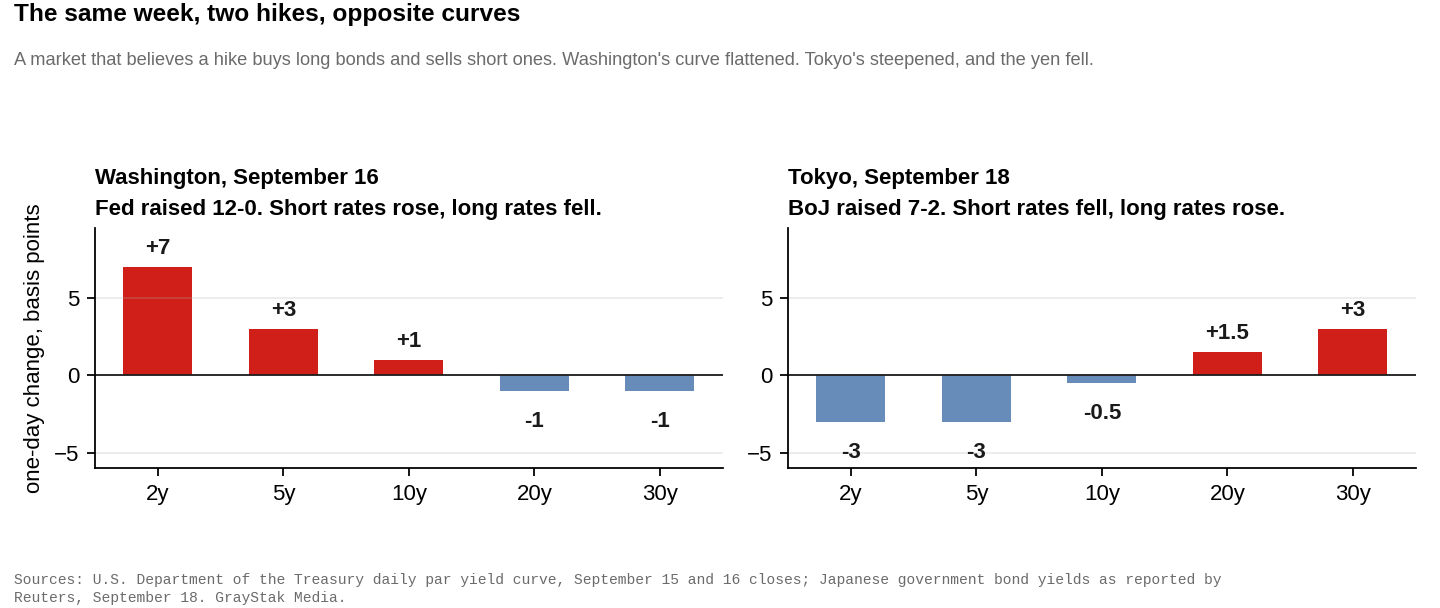
Figure 6. One-day change in government bond yields on each decision day. Sources: U.S. Treasury; Reuters.
Washington asked for this
This did not start in September. In August 2025, with the Bank of Japan’s rate at 0.5 percent, Scott Bessent told Bloomberg Television:
They’re behind the curve. So they’re going to be hiking and they need to get their inflation problem under control.
A year later he was helping buy yen. On August 30 he told Reuters he expected Ueda “to do the right thing,” while saying he was “not going to tell them what to do.” On August 31 he told CNBC he had information the market did not, and asked whether that meant higher rates, said: “I think the market’s pricing that in now.” Four days later he told CNBC that a central bank does not raise rates in a supply shock until the second and third order effects appear. That was about the Federal Reserve, twelve days before it hiked.
Five Percent called the administration’s public pressure on the Fed a speech act, a request made in public by people who cannot compel the outcome. Pointed at Tokyo, the same request was met. Japan raised rates twice and spent $170 billion, some of it alongside the United States. The yen still ended the week weaker than it began.
An ally’s oil bill and America’s deficit
Foreigners hold about $9.2 trillion of U.S. Treasuries. The largest holder is an ally that buys almost all of its oil from a region where the United States is now at war, and pays for that oil in dollars. Japan’s capacity to fund the American deficit turned out to depend on the price of a barrel of crude at Yokohama.
Japan’s capacity to fund the American deficit turned out to depend on the price of a barrel of crude at Yokohama.
The usual worry is that foreign governments will one day tire of the dollar and leave. This year ran the other way. The dollar is strong, and its strength against a currency weakened by a dollar oil bill is what forced the sales. That distinction carries a forecast. Money that left because of a war can come back when the war ends. Money that leaves because it has stopped trusting the borrower does not. China, which has been reducing its holdings for a decade and for different reasons, is down $76 billion since February and has not accelerated.
The Treasury’s borrowing costs now run partly through the Strait of Hormuz and the Bank of Japan’s board.
Is foreign money still financing Washington?
The evidence on the question Five Percent left open runs a week behind at the Federal Reserve, and it has pointed down since February. Foreign governments’ Treasury holdings fell in four of the five months through July. Treasury’s flow data for July are more mixed: official institutions bought $44.4 billion of long-term U.S. securities while private foreign investors sold $3.7 billion, which suggests the declines sit in short-term holdings and in price. The dollar itself rose 1.1 percent last week, its best week in three months.
The next readings are dated. The August TIC report on October 16 covers the intervention month. On November 4, a week after the Fed meets and the day after the election, the Treasury announces its quarterly refunding: new ten-year and thirty-year bonds, auctioned the following week. Each auction publishes the share taken by indirect bidders, the closest public proxy for foreign demand, which was 79.2 percent at the September 9 ten-year auction. The September report on November 18 will show whether the selling stopped when the intervention did.
Effects
The Treasury sells bonds into a market where the largest foreign holder’s position is down $135 billion since February. The refunding announced November 4 and auctioned the following week prices against that.
American borrowers pay through the long end. The thirty-year ended the week at 5.34 percent and the ten-year at 5.01, which is where mortgages are set.
Japanese households are paying less than the war costs, because the government pays part of the fuel bill. That support is due to wind down, and Japan’s government debt is more than twice the size of its economy.
Japanese insurers and pension funds can now earn about 4.1 percent on a thirty-year bond at home, against 5.34 percent in the United States before the cost of hedging the currency, which is roughly the gap between the two countries’ short rates. The Fed widened that gap on Wednesday and the Bank of Japan narrowed it on Friday.
Registry
Six entries carry over from the first two pieces, two of them took observations this week, and one is new.
FC-26-004, that the two-year rises more than the thirty-year between September 15 and December 9, is eleven basis points ahead after week one: the two-year up nine, the thirty-year down two.
FC-26-001, that Treasury qualifies or revises its August coupon guidance at the November 4 refunding, now has a sharper test in the indirect share at the refunding auctions that follow it.
FC-26-007, new today: Japan’s holdings of U.S. Treasuries in the August and September TIC reports do not fall below the July level of $1,103.9 billion. Confidence: contested. The August report covers the month of the intervention and publishes October 16; the entry resolves with the September report on November 18. The counter-case is the intervention itself, which was still running on August 26.
What would show this wrong
If the August TIC report shows Japan’s holdings roughly unchanged, the intervention was funded from deposits and maturing bills rather than sales, and the connection this piece draws between the two ledgers is weaker than it appears.
If the indirect share at the November refunding auctions comes in near the 79.2 percent of September 9, foreign demand is intact at the margin that matters and the six-month decline is a story about reserves rather than about the bid for American debt.
If the Federal Reserve’s custody series keeps rising over the next four weeks, as it did by $18.7 billion in the week to September 16, while the yen holds near 157 without another intervention, the selling was the intervention and it is over.
Method note
Interest rates are from the U.S. Treasury’s daily par yield curve. Foreign holdings are from Treasury’s TIC Table 5 and the July press release. Custody holdings are from the Federal Reserve’s H.4.1. Japanese intervention totals, foreign reserves and trade statistics are from Japan’s Ministry of Finance. Japanese consumer prices are from the Ministry of Internal Affairs and Communications. The Bank of Japan’s decision, vote and risk language are from its release and reference document of September 18; its governor’s remarks are quoted from Reuters’ translation and will be reconciled against the Bank’s English summary when it posts. Friday’s yields are Treasury’s official closes. Fed funds futures are from CME FedWatch as reported at Friday’s close. The rate check is as reported by the Nikkei and Bloomberg. The dollar index is as reported by market data services. Japan’s revised second-quarter growth and July real wages are from the Cabinet Office and the labor ministry as reported by Reuters. Japan’s foreign reserves are the Ministry of Finance’s monthly figures as reported by Reuters. Japan’s trade figures and crude volumes are from the Ministry of Finance’s preliminary August statistics as reported by Jiji Press and Reuters; the prewar share of Gulf crude is as reported by Reuters. One wire report characterized the Bank as forecasting slower growth from oil prices; that sentence does not appear in the Bank’s release, and this piece uses the Bank’s wording instead.
Archive entries
FC-26-007 · Japan’s Treasury holdings do not fall below $1,103.9 billion in the August or September TIC reports · Contested · Made September 21, 2026 · Resolves November 18, 2026.
FC-26-004 · Observation 2, week ending September 18: two-year +9 basis points, thirty-year -2, from the September 15 baseline.
Disclosure
Christopher Sweat covers Chicago and Illinois government from the public record, reporting local social and political dynamics for a national and international audience. He also reports on national security policy, intelligence oversight, public finance, and the defense technology sector. He is an analyst working across finance, technology, and politics, and CEO and Co-Founder of GrayStak.
GrayStak Media is an independent press operation covering institutional politics, elections, immigration enforcement, and investigative work where politics meets the economy, centered in Washington, D.C., New York, and Chicago.
GrayStak holds no position in anything discussed here. This piece is not investment advice.