

In February, Palantir told the world it was leaving. The announcement came as a single sentence posted to X: the company had moved its headquarters to Miami, Florida. No press conference, no farewell to the city that had taken it in back in 2020. Colorado’s governor said he learned about it from the post. Denver’s mayor said the same. A company valued in the hundreds of billions of dollars, one of the largest publicly traded firms the state had ever hosted, changed its home with less ceremony than most people give to changing a mailing address.
And in a sense, that is all that happened. Palantir changed a mailing address.
Because when you read past the post and into the company’s own annual filing, the picture is narrower than the headline. On paper, the principal executive office is now in the Miami area. The people are not. Palantir does not disclose how many employees it has in Colorado, but no relocation of any of them was announced, and only months earlier the company had been building out a new office in Cherry Creek. That gap between the address a company claims and the capability it actually maintains is the whole story, and it is a story that runs the length of an interstate.
The filing moved. The workforce stayed.
Drive it
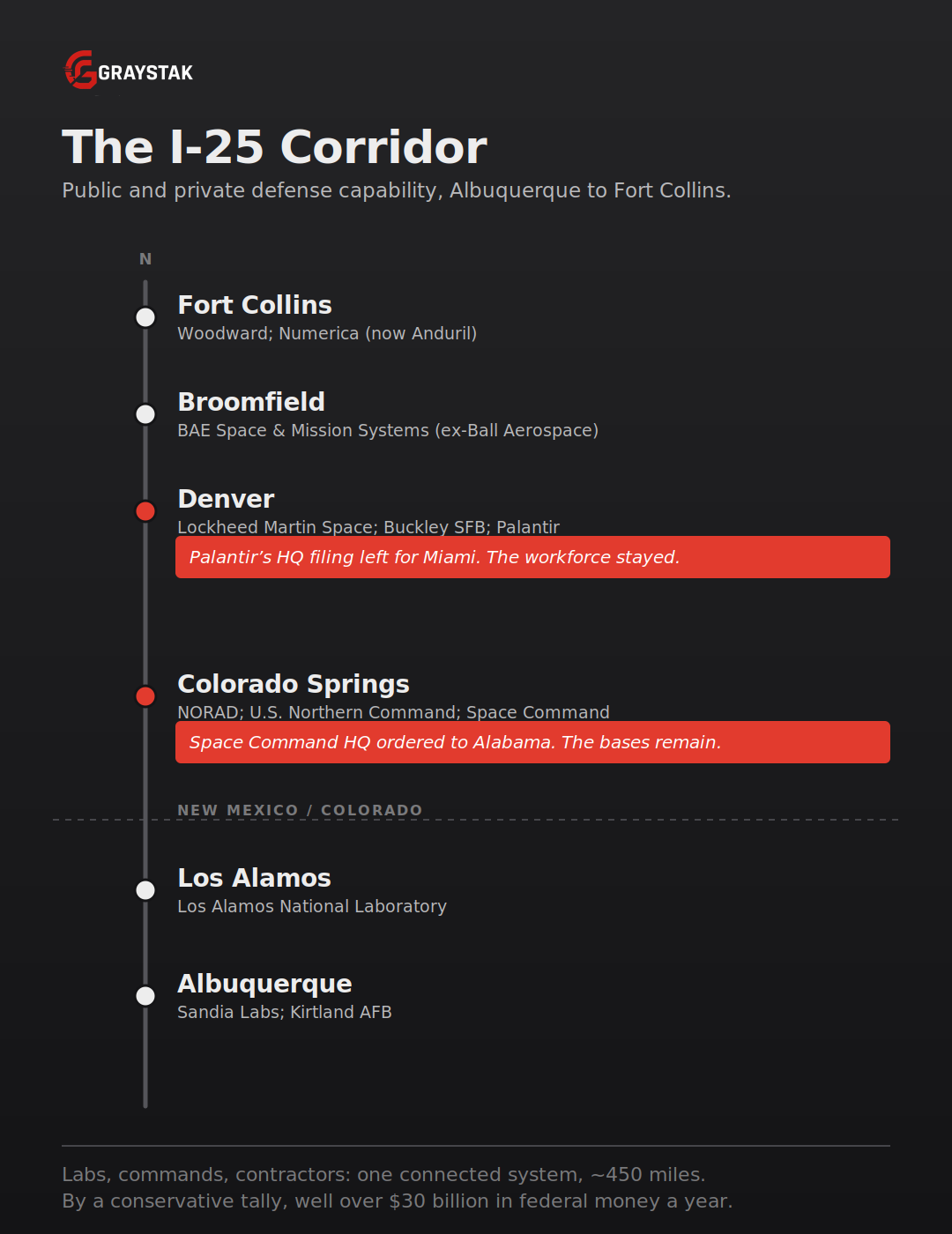
Get on Interstate 25 outside Santa Fe and point the car north. I lived on this corridor for twenty-four years, in Colorado Springs, in Denver, and in Boulder, and from the driver’s seat it does not read as anything unusual. It is just the road home. But you are not on an ordinary highway. You are driving the spine of the American national security state, and almost none of it is hidden. Every node on this corridor is documented in public filings, local newspapers, and federal contract databases. You just have to be willing to read them as a single map.
Start at the southern end, in Albuquerque, where Sandia National Laboratories sits on Kirtland Air Force Base alongside the Air Force’s nuclear weapons and research work. An hour or so north, just off the interstate above Santa Fe, is Los Alamos, where the laboratory designs the country’s nuclear weapons and maintains the stockpile under federal contract. Two of the country’s three nuclear weapons laboratories sit within an hour of the same road, before you have even left New Mexico.
Cross into Colorado, and the corridor changes uniformly from laboratory to command. Colorado Springs is the densest stretch of all of it. Peterson Space Force Base hosts the North American Aerospace Defense Command and U.S. Northern Command. Cheyenne Mountain, the hardened complex carved into the granite, sits a few miles away. Schriever runs satellites and the GPS constellation. Fort Carson trains the Army’s Fourth Infantry Division. The Air Force Academy turns out officers above the city. The regional business press has a name for this stretch, the corridor of Colorado spacepower, and the boosters who use it are describing exactly the same geography I am, just with a different purpose.
Keep going north into the Denver metro and the corridor shifts again, from public command to private contractor, though the line between the two is thinner than the categories suggest. Lockheed Martin’s space division runs a sprawling campus in Jefferson County, out in Waterton Canyon south of the city, a manufacturing and testing hub for GPS III satellites, missile-warning systems, and NASA’s Orion crew capsule. Buckley Space Force Base, out in Aurora, runs the missile-warning mission. And until February, downtown Denver and then Cherry Creek held Palantir.
Northwest of the city, in Broomfield, sits the company that was formerly Ball Aerospace. In 2024, the British defense giant BAE Systems bought it for more than five billion dollars and folded it into a new division called Space and Mission Systems. The interesting part, for our purposes, is what happened to the location. Nothing. The division’s president said plainly that the company was staying in Colorado because the billions already invested were in the facilities, capabilities, and people, all of which were here. A foreign multinational acquired one of the corridor’s crown jewels but could not meaningfully move it because its value was bolted to the ground.
Finish the drive in Fort Collins. Woodward, headquartered there, makes the fuel, actuation, and motion control systems that go inside commercial and military aircraft, and its biggest customers are the largest aerospace primes in the country: RTX, GE Aerospace, and Boeing. The company reported record net sales of $3.6 billion in its 2025 fiscal year. It is the sort of supplier most people have never heard of, and the defense aviation business cannot function without it. A few miles away sits what is left of Numerica, a firm that spent years building radar and sensor-fusion software for air and missile defense, and its recent history is the corridor’s logic compressed into a single company. In 2022, it sold its space tracking telescope network to Slingshot Aerospace. In early 2025, the California defense technology firm Anduril bought its radar and command-and-control business and folded the technology into its Lattice platform. The valuable assets were acquired by larger players, but the engineering work remained where it was built, in northern Colorado.
That is roughly four hundred and fifty miles of road, packed end to end with the public and private machinery of defense. And these are not separate dots that happen to share a highway. They feed one another. The laboratories design the weapons; the commands above Colorado Springs operate them and the satellites that guide them; the contractors build the hardware and write the software that ties the two together. They draw on the same pool of cleared engineers, who move among the labs, the primes, and the startups without ever leaving the corridor, carrying their clearances with them. The federal money that enters at one node circulates through the rest. This is less a row of installations than a single machine stretched across the length of a state and a half.
Put a number on it. The two New Mexico laboratories at the southern end run about five billion dollars each, better than ten billion a year between them. At the northern end, Colorado drew $22.8 billion in federal defense and aerospace contracts in 2024, a record, by the count of its own economic development office, on top of billions more flowing to its military bases and its federal labs. Set the laboratory budgets beside the contract awards and this single interstate, by a conservative tally, channels well over thirty billion federal dollars a year, before a cent of military payroll is counted. None of it is secret, and all of it is on the public record. There is no other stretch of American road like it.
Two stories about one move
There are two ways the Palantir departure has been told, and the distance between them is instructive.
The first is a victory story, and it belongs to the activists who spent more than a year organizing against the company’s presence in Denver. They objected to Palantir’s contracts with immigration enforcement and to its work for the Israeli military, and they made the company’s offices a regular site of protest. The Cherry Creek building was vandalized with the words “Palantir Out”. When the Miami announcement came, organizing groups including Denver Anti-War Action and the national Purge Palantir campaign read it as the direct result of their pressure, a repeat of 2020, when the company had left the Bay Area for Denver after a similar campaign. They have said they intend to follow the company to Florida.
The second is the documented story, and it is more complicated. Palantir’s own filing did not cite protests as the reason for the move. It instead pointed to Colorado’s 2024 artificial intelligence law and to climate-related risks to its operations in Colorado. A Colorado labor organizer who had been part of the protests told CBS Colorado that he did not think any single thing had driven the company away. And the hardest fact for the victory story to absorb is the one already on the record: the people did not leave, and the timing of the company’s own real estate moves runs counter to any picture of a hasty exit. In the autumn of 2025, only months before the Miami announcement, Palantir took roughly eleven thousand square feet at the Financial House in Cherry Creek and, public records show, spent around $227,000 building it out, upgrading from its longtime downtown offices in the Tabor Center. That space was meant to be the company’s new headquarters. Reporting at the time described the Miami announcement as scrapping those Cherry Creek plans, and sublease listings in the building surfaced by the following spring, so what the company holds there now is unclear. But a firm spending real money on a new Denver headquarters in September was not a firm with its bags packed for Florida, which tells you how fast the decision was reversed. And the destination is its own kind of tell. The global headquarters Palantir moved to is a coworking suite at an Industrious location on Biscayne Boulevard in Aventura, the principal executive office of a company worth hundreds of billions of dollars reduced to a flexible workspace address.
How many people that even involves is itself disputed, and the honest thing is to say so. Palantir reports only a global workforce in its filings, with no state-by-state breakdown, and estimates of its Colorado presence range widely. The Common Sense Institute, citing figures from the workforce-data firm Unify, put the Denver office at about 87 people. Governor Polis said the company’s executives told him it had closer to five hundred employees in the state. Palantir has long run a distributed workforce, so the true number physically in Colorado is genuinely unclear. But the direction of travel is not. No relocation of those employees to Florida was announced. The headquarters that moved was a line in a filing, not a building full of people boarding flights to Miami. Whatever moved to Miami, it was not the part of Palantir that does the work.
I am not in a position to say which account is closer to the company’s true motive, and that is precisely the point. I do not need to. The public record cannot tell us what is in a corporation’s head, but it can tell us with great precision what is in its buildings, and the buildings in Denver still have people in them. The honest version of this story does not allege a hidden motive. It reports the gap between the announcement and the footprint, and lets the reader sit with it.
What it actually costs to leave
If you want to know how hard it is to move real capability off this corridor, you do not have to speculate, because the federal government is attempting it right now, in public, with one of the corridor’s marquee institutions.
U.S. Space Command was provisionally headquartered at Peterson in Colorado Springs. In September 2025, the Trump administration designated Huntsville, Alabama, as the permanent home of the command, reversing a Biden-era decision to keep the command in Colorado. So the address, in the most literal sense, has been ordered to move. And here is what moving it actually looks like.
As of this spring, about twenty people were working out of a temporary office at Redstone Arsenal in Huntsville. The command expects to grow that to roughly two hundred by the end of the year. The permanent headquarters is not expected to break ground until 2027 and not to be finished until around 2031, with another year after that to move people in. Somewhere between 1,400 and 1,700 personnel are expected to relocate over roughly 5 years. To make any of it happen, the command is paying relocation bonuses to convince people to go and retention bonuses to convince others to stay in Colorado Springs until their jobs are physically moved. And the state of Colorado is suing the federal government to stop the whole thing.
That is what it takes to move a headquarters when you actually mean to move it: years of construction, active litigation, bonuses paid in both directions, and a decade-long managed migration of cleared people and classified work. Set that next to a one-sentence post on X announcing a new mailing address in Miami, and the contrast tells you everything about which kind of move is real. Even Space Command, with the full force of a presidential order behind it, is discovering that the corridor does not readily relinquish its capabilities. The flag can be reassigned in an afternoon. The infrastructure takes until 2031.
And notice what is staying behind even as the flag departs. The Space Force units remain at Peterson and Schriever. Cheyenne Mountain is not going anywhere. Local officials in Colorado Springs, by their own accounts, have watched the commercial space sector continue to grow throughout the entire saga. The headquarters designation is leaving. The corridor is not.
Everything that matters sits downstream of a budget line in Washington, not a logo in Denver.
The dependency
The dependency here runs in one direction, and it is not the direction the announcements imply.
A defense company’s address is the most mobile thing about it. It can be changed to chase a tax advantage, to escape a state law, to make a political statement, or simply to follow a founder’s preference, and it can be changed overnight. Everything that actually constitutes the enterprise is far more difficult to move. The cleared workforce, built up over years. The physical proximity to the bases and laboratories that generate the contracts. The supplier relationships measured in decades. The classified facilities that take years to build and certify. These are the assets, and they are tethered to the corridor whether or not the logo on the filing still says Colorado.
This is why I would not write that Palantir left Denver. Palantir’s address left Denver. The company, in the sense that matters, the people and the work, did not go anywhere, the same way BAE’s Colorado division stayed put through a foreign acquisition, the same way the bases and contractors are staying put even as a four-star command begins its slow march to Alabama.
Consider what Palantir actually is. Its federal contracts reached $970.5 million in 2025, according to USAspending.gov, and in July of that year the Army awarded it an enterprise agreement worth up to $10 billion dollars over the next decade. Its business is the government, and it has bound itself to that customer for years to come. What roots a book of business like that, if not a headquarters sign? It is the cleared, specialized workforce and the federal relationships built up over years, and none of that boarded a plane to Florida when the filing changed.
This is the part worth sitting with, because it changes where the leverage is. A corridor that moves more than thirty billion federal dollars a year, anchored by clearances, contracts, and proximity that took eighty years to assemble, does not answer to a press release and will not be moved by one either. The organizers who spent a year trying to push Palantir out of Denver were right about the company and aimed at the wrong lever. You cannot relocate a machine like this by making a single city uncomfortable, because the machine is not held in place by any one company’s willingness to stay. It is held by federal appropriations and the political choices that route them. The address on a filing is the most movable thing in the entire system, which is exactly why a company reaches for it first when it wants to appear to have changed. Anyone who wants to understand or contest the power in this corridor should follow the money to its source rather than the sign to its new ZIP code.
The corridor was built over eighty years, from the first laboratory above Santa Fe to the missile components rolling off the line in Fort Collins, and it was built in concrete, clearances, and proximity. Those are not things you relocate with a post. So the next time a company on this road tells you it has moved, the useful question is not where the filing now says it lives. The useful question is whether anyone actually packed a box. Usually, if you read the public record carefully, the answer is no.
A disclosure: I lived on this corridor for twenty-four years, in Colorado Springs, Denver, and Boulder. I studied political science at the University of Colorado Boulder, and in 2024 I ran for Congress in Colorado’s Fifth Congressional District, the Colorado Springs-centered district whose economy is anchored by several of the installations described above. I hold no financial position in any company named here.
Sources and method
This piece is reported entirely from publicly available records: local and state reporting in Colorado and New Mexico, SEC filings, federal contract data on USAspending.gov, and company and government disclosures. It documents footprint, not intent, and attributes every characterization to the party that makes it. The corridor’s federal-dollar figure is a deliberately conservative tally, the two New Mexico laboratories’ budgets set beside Colorado’s own reported defense and aerospace contract awards, before military payroll is counted. Key facts are linked inline above. Figures are current as of mid-2026; this is analysis, not investment advice.