

Third in a series on Chicago’s data center regulation. Previously: Chicago Zones Data Centers as Offices, August 17, and A Council Committee Votes September 1, August 27.
What happened. The Committee on Environmental Protection and Energy amended substitute ordinance SO2026-0027165 on the floor September 1 and sent it to the full City Council with a recommendation to pass. The Council takes it up September 23.
Why it matters. Asked how much water usage data the city has collected for its roughly 3,800 covered buildings, the Department of Environment said it has not requested any this reporting year and that the Department of Water Management has not provided any, this year or last. The provision authorizing that transfer entered the Municipal Code on November 21, 2017.
What is pending. A second amendment routing the same data to the City Council was never brought to a vote. The department’s rules governing this program took effect February 4, 2019, contain no inspection mechanism, and define a covered building by reference to a building code the city has replaced.
The question, and the answer
Alderman Raymond A. Lopez, 15th Ward, opened by asking how many covered buildings exist in Chicago.
Joe Arcus, a project manager at the Department of Environment who helped draft the substitute language, said there are approximately 3,800.
Lopez asked how many of those buildings have had water usage information transmitted to the Chief Sustainability Officer.
“We have not, as of this reporting year, requested any water usage information,” Arcus said.
Lopez pressed. The Department of Water Management may transmit the data whether or not it is asked, he said, so had it provided any?
“There may have been information transmitted to our department regarding data centers,” Arcus said.
Lopez asked again, this time about the current law and the 3,800 covered properties. How many had Water Management provided information on?
“They have not provided any.”
And last year?
“They do not provide any.”
“They do not provide any.”
Joe Arcus, Department of Environment, September 1
The authority is nine years old
Section 18-14-101.4(b) of the Municipal Code provides that the Commissioner of Water Management may transmit water usage information for covered buildings to the Chief Sustainability Officer, and that she is authorized to make it public unless an owner asks her not to.
That subsection is not in the original benchmarking ordinance. In 2013, Section 18-14-101.4 was titled “Solicitation of compliance information” and its whole content concerned what tenants owe building owners: a tenant has 30 days to supply information the owner cannot otherwise obtain, and an owner who asks and does not receive it is still obliged to benchmark the building. That subsection is unchanged today. The 2017 amendment, SO2017-7060, retitled the section “Solicitation of compliance information and water usage data” and inserted the water provision as new language. The City Council passed it on November 21, 2017.
The amendment
Lopez moved to change the provision on the spot.
“So to my colleague’s point about may or shall, may means they could,” he said. “They could, but yet they have not, and now we are to sit here and see that maybe they will?”
He was referring to Alderman William Conway, 34th Ward, who had raised the question of discretion minutes earlier.
“Based on what we just heard, it is clear that the very first line of Section B of 18-14-101.4, solicitation of compliance information and water usage data, the Commissioner of Water Management may transmit, that needs to be amended immediately, because clearly the intent, as my colleague started with, is not being lived up to,” Lopez said. “Yes, they may provide us information, but they’re not. The water department is silent. Further, you just stated the department’s not even asking.”
Then he turned to what the ordinance covers.
“So we are going to single out one industry, one building out of 3,800, to ask their water usage while ignoring three thousand eight hundred covered buildings in the City of Chicago. That, sir, is ridiculous.”
His motion struck “may” after “water management” and inserted “shall transmit water usage information,” so the provision reads that the Commissioner of Water Management shall transmit water usage information for covered buildings to the Chief Sustainability Officer.
He limited it deliberately. “Let all of the other mays stand, but one needs to talk to the next,” he said, “but we shouldn’t be in a position wondering why our departments are working in silos, especially on something that should be so readily available to the public.”
Alderman Matthew J. Martin, 47th Ward, asked whether the department could absorb the requirement. The chair called for a witness.
“Brendan Schreiber, I’m the Deputy Commissioner for Sewer Engineering, which I think is a critical component to this discussion,” he said. “I won’t be able to speak to the resources needed for such a requirement.”
Martin acknowledged the process. “I can appreciate the work, springing this on you last minute,” he said, and proposed that the committee continue engaging the department between the hearing and the full Council, with any modifications handled before September 23.
The amendment passed by voice vote. The committee’s letter to the Council reports that the members present concurred unanimously, with no dissenting votes. The Clerk’s record shows the action and contains no individual positions.
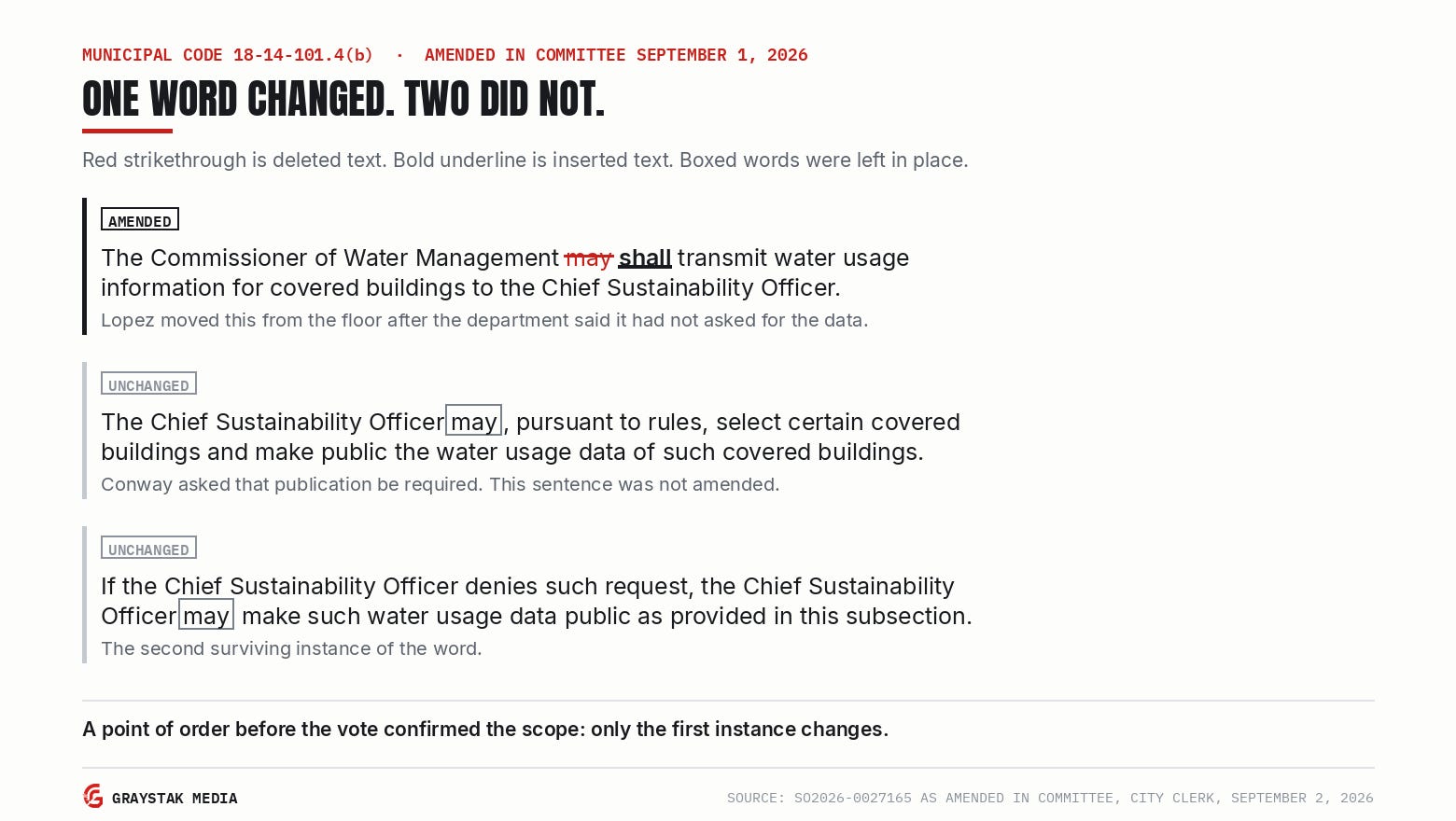
Section 18-14-101.4(b) as amended in committee September 1, 2026. Struck text in red, added text underlined, boxed text left in place. Source: SO2026-0027165 as amended in committee, City Clerk, retrieved September 2, 2026.
The second amendment
Chair Maria E. Hadden moved to close the item. “As long as you don’t have any more motions,” she said.
“Well, Chairman, I actually do,” Lopez said.
He proposed adding “and City Council” to the same sentence, so the data would run to both.
“To our colleague from the first ward’s point, information is key, right? And I think we should not have to have hearings or do FOIAs or try to do email chains to try to get information for this body, for City Council,” he said. “If we are going to treat water as a limited resource worth protecting, we should all know what we’re protecting and who are the users of it.”
The colleague was Alderman Daniel La Spata, 1st Ward, who came to the hearing with water data of his own.
The drafting was worked out aloud and never settled. Hadden read the amendment as a new sentence routing the data to the Council. Lopez said he wanted it to go to both. Hadden asked whether he wanted an “and” clause instead, then opened the floor.
“I think I have questions of whether it’s wholly necessary,” she said. “I know Ald. Conway mentioned earlier, sometimes we like to put things in our code as Council, of course, make sure things happen no matter who is in the role or who the administration is, so I understand the desire for this. I’ll say I feel that we do have the power already in City Council to compel this information to be shared with us.”
The amendment was never brought to a vote.
La Spata’s office obtained citywide water consumption data from the Department of Water Management in the autumn of 2025, during budget season, under Section 3-80-040 of the Municipal Code, which gives the Council access to departmental records. The department returned account counts by consumption band for 2024: 292,926 accounts using under 200,000 gallons a year, and 910 using more than ten million.
The discretion nobody removed
Conway had raised the question before Lopez ever spoke.
“I think it’s great that the ordinance seems to give us a pathway to disclose this water usage of data centers to the public,” he said, “but the questions I have in terms of the drafting specifically under 18-14-101.4 are, you know, in two places it says the Chief Sustainability Officer may make such water usage data public as provided in this subsection.”
Then the question. “Why are we giving the administration the discretion to be able to hide this information from the public, if we are trying to do something transparency, why are we putting the discretion specifically in the lap of the Chief Sustainability Officer as opposed to this body or simply saying that they shall make that water usage public.”
Arcus answered that the word attaches elsewhere.
“So I believe that the may in this section is actually amending the select certain covered buildings,” he said. “Again, our intent for this ordinance is to allow the Chief Sustainability Officer to identify buildings that are already identified by the public interests, by our stakeholders, and community members who are concerned about their water usage. That would include data centers. So in our original intent of this, the may was to amend select certain covered buildings instead of the make public the water usage data. If we were to collect that water usage data from the Commissioner of Water Management, then we would intend to make public that data.”
The sentence he was describing reads: “The Chief Sustainability Officer may, pursuant to rules, select certain covered buildings and make public the water usage data of such covered buildings.”
Hadden restated his answer and asked him to confirm it. The change cleaned up language, she said, and gave “the flexibility that was originally intended in the initial drafting, but cleaning that up while still allowing for the Chief Sustainability Officer to determine through rulemaking and not through ordinance where we need to collect water usage, because it’s not necessarily for every industry.”
“That is correct, Chair,” Arcus said.
Conway asked for “shall” on publication. The amendment that passed applied “shall” to transmission. The publication provision was not changed, and the ordinance as amended still reads that the Chief Sustainability Officer may make the water data public.
Conway said afterward that he still wants publication required.
“I appreciate the change that now requires the Water Commissioner to send the water usage information to the Chief Sustainability Officer, though I would still prefer that the public reporting of water usage be required rather than discretionary,” he said in a statement provided by his office on September 3. “This substitute is a good step towards transparency, and I appreciate the Chief Sustainability Officer’s advocacy for this legislative improvement.”
Asked whether the text supports the department’s reading of the word “may,” he described his own approach to the language.
“I use my 20 years of experience as an attorney to parse the language of proposed legislation, as I did at Tuesday’s committee meeting,” he said. “I was happy that the committee changed the text, which now compels the Department of Water Management to submit water usage data to the Chief Sustainability Officer.”
He did not address the department’s interpretation.
Asked whether the water provision reaches all covered buildings or only those containing data centers, the Chair’s office answered in writing on September 3: “All covered buildings.”
Asked why the paragraph letting an owner decide whether published water data enters the building’s benchmarking was struck, the office wrote that “now all covered buildings will be required to have their water data published unless provided an exemption for an existing allowable reason under the benchmarking code.”
The sentence governing publication was not amended. It reads that the Chief Sustainability Officer may, pursuant to rules, select certain covered buildings and make public the water usage data of such covered buildings.
Later, La Spata asked whether the water data would reach the city’s published data sets. He described what already exists: benchmarking information on the Chicago data portal, and an annual report required by ordinance.
“The water usage would be included in that annual data set that is published as an open source data set on data.chicago.gov,” Arcus said, “and it will be included in the annual report for our analysis and discussion.”
The data set he described already carries a field for water use. Owners submitting benchmarking data may include water voluntarily, which the Chair’s office confirmed on September 3 is how the current ordinance operates. That is a separate route from the departmental transfer at 18-14-101.4(b), which has not been used. Across 28,329 building-year records covering 2014 through 2023, 4,049 contain a water figure. The field is populated for 90 percent of buildings in data year 2018, 9 percent in 2019, none at all in 2020, 2021 or 2022, and 19 percent in 2023. The published set ends at data year 2023.
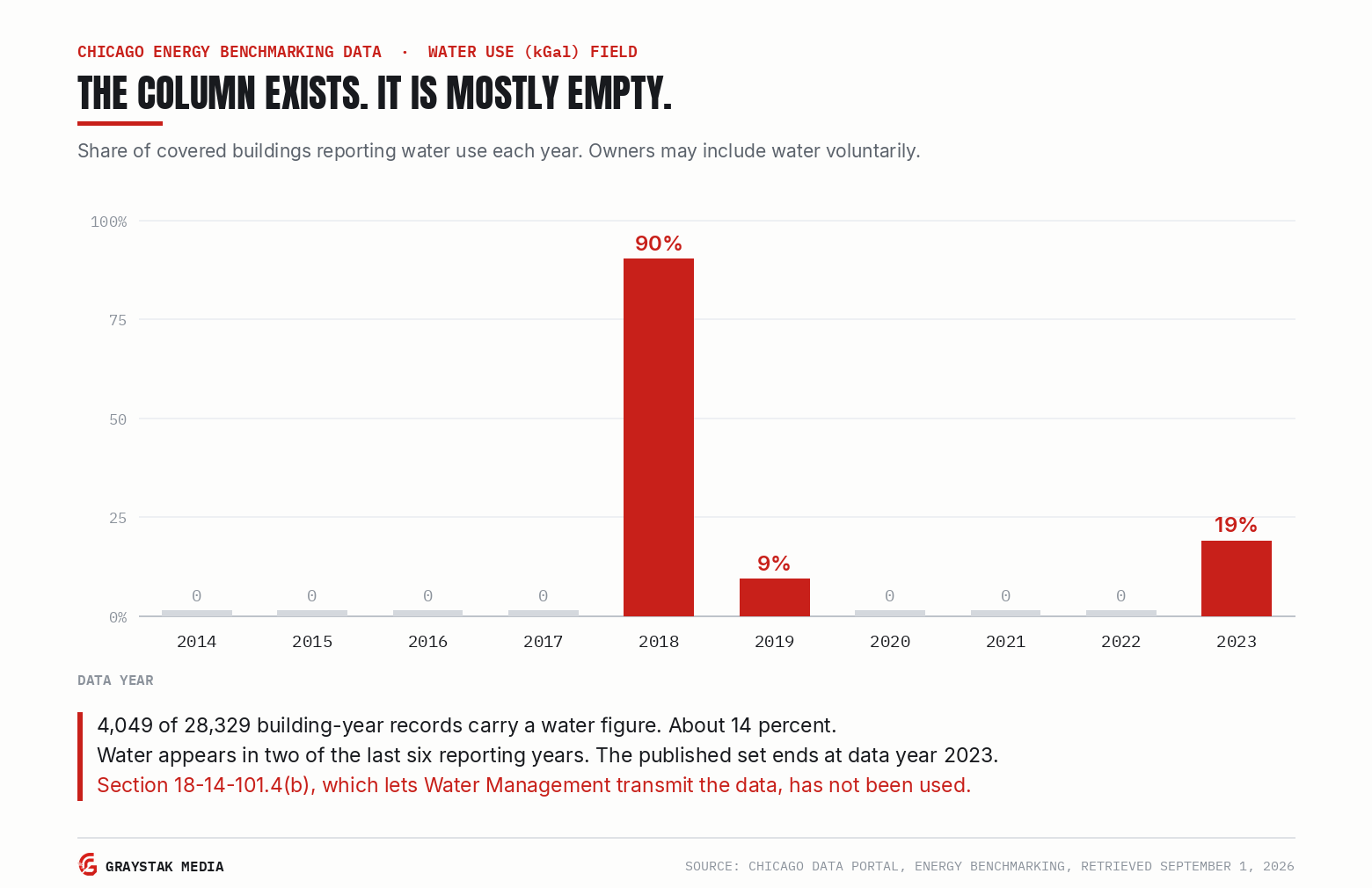
Share of covered buildings with a water use figure in the city’s published benchmarking data, by data year. Source: Chicago Data Portal, Chicago Energy Benchmarking, retrieved September 1, 2026.
A card nobody can find
La Spata raised one more provision before the vote.
“It’s in the broader benchmarking ordinance but I think it’s pertinent to today, 18-14-102.3, letter E,” he said, and read it aloud:
Upon receipt of an energy rating card a covered building shall conspicuously post the energy rating card so that it is visible to the general public and to visitors prior to or upon entering the covered building.
“These tend to be buildings with very large footprints, some of them without, often for good reason, without access to the public,” he said. “How does conspicuous posting look, do you think, where data centers are concerned?”
“I think I would have to refer to the Department of Law for their interpretation of conspicuous,” Arcus said.
“That’s fine and fair,” La Spata said. “I mean, topic for another day, I have found it generally hard to find these energy rating cards on any of these buildings. I looked at the Aon Center for five years, and couldn’t have told you where that card was.”
The Aon Center, at 200 East Randolph, has carried a rating every year since the system began. Four stars for data year 2018, three and a half in 2019, four in 2020, three and a half in 2021 and 2022, and four in 2023.
The requirement La Spata read has been in the Code since the 2017 amendment, which also created the star rating. It provides that the card shall not be defaced, marred, camouflaged, or hidden from public view.
Nothing in the rules implementing the program provides for checking. The Building Energy Use Benchmarking Rules, effective February 4, 2019, run twenty-six pages. The words “inspect” and “inspection” do not appear in them. No rule addresses the posting requirement. The rules’ disclosure section covers only what an owner must tell a tenant or a buyer at lease or sale.
The enforcement section runs three sentences. The Commissioner may determine whether persons subject to the ordinance have complied, may issue a Notice to Correct giving thirty days to come into compliance, and may then issue a notice of violation. The penalty is up to $100 for a first violation and up to $25 for each day it continues.
The pending draft rules would change the card itself. Rule 5.04 currently sets it at 17 inches wide by 11 inches high and requires the Commissioner to mail it to the owner. The June 2026 draft would make it 11 by 8.5 inches, half the area, provide it digitally, and make owners responsible for printing and display. Public comment on that draft closed July 10.
Hadden routed the question to the official who was not in the room. “That’s maybe something we can take back with our Chief Sustainability Officer, Commissioner Tovar, to have a discussion if it sounds like maybe something that’s just an update in the rulemaking,” she said. “Since it exists currently in the code already.”
The vote
The committee recommended the substitute as amended on a voice vote. No roll call was taken. The Clerk’s record contains no individual positions.
Thirteen of the committee’s fifteen members were present. Vice Chair Timothy R. Knudsen and Alderman Julia M. Ramirez were absent, both co-sponsors of the ordinance.
Alderman Byron Sigcho-Lopez was not a sponsor when the substitute published on August 26. He appears as the twenty-third co-sponsor on the Clerk’s record as of September 2.
He said in an interview on September 3 that he signed on the day of the committee meeting, or shortly before it. He had not been approached earlier because, he said, the sponsorship petition circulated without reaching him.
“I just was not asked,” he said. “They started circulating the petition, my understanding was, during the last city council meeting, and they just, I think for whatever reason, they didn’t ask me. They didn’t ask Rossana and a few others.”
He said he read the bill and signed with no reservations, and that he will vote for it at the full Council on September 23.
No one addressed the ordinance during public comment. Four speakers appeared, all on urban flooding, the committee’s second agenda item. Four written comments were submitted and distributed to members by email. They have not been published.
Hadden closed the item by calling the ordinance a first step. It will not regulate how data centers operate or whether they are allowed, she had said earlier. It requires them to turn over information to the city.
What the room did not settle
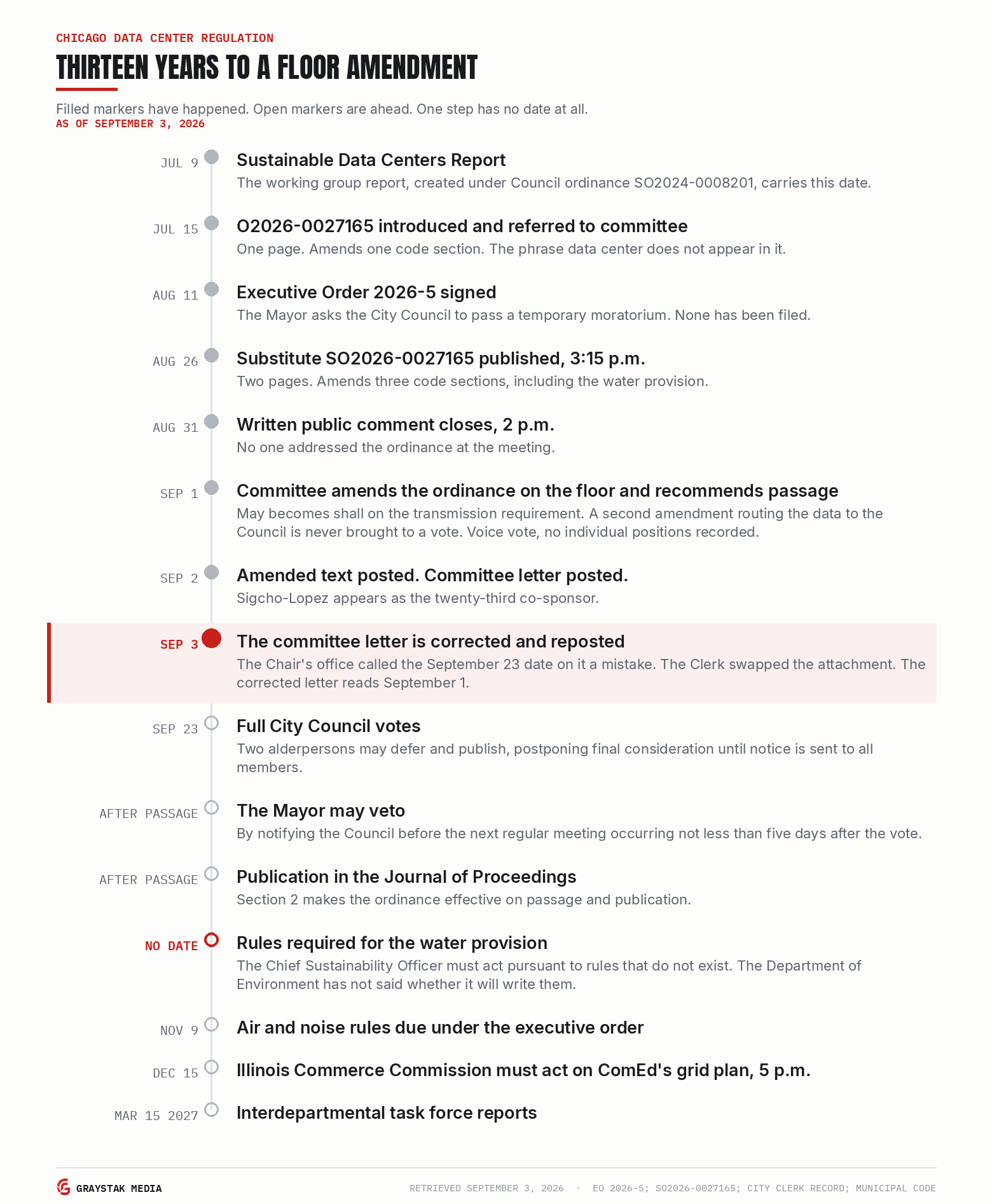
The path from the 2013 ordinance to the deadlines ahead, as of September 3, 2026. Filled markers have happened, open markers are ahead, and the rules the water provision depends on have no date. Sources: Executive Order 2026-5; SO2026-0027165; City Clerk matter record, retrieved September 3, 2026; Municipal Code.
The determination. The exception at Section 18-14-102.3 reads:
Unless a different result is mandated by applicable law, the Chief Sustainability Officer shall not make readily available to the public any individually attributable reported benchmarking information or energy performance rating pertaining to a covered building that contains a data center, television studio, or trading floor that together exceed 10 percent of the gross square footage of any such building until the Chief Sustainability Officer determines that the benchmarking tool can make adequate adjustments for such facilities. When the Chief Sustainability Officer determines that the benchmarking tool can make such adjustments, it shall report such determination to the Mayor and the City Council.
That provision is in the original ordinance, passed September 11, 2013, which also defines “data center” in the words the Code carries today. Thirteen years.
GrayStak asked the Department of Environment on August 13, August 21, and August 26 whether the determination has ever been made. Those requests went to an address that does not appear on the department’s website and went unanswered. A fourth request went September 1 to the address published on the department’s own page and was acknowledged the following day, with a response promised for September 3. The Mayor was asked at his August 25 availability and said he would get back to us. His office responded that evening but did not address it.
The occupancy question. The Department of Buildings answered on September 2, twenty days after GrayStak first asked. Electronic data processing with only incidental human occupancy is classified as Group S-1 under Section 14B-3-311.2. Group S is on the exclusion list in the covered building definition, which is why the ordinance as introduced struck the letter and why the substitute adds an override instead.
It also said the city does not track the occupancy classification of existing buildings. The city cannot say how many of the thirty-nine data centers identified in its own working group report carry that classification.
The rules. The 2019 rules define a covered building by exclusion using Chapter 13-56 occupancy classes. The Municipal Code uses Chapter 14B-3 groups. Hadden told the committee the substitute avoids amending the groups listed in the definition because doing so would require updating the building code.
That draft addresses three things: the size and delivery of the rating scorecards, references to the department’s former name and outdated links, and contingencies in the event of disruption at the U.S. Environmental Protection Agency. The phrase “data center” does not appear in the twenty-page document. Its one reference to Section 18-14-101.4 concerns the owner’s option to include published water data in a building’s benchmarking, which the substitute strikes from the Code. Whether those rules have been adopted is not established.
A letter, corrected. On September 2, the Clerk’s matter record for the ordinance listed four attachments. One was a letter dated September 1, on the Chair’s letterhead and over her signature, transmitting the ordinance to the President and Members of the City Council and recommending passage.
The letter states:
The amendment was concurred by unanimous vote of the members of the committee present and with no dissenting votes on September 23, 2026.
The committee met on September 1. September 23 is the date of the Council meeting the letter is addressed to.
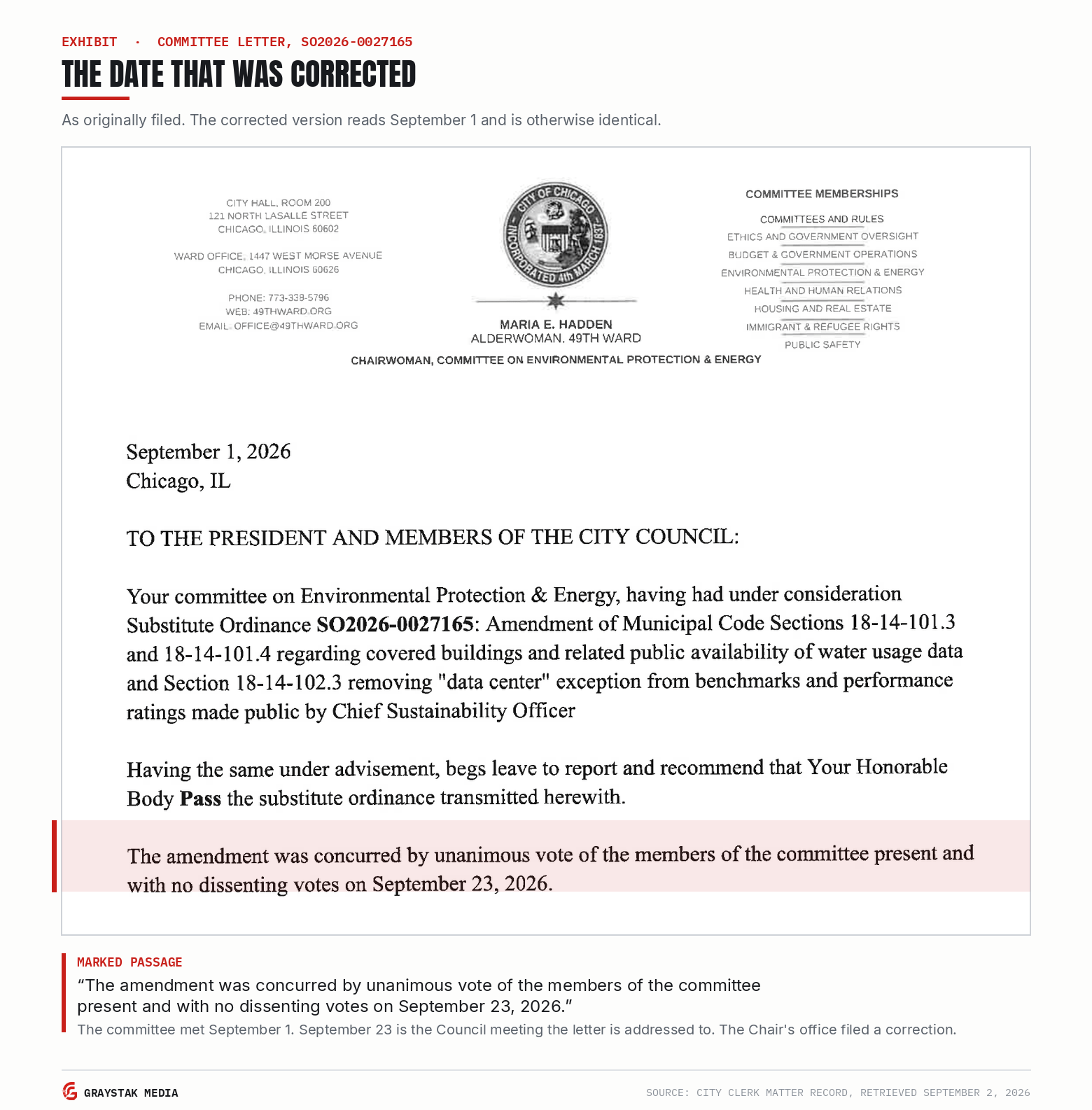
Committee letter transmitting SO2026-0027165 as originally filed, dated September 1, 2026, retrieved from the City Clerk’s matter record on September 2. Highlighting added by GrayStak. The Chair’s office called the September 23 date a mistake and filed a correction. The Clerk’s office swapped the attachment on September 3. The corrected letter reads September 1 and is otherwise identical.
GrayStak wrote to the Chair’s office on September 2 asking about the date. Chief of Staff Leslie Perkins responded on September 3.
“We made a mistake and are correcting it with the City Clerk’s office to show the correct date of September 1,” she wrote.
The record was republished that morning at 10:35 a.m. with three attachments, the letter no longer among them. Diana Martinez, Chief of Communications and External Affairs at the Clerk’s office, said that afternoon that her team had replaced the letter with a corrected version supplied by the committee, and that the replacement was possible because the ordinance has not yet been reported out in Council.
The corrected letter is identical to the first except for the date, which reads September 1.
Both versions state that the amendment was concurred by unanimous vote of the members of the committee present, with no dissenting votes. That is the only record GrayStak has identified of how the amendment carried. The Clerk’s matter record contains no individual vote positions on any action in this matter.
Martinez also said the Clerk’s office creates or modifies matter titles as needed, and that the phrase describing the ordinance as requiring public release was added when the title was modified after the substitute was submitted on September 1. She did not address what the phrase is based on. Section 18-14-102.3(g) in the ordinance as amended reads that the Chief Sustainability Officer is authorized to make the information available.
The exemption grounds. The substitute directs an owner seeking to withhold water data to establish any of the grounds in Section 18-14-102.1(c)(i), (c)(iii) or (c)(iv). Asked how those were selected, the Chair’s office wrote that the grounds “are already established in the existing code” and that the substitute “simply reiterates the existing exemption grounds.”
Those grounds exist for a different purpose. Section 18-14-102.1(c) lets the Chief Sustainability Officer exempt a building from the benchmarking requirement altogether on documentation establishing any of four conditions: qualifying financial distress, average physical occupancy below 50 percent throughout the year, new construction with a certificate of occupancy issued that year, or a change of ownership. The substitute borrows three of the four as criteria for withholding water data from publication.
The one it does not borrow is subsection (c)(ii), occupancy below 50 percent.
What comes next. Committee approval is one of several steps. A member may move to disapprove the committee report. Two alderpersons may exercise a statutory right to defer and publish, which sends the text to the Journal of Proceedings and postpones final consideration until notice is sent to all members. The Council votes September 23. The Mayor may veto by notifying the Council before the next regular meeting occurring not less than five days after the vote. Section 2 of the ordinance makes it effective upon passage and publication.
And the water provision depends on rules that do not yet exist. The ordinance directs the Chief Sustainability Officer to select buildings pursuant to rules, and to provide a form and manner by rule for owners seeking to withhold. Removing the data center exception from Section 18-14-102.3 requires nothing further.
HOW THIS WAS REPORTED
This piece is built from primary documents and from the September 1 committee meeting, which GrayStak attended and recorded. Every quotation was verified against that recording.
Ordinances. Substitute ordinance SO2026-0027165, published by the City Clerk August 26, 2026 at 3:15 p.m., and as amended in committee, posted September 2; the committee letter transmitting the ordinance, signed by Chair Maria E. Hadden, in both the version retrieved from the matter record September 2, 2026 and the corrected version posted September 3; ordinance O2026-0027165 as introduced July 15, 2026; the Clerk’s matter record, captured August 26, September 2 and September 3, 2026; substitute ordinance SO2013-5384, passed September 11, 2013; substitute ordinance SO2017-7060, passed November 21, 2017. The 2013 and 2017 ordinances are published by the City of Chicago on its Chicago Energy Benchmarking page.
Rules. Building Energy Use Benchmarking Rules, effective February 4, 2019, published on the City of Chicago Rules Portal by the Department of Law. Building Energy Use Benchmarking Program Rules, Draft Update June 2026, published by the Department of Environment for public comment closing July 10, 2026.
Municipal Code. Sections 18-14-101.3, 18-14-101.4, 18-14-101.5, 18-14-102.1 and 18-14-102.3, and Chicago Building Code Sections 14B-3-302 and 14B-3-311.2, as published in the current supplement.
Meeting records. Notice of meeting dated July 22, 2026; the Agenda of Matters for the September 1 meeting; the Clerk’s legislative body record for the Committee on Environmental Protection and Energy, retrieved August 27, 2026.
Data. Chicago Energy Benchmarking data set, Chicago Data Portal, retrieved September 1, 2026.
Correspondence. Written responses from the Committee on Environmental Protection and Energy dated August 18, 21 and 26; from the Department of Planning and Development dated August 17; from the Mayor’s Press Office dated August 17 and 25; from the Department of Buildings dated September 2; and from the 1st Ward office dated September 1 and 2.
Procedure. Office of the City Clerk, About City Government and the Chicago City Council; Rules of Order and Procedure; Municipal Code 2-12-050.
This piece continues GrayStak’s reporting on Chicago’s data center regulation, which began with Chicago Zones Data Centers as Offices on August 17, 2026, and continued with A Council Committee Votes September 1 to Repeal a Data Center Rule That Requires No Council Vote to Lift on August 27, 2026.
WHAT IS NOT YET IN THE RECORD
Whether the Chief Sustainability Officer has ever made or reported the determination required by Section 18-14-102.3 has been requested from the Department of Environment four times since August 13 and from the Mayor’s Press Office once. It has not been provided.
Whether the June 2026 draft rules have been adopted is not established.
The four written public comments submitted to the committee have not been published. GrayStak has requested them.
What the Clerk’s description of the ordinance as requiring public release is based on has been requested from the Clerk’s office. It has not been provided.
COMMENT
Requests were sent to the Department of Environment on August 13, August 21, August 26, and September 1. The first three went to an address that does not appear on the department’s website and were not answered. The September 1 request, sent to the address published on the department’s own page and covering the department’s statements to the committee, the status of the draft rules and the determination under Section 18-14-102.3, was acknowledged on September 2 with a response aimed for September 3. No response had been received at publication.
Requests were sent September 1 to Alderman Conway, Alderman La Spata and Alderman Lopez, with responses requested by September 3. The 1st Ward office responded September 1 and September 2. The 34th Ward office responded September 3. The 15th Ward office had not responded at publication.
Requests were sent to the Committee on Environmental Protection and Energy on August 26, September 2 and September 3. The Chair’s office responded September 3. Requests were sent to the Department of Water Management on August 26 and again on September 2, copied to the Mayor’s Press Office. No response had been received at publication.
Requests were sent to the Office of the City Clerk on September 2 and September 3, concerning the description of the ordinance on the matter record and the change to the attachments. The Clerk’s office responded September 3.
A request was sent to the 25th Ward office September 2 about the timing of Alderman Sigcho-Lopez’s co-sponsorship. The office responded September 3 and the alderman spoke by telephone that afternoon.
The Department of Buildings responded September 2. A follow-up sent the same day, on whether occupancy classification is recorded in permit records, on Section 14B-3-304.2, and on the number of data center permits issued since January 1, 2024, had not been answered at publication.
CORRECTIONS
None to date on this piece.
An earlier version of the August 27 piece stated that the Agenda of Matters for the September 1 meeting was posted on August 27, a day after the Clerk published the substitute. GrayStak observed that the agenda had not posted as of August 24 and was on the Clerk’s site by August 27. The intervening days were not observed, and the sequencing claim was not supported. That piece has been corrected.
GrayStak corrects errors on the record and marks the change. Corrections are dated and the corrected text is identified. Send corrections to christopher@graystak.com.
UPDATES
Responses received after publication, and the outcome of the September 23 City Council vote, will be added here and dated. The original text stays intact.
September 9, 2026. The Department of Environment responded to questions sent September 1.
Asked why the city has never requested water usage data from the Department of Water Management, the department said the Annual Benchmarking Report has not historically reviewed water usage data, and that accordingly the Chief Sustainability Officer has not requested it from Water Management for that report.
The department said the June 2026 draft rules have not been adopted, and that the proposed changes were not related to data centers or water usage. It said the Chicago Energy Benchmarking program transferred to the Department of Environment in January 2025 as part of the department’s restoration.
It said the department was represented at the September 1 committee meeting by Joseph Arcus, Project Manager, and Belinda Wordlaw, Assistant Commissioner.
On the ordinance, the department said the Municipal Code currently exempts data centers from reporting their energy and water usage, that adding them to the list of buildings that must report requires action by the City Council, and that the department fully supports the amendment. It said that if the ordinance passes, it anticipates updating its rules and the benchmarking tool to accommodate water usage reporting.
The response did not address Section 18-14-102.3, the provision that withholds benchmarking information and energy ratings for buildings containing a data center until the Chief Sustainability Officer determines that the benchmarking tool can make adequate adjustments and reports that determination to the Mayor and the City Council. Whether that determination has ever been made or reported has now been requested from the department four times since August 13 and from the Mayor’s Press Office once. It has not been provided.
DISCLOSURES
GrayStak uses commercially available artificial intelligence tools, including Anthropic products, in its research and production workflow, and holds no financial interest in any of their makers.
ABOUT THE AUTHOR
Christopher Sweat covers Chicago and Illinois government from the public record, reporting local social and political dynamics for a national and international audience. He also reports on national security policy, intelligence oversight, public finance, and the defense technology sector. He is an analyst working across finance, technology, and politics, and CEO and Co-Founder of GrayStak.
GrayStak is a media and political risk company. We report from the public record and from the ground, centered in Washington, D.C., New York, and Chicago. Our real-time Domestic Political Volatility Index (DPVI) measures the velocity and volatility of U.S. domestic politics.
Excellent article! Thank You Chris and GrayStak!
I guess the administrative evasiveness does not seem too surprising. Thank you for doing the digging as always 👍👍👍
Those empty columns in the reported usage chart were crazy 😂