

The claim
A regulated utility cannot refuse a data center.
The obligation to serve is written into state law. It applies on the same terms to a shopping center, a housing development, a federal installation, and a single facility interconnecting at 700 megawatts, which is roughly twice the peak demand of Naperville, Illinois. Bill Murray, who runs state and electric public policy for Dominion Energy, told a room of state legislators and staff in Chicago on July 27 that his company does not assign blame and has to serve them all. The question he posed to the room was how to do that effectively and affordably.
Whether these facilities get built is therefore largely settled outside the legislature. What remains unsettled is how the cost of serving them is divided among customer classes. That division is decided in rate cases at state public utility commissions and in the capacity market run by the regional grid operator.
Thirty-nine states introduced legislation on data centers and power in 2026, and thirty-one on water. Thirty-eight states currently offer preferential tax treatment to data centers, and thirteen have introduced changes to that treatment. Almost all of that regulation governs the building: whether it gets a tax exemption, whether it can be sited, what it has to disclose, and whether it must bring its own generation. At least seven states have passed a law that addresses how the cost is divided.
Serving new load means building, and a utility recovers what it builds through rates with a return, subject to a commission finding that the spending was prudent and that the asset was used and useful. The generation that would serve this load at a lower marginal cost arrives in the early 2030s, a date its suppliers cite in their own securities filings. The five to seven years in between are served by additions to the existing system, and the size of those additions is the largest sum in play.
Of the four state designs described from a single afternoon of testimony in Chicago, one reached that decision.
The legislation that failed in Illinois in the spring reached the commission. The POWER Act amended the Public Utilities Act, prohibited cost shifting, and created a fund to compensate community intervenors in proceedings. The industry group opposing it counted 638 pages. It died anyway, and the governor paused tax incentives instead.
The argument is regional. It applies where anticipated load growth meets supply and delivery constraints. PJM is that case. Illinois sits inside it.
The utility cannot decline the load
The obligation to serve shifts the threshold question away from legislatures. It does not diminish the scale of what arrives.
Murray established units before making any argument: a megawatt is roughly 250 homes, and a gigawatt is a thousand megawatts, or 250,000 homes, both flagged as averages. He then gave four reference points across Dominion’s fifteen years of data center interconnections.
He noted in passing that the company had not begun this recently and that Amazon was among its earliest data center customers. He also observed that Amazon’s energy policy head was on the panel that followed. The two men described the same commercial relationship from opposite ends of it, ninety minutes apart, in different rooms.
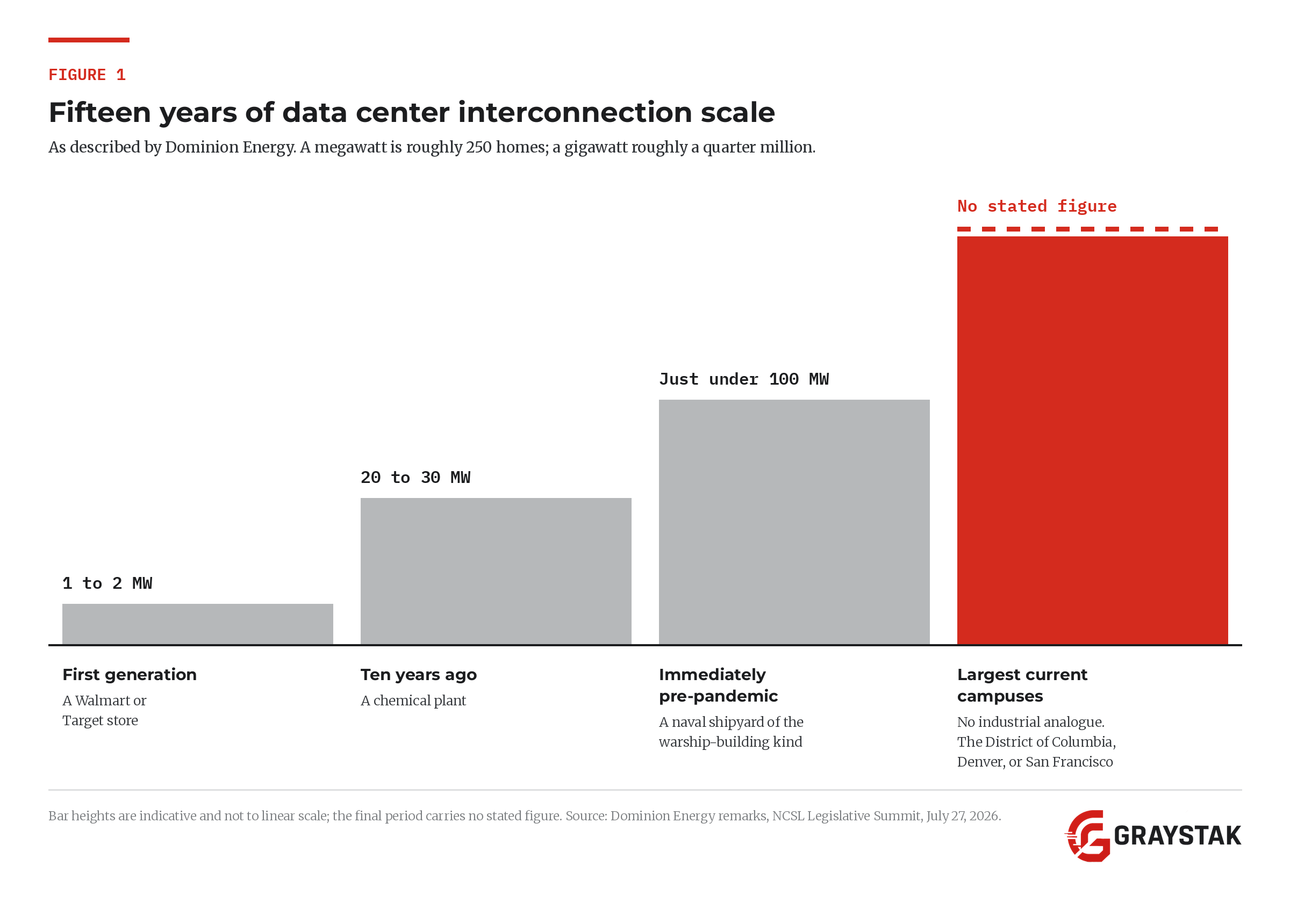
Murray noted a corresponding shift in vocabulary. Across his first fifteen years he encountered the term gigawatt three or four times. It is now the standard unit for discussing supply.
Kim Janas, counsel to the Illinois attorney general, offered the same finding in Illinois terms. A single data center, she said, can interconnect at 700 megawatts, and she set that against Naperville, a city of roughly 150,000 in DuPage County that she has watched grow over her lifetime. Her framing was forty-four years of municipal growth against one interconnection.
Naperville operates its own municipal electric utility, serving about 63,000 customers, according to the city’s count, and buying its power through the Illinois Municipal Electric Agency. Across 32 member municipalities, its peak demand is 37 percent of the agency’s total and its energy 34 percent. Naperville Development Partnership reports the city’s peak demand at 343 megawatts.
Against either figure, the comparison holds, and against the published figure it is starker. The interconnection would draw about twice the peak of the entire city, and it would draw it differently. A municipal peak is the highest hour of the year, while a data center runs closer to flat, so the gap in annual energy is wider than the gap in peak.
Asked whether she was describing peak demand or another measure, the attorney general’s office did not respond to questions sent on July 31, which had an August 7 deadline.
Paul Cutler, vice chair of Utah’s economic development committee, identified the discontinuity as categorical. Facilities built between roughly 2005 and 2022 were latency-constrained, which held them near metropolitan areas and therefore small. Training facilities are not latency-constrained, so siting follows cheap land and cheap power, and scale follows economies of scale. He proposed AI factory as the more accurate term.
The same comparison appears in state government. The Illinois governor’s June release describes data centers as consuming resources comparable to those of a mid-sized city, echoing the utility executive’s analogy. The scale of what is queued supports this framing. As of May 2026, nearly 12 gigawatts of data center load requests sat in the New York Independent System Operator interconnection queue, with more than two-thirds of that capacity entering the queue in 2025 alone.
Bridget Bartol, executive director for industry and regulatory affairs at the National Electrical Manufacturers Association, supplied the supply-side reason the discontinuity bites. For ten to fifteen years the sector’s operating question was whether utilities would survive flat demand. That signal shaped manufacturing capacity against expansion. Her members have since doubled and tripled capacity and retain backlogs.
The load arrives on terms the utility cannot refuse, at a magnitude with no operating precedent, into a supply chain built for the opposite condition. Whether it materializes at the size forecast is the question underneath everything that follows.
The suppliers date their own arrival to the 2030s
New generation is the answer everyone reaches for, and the companies selling it put their delivery dates in their own filings.
Christina Walrond, director of state government relations at X-energy, presented two advanced nuclear projects. Four 80-megawatt Xe-100 units at Dow’s UCC Seadrift Operations on the Texas Gulf Coast, 320 megawatts total, developed through Dow’s subsidiary Long Mott Energy. And the Cascade Advanced Energy Facility at Richland, Washington, with Energy Northwest, four units expandable to twelve for 960 megawatts. Amazon led a roughly $500 million financing round in the company in October 2024 and signed a binding agreement to purchase up to five gigawatts by 2039.
Ceramic-coated fuel tested at Idaho National Laboratory allows the company to draw its emergency planning zone at the fence line rather than ten miles out. That is why the reactor can sit a mile from a working chemical plant. The peak construction workforce would be near a thousand, compared with five to six thousand at Vogtle, the most recent large nuclear plant brought online in the United States. The stated design goal was replicability: the company can build a zebra and cannot build a unicorn.
The Nuclear Regulatory Commission completed the environmental review for Seadrift in May 2026 through an environmental assessment rather than a full environmental impact statement. No US nuclear project had cleared that step by that route before. The construction permit remains pending under an eighteen-month review docketed in May 2025, with the safety review still ahead.
She then dated the project without being asked. The downside of nuclear is the timeline. The next facility lands in the early 2030s, with fast followers after. She named batteries and gas as the bridge and used the gap to argue for an all-of-the-above posture.
X-energy’s registration statement filed with the Securities and Exchange Commission states that Dow and X-energy have coordinated financing and strategy for the long-lead procurement items required to support construction, commissioning, and commencement of operations of the reactor, expected in the early 2030s. Site construction is expected to begin in the first half of 2027, after the construction permit is issued, which the filing expects in the first quarter. Its risk factors state that the company has not achieved a final investment decision for any deployment.
The date is in a securities filing.
Tom Erb, head of federal affairs at Fervo Energy, contested the timeline from the adjacent chair, claiming enhanced geothermal as the only clean baseload resource capable of coming online before 2030. Cape Station in Beaver County, Utah is targeted to deliver first power in late 2026 and reach roughly 100 megawatts of operating capacity by early 2027, with a further 400 megawatts targeted for 2028 and permits in place for two gigawatts on the site. He put the sequence at three years from first drill line to first power, at an 83 percent capacity factor. Fervo’s IPO filing puts the project’s cost at $7,000 per kilowatt and compares that to both traditional and next-generation nuclear. The company raised approximately $1.9 billion on Nasdaq in May and closed $421 million in non-recourse project financing in March, which Erb identified as the more meaningful signal because it demonstrates that infrastructure lenders will underwrite the asset class repeatedly.
Two additional figures he cited, a 13-gigawatt shortfall in Western baseload power by 2030 and a Department of Energy estimate of the domestic geothermal resource, could not be traced to a public source. Fervo did not respond to questions sent on July 31 with an August 7 deadline, and this analysis does not use them.
A third answer requires no new generation. Kelt Wilska, senior manager of state policy for advanced transmission technologies at Grid Strategies, said he supports coalition work on these technologies. He described four categories of capacity recoverable from existing infrastructure. Substation hardware shifts power from congested lines to uncongested ones. Software reconfigures the network. Sensors read real-time conditions against static ratings set for the hottest possible day. Composite-core conductors sag less under heat and carry more. He noted one of the country’s few superconductor installations in Chicago, and that one checks out.
The Resilient Electric Grid system beneath Chicago’s central business district was commissioned in August 2021 as the first commercial adoption of high-temperature superconductor cable in North America. Wilska confirmed that this is the installation he meant. ComEd built it with American Superconductor, with partial funding from the Department of Homeland Security. Its high current capacity in a compact footprint suits dense urban corridors, and it produces no local heating or magnetic fields. FERC classified it as a transmission asset, allowing it to be built as permanent infrastructure rather than a demonstration. The cable is under Chicago because a regulator decided how to categorize it.
Asked afterward to source the figures he gave, Wilska supplied them. As of the end of July, twenty-three states have passed laws with provisions encouraging adoption. The $12 billion congestion figure is from Grid Strategies’ own Transmission Congestion for 2024 report, covering that calendar year, with a 2025 edition due this fall. The deployment cost multiple he cited on stage was 1 to 20, compared with 1 to 200 for a full traditional line rebuild, varying by technology, with topology optimization effectively free, since it is a software subscription rather than hardware.
The three compete for the same customers and disagree only about whether the gap runs five years or ten. Whichever resource fills it, the load arrives first.
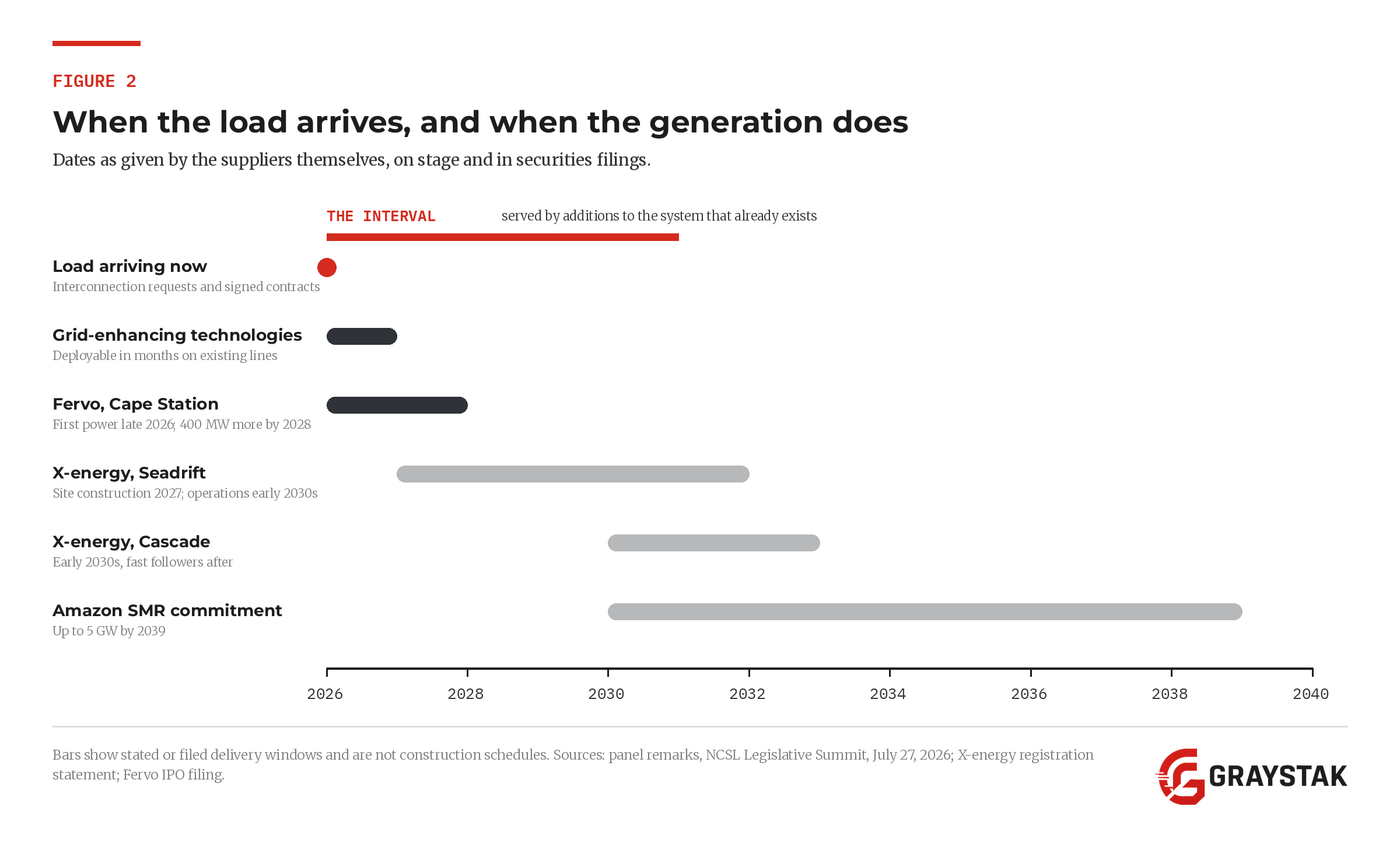
The interval is documented by the parties with the least incentive to overstate it. Which resource fills it is a procurement question.
Utilities earn a return on what they build
Those years get served by building on the system that exists, and how a utility earns determines what gets built.
A utility’s return is calculated against the rate base. Janas stated the consequence plainly: transmission built to serve a large load generates revenue for the utility, and if the load fails to materialize, the asset was still constructed. She raised stranded assets directly and identified the risk as a buildout without the future demand to pay for it. Her prescription is cost causation, with large loads paying distribution costs in full and up front, and she stated that this is not how the system currently operates.
Two other parties described the same incentive.
Wilska located it as the barrier to his own product. The utility business model was designed more than a century ago to reward building; a sensor placed by drone is not a significant capital investment, and utilities hesitate where cost recovery is unclear. He sells the sensors.
The AMP Coalition and WATT Coalition, whose work he supports, published a policy memo in June quantifying the gap in a single metric: new grid capacity added per dollar spent. For an illustrative 230-kilovolt, 11-mile line, straight asset replacement delivers no additional capacity at a cost of $5.28 million. A new line delivers 372 megawatts at $23.1 million over five or more years. Advanced power flow control delivers 185 megawatts at $14 million in one to two years. Adding dynamic line rating to the existing line delivers 37.2 megawatts for $550,000 in under a year, the highest capacity-per-dollar ratio on the list by a wide margin.
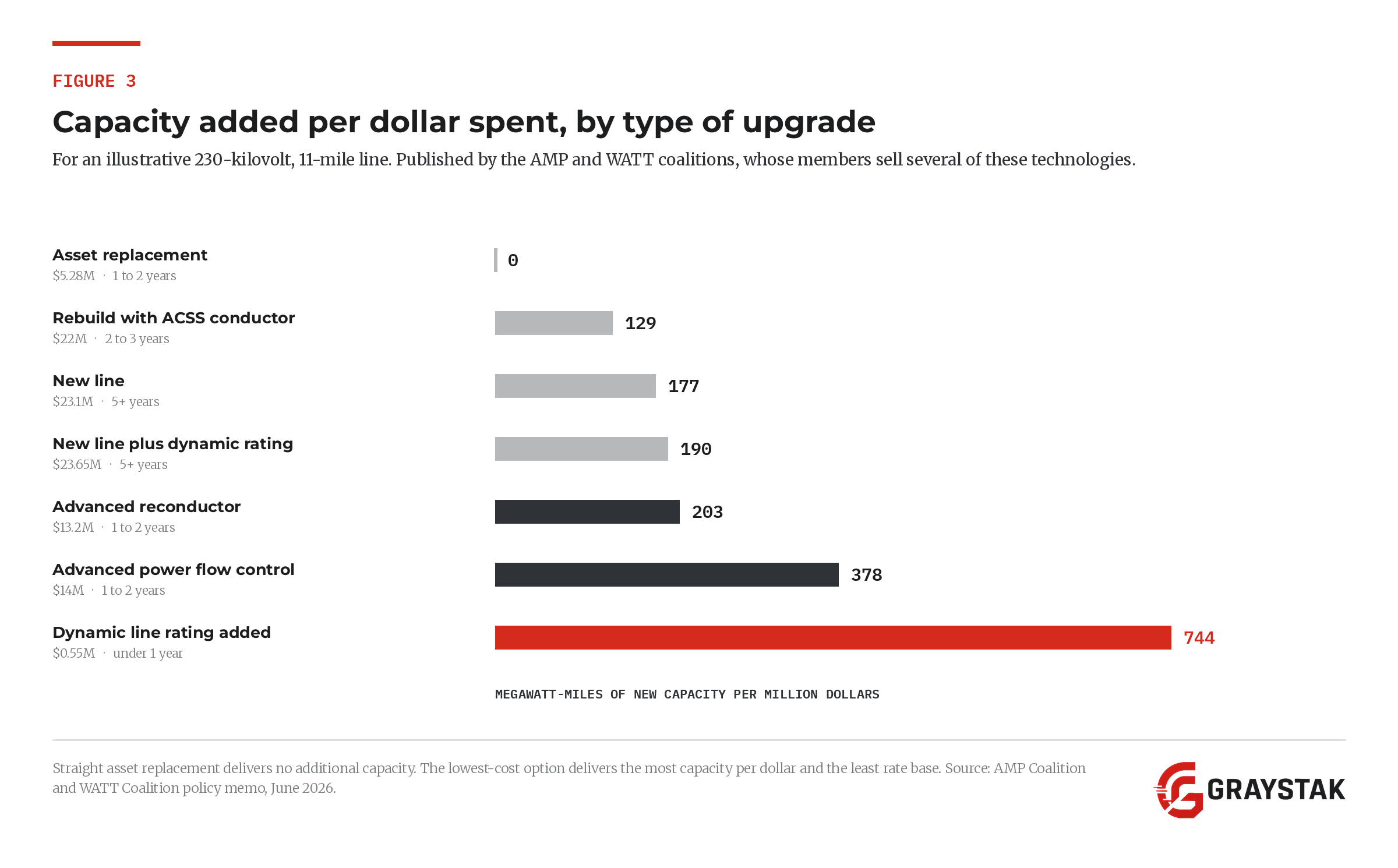
Both coalitions represent companies selling the technologies. The memo’s second stated driver holds that new electric demand reduces costs to ratepayers by spreading fixed costs over more customers and kilowatt-hours, the load-growth argument in its strongest form, published by coalitions whose members sell the technologies in question. The cost comparison is checkable. The ratepayer conclusion is contested by other parties in this analysis.
Craig Sundstrom, who heads energy and sustainability policy at Amazon Web Services, arrived at a third version from the load side. He proposed that customers like Amazon take on construction and supply chain risk to build assets such as substations directly, which then integrate into the utility system, and stated the company has worked with states on enabling legislation. He was proposing that the customer do the building. No panelist took it up.
Asked which states have enacted that enabling legislation, Amazon did not respond to questions sent on July 31 with an August 7 deadline.
Sundstrom came to that argument through the regulated side of it. Before joining Amazon in 2021, he was director of government and regulatory affairs at three renewable developers, RWE Renewables, Innogy Renewables US, and Apex Clean Energy. Before that, he served as deputy secretary of energy in the office of the Oklahoma Secretary of Energy and Environment, and earlier as a legislative associate at the National Governors Association. He was a former state energy official who addressed state legislators.
A consumer advocate, a transmission vendor, and the largest data center operator in the country described the same mechanism from three commercial positions. None named it as the thing that determines what other customers pay.
Commissions do sometimes decline. In a recent Dominion rate case in Virginia, distribution and substation upgrades for data centers could have cost $1.5 billion, and the State Corporation Commission reduced that by $853 million. But how often they decline is answerable in the aggregate, and the answer does not favor the ratepayer. Berkeley Lab reports that over the last five years, public utility commissions approved, on average, 64 percent of the dollar value of investor-owned utility revenue increase requests, and 66 percent in 2025, compared with an average of 52 percent across the previous two decades. Authorized returns on equity have trended upward. The lab’s own reading is that high request volumes combined with high approval rates suggest further upward price pressure.
The recovery structure favors capital-intensive answers and disfavors cheap ones. Forecast risk sits with ratepayers unless a commission disallows, and commissions are disallowing less than they used to.
What the state laws regulate
Four state designs were described from the stage that afternoon. Three more came up in the reporting afterward. Set against what a state could regulate, they cluster.
Nicholas Miller of NCSL’s Fiscal Affairs Program opened with the national count, and added that repeal bills advanced in Washington, Arizona, and North Carolina this year. NCSL’s own published research puts the thirteen states in two groups, nine considering a repeal and four considering an adoption, and counts more than 150 bills in 2026 addressing data center energy consumption. There are more than 4,000 data centers in the country.
Washington: conditioning the deal
April Berg chairs the House Finance Committee in Washington and is prime sponsor of the state’s 2022 exemption, with Rep. Ramel. The statute conditions the tax benefit on performance, and the conditions are as she described them. Community workforce agreements or project labor agreements, area standard prevailing wages, and apprenticeship utilization requirements, binding the prime contractor and subcontractors for new on-site construction. Green building certification within three years against a named list including BREEAM, Energy Star, Envision, ISO 50001, LEED, Green Globes, and UL 3223. A minimum of 1.5 megawatts of available power. Three family-wage positions per 20,000 square feet, with family-wage defined as full-time permanent work with employer-provided health care at 125 percent of county per capita personal income. Failure on the jobs requirement makes all previously exempted taxes immediately due and payable.
Her method was consultative. She visited facilities and the communities that had or might have them, and consulted with tribal leaders, public utility districts, economic development officials, fishermen, and the state ecology agency. Those communities specified hundreds of jobs instead of thousands, to avoid housing and road pressure. Her instruction to the room extended to anyone drafting a moratorium. See a facility first. Her test for whether a facility belongs is whether it operates as a fiscal donor, contributing more in tax revenue than it consumes in public services; her test for whether an exemption belongs is but-for causation. Her claim that the program worked has an independent basis she did not cite, in the Joint Legislative Audit and Review Committee’s prior finding that the exemption met its statutory objective.
She stated she would not write the exemption today, holding that conditions have changed and the incentive is no longer necessary, while retaining the energy protections, labor standards, community transparency, and tribal consultation. Her objection to the 2026 amendments was regulatory certainty. Altering terms mid-certificate in response to events in other states removes the predictability the program depends on. The 2026 vehicle was SB 6231, Chapter 266, which repealed the exemption for refurbishment and replacement server equipment effective July 1, 2026, while preserving it for new equipment at new facilities. An earlier version would have ended the program entirely; the engrossed substitute pulled that back.
The 2022 act carried one provision that never became law. Section 8 directed the Department of Commerce to contract with Pacific Northwest National Laboratory to evaluate the state’s grid resilience and reliability, including the impact of increased data center energy demand from these exemptions, and to report to the legislature by December 1, 2022. Governor Inslee vetoed Section 8 and the null and void clause attached to it on March 31, 2022. His message gives the reason as duplication of resource adequacy planning already underway at the Utilities and Transportation Commission, the Department of Commerce, and the Northwest Power and Conservation Council, and notes that no funding had been provided for the study in any case. The exemption took effect on June 9. The measurement of what it would cost the grid did not.
Against moratoriums, she argued that a legislature leaving the table routes facilities to states with weaker labor and environmental standards.
A disclosure the panel did not make
Associated Builders and Contractors of Washington testified in opposition to HB 1846. Its objection was that the project labor agreement requirement would effectively mandate union contractors and preclude roughly half the construction industry, including most women- and minority-owned firms. Associated General Contractors of Washington and the Association of Washington Business also opposed. Supporting testimony came from the Washington State Labor Council, the state and Central Washington building trades councils, IBEW Local 191, and Ironworkers Local 86.
Brandon Ray, senior director of state and local affairs at Associated Builders and Contractors, spoke immediately before Berg on the same NCSL panel, on workforce pipelines and labor demand in data center construction. The panel did not take up the disagreement between his organization’s Washington chapter and the bill she was describing. Neither speaker was asked about it.
Asked about that position, ABC’s director of media relations directed this analysis to the organization’s published statements on government-mandated project labor agreements and invited their use. Those statements are national and categorical. Ben Brubeck, ABC’s vice president of regulatory, labor and state affairs, has written that government-mandated PLAs box out almost 90 percent of the U.S. construction workforce that does not belong to a union, at a time when the industry faces a labor shortage of more than half a million people, and that PLA schemes increase costs 12 to 20 percent by imposing inefficient work rules and discouraging competition.
The organization has applied that position to energy projects specifically. When the Internal Revenue Service proposed rules in 2023 conditioning the enhanced clean energy tax credits under the Inflation Reduction Act on prevailing wage and registered apprenticeship requirements, ABC opposed them. It led a coalition of a dozen construction and business associations in comments urging the agency to abandon what the coalition described as a coercive scheme pushing developers into PLAs. The rule does not require a project labor agreement. The final regulations issued in June 2024. That is the same conditioning structure the Michigan bills propose, applied to a tax credit instead of to a utility rate.
ABC did not address the rate question directly. Asked whether it has a position on barring a public service commission from approving a data center electricity rate absent those labor conditions, and whether it has a position on what Illinois should carry in veto session, the organization’s response did not reach either point.
Utah: conditioning the power supply
Utah’s SB 132, titled Electric Utility Amendments and sponsored by Sen. Scott Sandall with Rep. Colin Jack, was signed in March 2025 and took effect that May as Chapter 26 of the state utility code, Large-Scale Electric Service Requirements. It applies to new service expected to reach a cumulative demand of 100 megawatts or greater within five years. Cutler described it as a requirement that such users bring their own power. The statute creates an alternative pathway. The utility evaluates the request, and if it cannot serve without significant investment, the customer may contract with a large-scale generation provider, either connected to the utility’s transmission system or operating independently of it.
The chapter goes further than the description he gave. It exempts service provided under it from certain rate regulation requirements, and the implementing rules before the Utah Public Service Commission provide that large load facilities directly assigned to a large load customer are not included in rate base for recovery from the utility’s other Utah retail customers. Applications must include a methodology for keeping separate accounting records showing those costs are excluded from regulated retail rates.
Utah’s law reaches allocation, and it does so by assignment instead of allocation in the market monitor’s sense. Cutler described the power supply provision from the stage and not the rate base exclusion, which is the part that determines what other customers pay.
Utah separately requires water-use reporting from new large facilities, which he framed as measurement preceding restriction. Utah’s sales tax exemption rests on different ground than Washington’s. Cutler defended it as ordinary business-input treatment, on the principle that a state taxes the finished thing and not the parts that went into it. He was not defending an incentive. He was defending a definition.
He put the job split at roughly 80 percent construction and 20 percent operations, noting that AI facilities generate different operational roles than cloud facilities did, including cooling and electrical technicians he characterized as durable six-figure positions.
He also volunteered his state’s failure case: an investor announced a facility on a footprint larger than Rhode Island and characterized locals raising environmental concerns as Chinese operatives. His conclusions were that process governs outcomes, that some decisions proceeded without adequate local input, and that some approvals proceeded without anyone explaining benefits to the affected community.
His proposal for regional externalities was a community investment framework, in which a large project pays into mitigation projects improving air quality across a wider area, structured on the model of tax increment financing. Asked whether states should take siting authority from local bodies, he retained local control over the building and separated generation as regionally consequential, since it affects rates and air quality beyond the jurisdiction hosting it.
New York: the moratorium is executive
The stage account had New York’s legislature passing a moratorium that the governor matched by executive order. The sequence is the reverse. Both houses passed the Responsible Data Center Development Act on June 4, 2026. The Assembly recorded 103 ayes and 38 nays, with nine members excused. The Senate recorded 43 ayes and 17 nays. The bill imposes a one-year pause on Department of Environmental Conservation permits for facilities at 20 megawatts or more. It has not been delivered to Governor Hochul, so no signing clock has started. On July 14 she issued Executive Order 62, which directs that department to hold in abeyance any discretionary permit application for a data center that can consume 50 megawatts or more and that the department had not found complete before that date. The order does not carry a one-year term. It runs until the Department of Public Service submits its final generic environmental impact statement and findings. The one-year figure comes from the governor’s office, which told reporters the framework would take about that long and that the order was the fastest way to act while the bill remained under negotiation.
New York is the first state to impose a statewide moratorium, and it did so by executive action after its legislature acted and the governor declined to adopt the legislature’s instrument. Maine’s legislature passed one in April and Governor Mills vetoed it, in part because it made no exception for the town of Jay. Jay is a former paper mill town of about 4,600 people whose mill closed in 2023, and where a developer had proposed a $550 million data center in the vacant plant. Town officials lobbied the governor to preserve the project, and she wrote that the town’s perspective had to be considered. In June, the company that had agreed to operate the facility withdrew, and the project went on hold. Fourteen state legislatures had taken up a moratorium as of June, by the Rockefeller Institute’s count. None has been signed into law. Every statewide pause now in effect came by executive action.
Illinois followed the same sequence. A legislature acts or fails to act, and a governor moves by executive direction on a different instrument. In Maine the sequence ran its full length: the legislature passed a moratorium, the governor vetoed it over one town, and the project in that town then failed on its own terms.
Where the cost laws exist, and where they are still bills
Two of those instruments are enacted and were described in the room only glancingly.
Virginia: the assignment was struck before signing
Virginia’s 2026 legislation runs through two companion bills, House Bill 1393 from Del. Destiny LeVere Bolling and Senate Bill 253 from Sen. Louise Lucas, both backed by Dominion Energy, whose outside counsel testified for Senate Bill 253 in committee. As the General Assembly passed them, they directed the utility to propose that the costs of capacity procurement and distribution infrastructure be allocated to a customer class defined by demand of 25 megawatts or greater. That is an assignment of cost. Governor Spanberger struck it. She substituted language instructing the commission, in a biennial review, to take all measures to reasonably ensure that the costs of serving high load customers are not subsidized by other customers and that those other customers’ approved rates are not adversely impacted. At the reconvened session on April 22 the legislature took her recommendation in part, adopting amendments 7, 9 and 10 and passing by the other eight. On House Bill 1393 the vote to adopt was 70 to 29 in the House and 34 to 5 in the Senate. The Senate adopted the same three on Senate Bill 253, 37 to 2. Both bills were reenrolled and signed on May 14. House Bill 1393 is Chapter 1123, Senate Bill 253 is Chapter 1124, and both took effect on July 1, 2026. The amendment that struck the assignment was among the three the legislature adopted. Neither chapter instructs anyone to assign a cost to any customer. Both instruct a commission to take all measures to reasonably ensure a result. A high load customer is defined by two conditions, not one: demand of 25 megawatts or greater and an average annual load factor of 75 percent or greater. A customer that maintained at least 200 employees in manufacturing, industrial, or consumer goods warehousing work other than data storage could give notice by July 1 and stay on its existing rate schedule until the end of 2033. The two chapters are otherwise the same text. House Bill 1393 carries one additional enactment, on prevailing wage and apprenticeship requirements for generation and storage petitions above five megawatts. Both acts are titled the Fair and Affordable Electric Rates and Reliability Act.
The difference decides where the fight happens. A cost assigned in a statute is contested in a legislature, on a roll call, on a published schedule. A cost left to a commission is contested in a rate case, on a docket, by parties who file to be heard and generally pay counsel to do it. Virginia moved that contest from one venue to the other on April 22. The description that circulates carries the same weight. NCSL is legislators and staff; fourteen states have introduced restricting bills, and Illinois chooses among these designs in November. A state that drafts from Virginia’s capacity assignment would be drafting from the version that lost in Richmond. Washington’s legislature attached a grid study to its own exemption in 2022, and a governor struck that as well.
Texas: the standards are set and the rule is unwritten
Texas SB 6, signed June 20, 2025, directs the state commission to set standards for interconnecting large load customers in the ERCOT region, in a manner designed to support business development while minimizing stranded infrastructure costs and maintaining reliability. The threshold is 75 megawatts unless the commission sets a lower one. The statute itself carries the site control requirement, a screening study fee of at least $100,000, and disclosure of any substantially similar request for service elsewhere in Texas. That rulemaking is live. The commission published a draft rule, 16 Texas Administrative Code 25.194, on March 12, 2026, under Project 58481, took comments through April 17, and told the governor in a July 17 letter that it expects a final decision in December.
On August 3, the governor of Texas ordered the commission and the grid operator to audit every data center advancing through the interconnection queue, and directed that no project move forward until that audit is complete. He put the queue at 474 gigawatts across more than 1,800 projects, about 90 percent of which are data centers, and more than five times the grid’s record peak demand. He set no date for finishing the audit. The grid operator postponed the batch zero transmission planning study the commission had approved on June 18. It then missed the August 7 deadline to tell applicants which projects had made the first batch, and it will ask the commission for a good cause exception at the open meeting on August 20. Texas is the allocation state in this comparison. Its governor has now acted on the facility side by executive direction while the allocation rule is still unwritten. That is the fourth time this year a governor has moved while the legislature’s instrument sat unfinished or unsigned. Four instances is a recurrence. Maine ran the other way, where the legislature passed the moratorium, and the governor blocked it.
That category is larger than the room suggested. NCSL’s May briefing separately identifies enacted large-load tariff and contract legislation in Maryland, Oregon, Minnesota, Utah, and Idaho, with state definitions of a large load ranging from 20 to 100 megawatts. Counting those alongside Texas and Virginia, at least seven states have passed a law that touches allocation. Three more have it pending. North Carolina’s Ratepayer Protection Act, Senate Bill 730, passed the House 69 to 44 on June 3 and returned to the Senate for concurrence in the House substitute. It was referred to Senate Rules and Operations on June 8 and has not moved since. New York’s AC/DC Act comes from the same sponsors as the moratorium bill. Illinois is the subject of the closing section.
Allocation instruments are not rare. They are new. Nearly every one was enacted in 2025 or 2026. Virginia’s took effect on July 1 and has five weeks behind it. None has a record long enough to answer whether they protect other ratepayers.
What the designs have in common
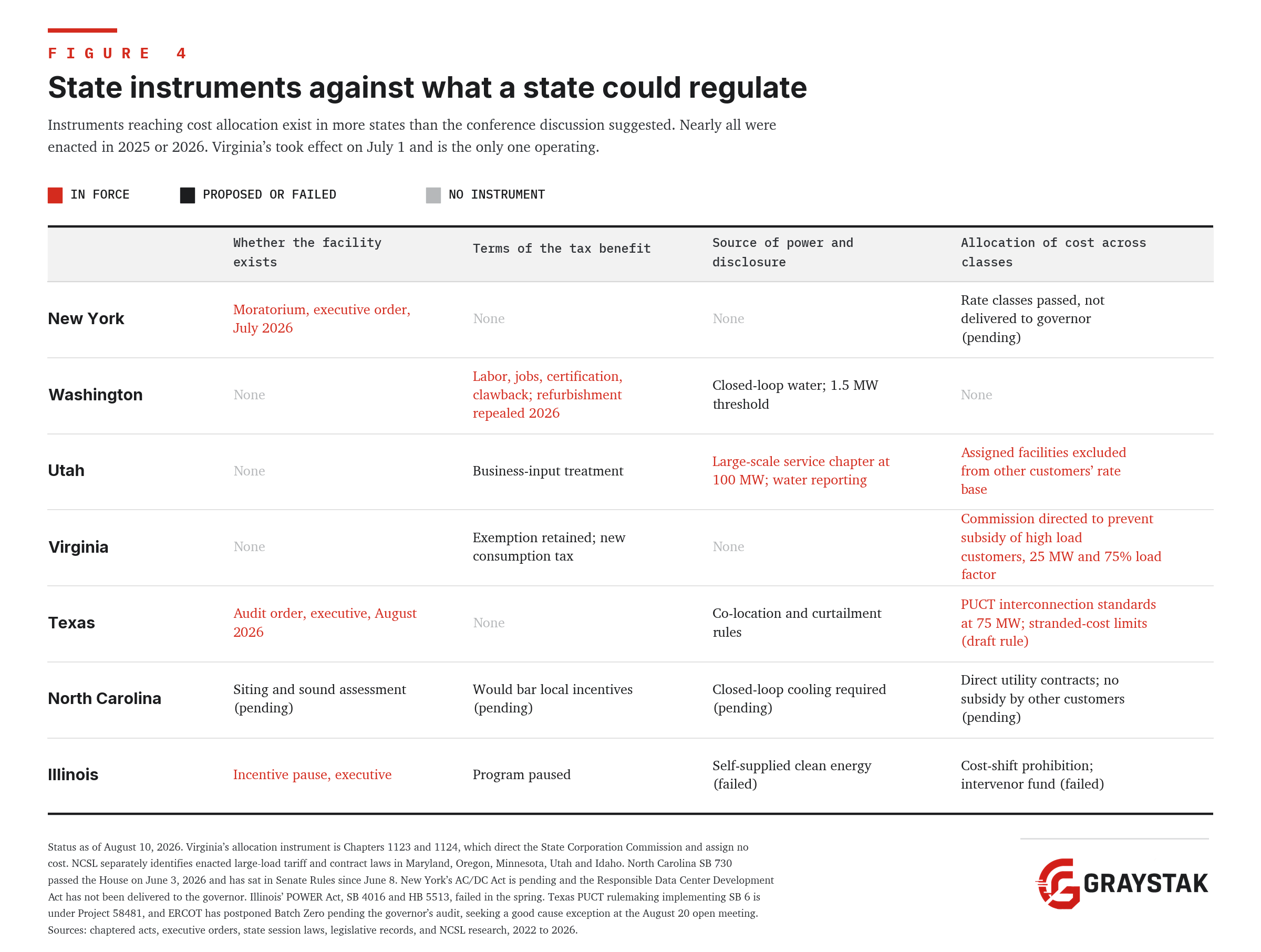
Allocation instruments exist in more places than the room suggested. They are also disproportionately unenacted, while facility instruments are law. Of the four designs presented to legislators on a single afternoon, one reached allocation, and the statute is weaker than the description given from the stage.
The case against this
Ryan Wiser, a senior scientist at Lawrence Berkeley National Laboratory, opened the last session of the day by arguing that the national framing of an affordability crisis misdiagnoses both scope and cause, and that misdiagnosis produces poorly targeted policy.
His account tracks the published work, which was updated in July, days before he spoke. The Berkeley Lab and Brattle data puts inflation-adjusted retail prices in 2025 at 3 percent above 2019 and 6 percent below 2010. It puts the average residential bill at 2.4 percent of household expenditure and 1.8 percent of pre-tax income, both lower than 2010 and near all-time lows. It attributes the 2024 to 2025 increase substantially to natural gas, which rose 36 percent from its 2024 low and drove retail prices in twenty-one states. And it identifies transmission and distribution investment as a principal driver of the longer 2019 to 2025 trend, concentrated in California, New York, and New England, driven by aging asset replacement, hardening, storm cost recovery, wildfire mitigation, and equipment prices running well above inflation.
He also gave a figure from the stage attributing roughly 60 percent of the six-year national price increase to transmission and distribution. That number appears in neither edition of the published work, and this analysis does not use it.
His load growth finding runs against the popular account. States with the most growth over two decades have generally seen prices rise more slowly than inflation. That list includes North Dakota, New Mexico, Nebraska, Virginia, Oregon, and Texas. The states with the steepest increases, including California, New England, and New York, have no load growth at all. He named the two entities most often blamed as hyperscalers and PJM interconnection, and asked the room to widen the aperture.
The same work reports that electricity burden worsened in twenty-seven states and the District of Columbia between 2019 and 2025 and improved in twenty-three. Average burdens exceed 5 percent for the third of households earning under $50,000, and after years of decline those burdens stabilized and then rose. One in six households is behind on energy bills, with arrearages at $21 billion in May 2025. And among low-income households reporting they feel very stressed about rising prices generally, the update puts the incidence of energy insecurity at 22 to 35 percent. It adds further indicators of upward pressure, including gas plant costs running 65 to 90 percent above recent historical builds in real terms, and solar and wind power purchase agreement prices up 60 and 100 percent since 2020.
Three studies published since have made the same case with more statistical force, and together they are the strongest evidence against the premise that data center load raises what other customers pay.
The most rigorous is a working paper by Asa Watten and Geoffrey Blanford of the Electric Power Research Institute and John Bistline of Watershed, titled Have Data Centers Raised Your Electric Bill? Causal Evidence From the United States, posted in June. The authors address the obvious objection to correlation studies: data centers choose states where power is already cheap. They instrument for siting using the 1947 interstate highway plan, arguing that terrestrial fiber follows the highway corridors and that the 1947 plan affects present-day prices only through population, economic activity, and communications infrastructure, the first two of which they control for.
Controlling for that selection, they find that a doubling of a state’s data center capacity caused residential retail prices to fall by about 3.5 percent, holding residential demand fixed. From 2019 to 2024, the average residential customer lived in a state where data center capacity grew 160 percent, which by their estimate left rates 6 percent lower than they would otherwise have been. The mechanism is economies of scale. Because retail rates recover large fixed costs, and because new generation tends to cost less per kilowatt-hour than the embedded mix, durable new demand spreads those fixed costs across more kilowatt-hours and pulls average cost down.
The paper contains one finding that cuts directly against the argument made here. Testing whether data centers lower system costs while shifting them onto households, the authors find that within states an increase in one customer class’s demand is associated with a price decrease for the others, which they read as rejecting the notion of widespread cross-class subsidization. They also note that the first-stage F statistic in their preferred specification is 7.9, below the conventional threshold for a strong instrument, and report weak-instrument-robust confidence intervals accordingly. Restricting the sample to 2019 through 2024 halves the estimated effect, on an instrument the authors report as substantially stronger.
Two other findings run the same direction. The Institute for Energy Research reported in March that the correlation between data center concentration and price increases is statistically insignificant, and that states with growing electricity sales between 2015 and 2025 paid less on average than states where sales declined. The Information Technology and Innovation Foundation argued in April that data centers peak for only a few hours a year, so a facility managing its load around those hours can draw power without adding to system peak, and may improve capacity utilization enough to reduce rates. A June literature survey from Columbia’s Center on Global Energy Policy concluded that recent price increases were driven by factors other than new load.
The authors attach three caveats, and two of them describe this analysis.
The first is supply constraints. They list backlogged gas turbine orders bidding up prices, persistent shortages of transformers and other equipment, tariffs raising the cost of solar, and stalled federal approvals for wind and solar. Each makes new capacity more expensive than it would otherwise be, and possibly more expensive than incumbent supply. Their own remedy for that condition is worth quoting closely: to the extent the constraints are temporary, price increases can be avoided entirely by delaying interconnection or by allocating the inflated incremental cost of grid expansion to rates paid by data centers.
The second is whether the demand is durable. If anticipated load materially exceeds realized consumption, a possibility they attribute to current interconnection queue dynamics, utilities risk overbuilding capacity whose fixed costs then spread across fewer kilowatt-hours, reversing the mechanism they identify. Even where the demand does arrive, they write, capacity investments made in advance could temporarily raise average costs. To address that, they note, states including Kansas, Michigan, and Delaware have pursued financial commitments from new large loads such as minimum bills or long-term contracts.
The third is fuel costs, which they exclude and expect to be small.
The historical finding is about a system with slack, and the authors say so. Their own model separates a regime where the capacity constraint is non-binding, in which new demand lowers average cost, from one where it binds, in which new capacity must be built and the cost of building it enters rates. PJM cleared short of its reliability requirement in each of the last two auctions. That is the second regime, and the authors name allocating grid expansion costs to data centers as the response to it.
The study has also become a political instrument. NetChoice, a technology industry trade association, published it under the headline that data centers are lowering electric bills, and it has been used in an argument against state moratoriums.
Two elements of Wiser’s testimony bear directly on that boundary.
He addressed the PJM case directly, stating that capacity prices there rose dramatically and that the region demonstrates how anticipated load growth combined with supply and delivery constraints produces rapid retail increases. And he stated that the direction and magnitude of load growth’s price effect is not preordained, with legislators, regulators, industry, and the facilities themselves determining whether residential prices rise or fall.
He also placed cost allocation at the center of the regulator’s function, describing it as an established role now facing a new customer class at a scale outside the working experience of anyone in the room, and comparing the growth to the 1970s and 1980s. He noted investor-owned utilities requested roughly $18 billion in rate increases in 2025, a level he placed as unmatched since the mid-1980s.
The published work sets out three factors determining whether load growth raises or lowers prices: how well existing assets can absorb the demand, what the new supply and delivery costs are, and cost allocation and recovery. On the third, it is explicit. Retail prices emerge from the allocation of system costs to specific customers, and allocation practices determine how increases or savings reach different customers and therefore the net impact of demand growth on any given customer’s price.
It then names the instrument, and the July update states it as a slide heading. If growth occurs in a supply- and delivery-constrained environment, protecting households may require allocating more total grid costs to the new loads. Large-load tariffs are the approach it identifies, and the first of the four themes it lists in those tariffs is fairly allocating electricity system costs to cost causers. Janas had used the same phrase an hour earlier.
A national alarm is unsupported, and four independent bodies now say so. A regional risk in constrained grids is supported, including by the authors of the study that most strongly contradicts the national alarm. And the national laboratory raising the objection identifies cost allocation as the determining variable and large-load tariffs as the tool.
What the PJM numbers show
Janas described the mechanism before giving figures. Capacity is a product PJM sells, committing generation to appear in a future delivery year. The independent market monitor produces the analysis. The regional reliability standard is one event in ten years, and the most recent auction cleared short of it.
The market monitor’s published figures differ from the ones given on stage, and they are more precise. In its quarterly report covering January through March 2026, Monitoring Analytics states that including existing and forecast data center load produced a combined increase in capacity market revenues across three auctions, for delivery years 2025/26, 2026/27, and 2027/28, of $23,100,955,341. The underlying analysis is its examination of the 2027/28 base residual auction, published January 5, 2026. The report adds that the total will keep growing until the issues associated with large data center loads are addressed.
On the shortfall, the report is equally specific. PJM’s capacity market failed to meet its reliability objective in the two most recent auctions, and the amount by which PJM is short capacity grew from 208.7 megawatts in the 2026/27 auction to 6,516.6 megawatts in the 2027/28 auction. The monitor’s assessment of the capacity market for that period is that market structure, participant behavior, and market performance were all not competitive, and that the market design is mixed.
A second figure in the same report is the one that matters most for Illinois. Isolating the effect of the price collar that PJM adopted under an agreement with Pennsylvania’s governor, the monitor calculates that the inclusion of data center load in the last two auctions increased customers’ bills by $13,768,851,483 even with the maximum price in place. Without that agreement, the figure would have been $26,852,039,314. The monitor’s reading is that the agreement was a reasonable response to market distortions created by data center load forecasts that should not have been included in the market clearing at all.
That $13.77 billion is almost certainly the source of the $13 billion the Illinois governor’s office cites. The larger $23.1 billion figure measures something different: total capacity revenue increase across three auctions. Both come from the same monitor. A reader encountering the two numbers in different documents would have no way to know they are not in conflict.
But for data center growth, both actual and forecast, the market would not have seen the tight supply-and-demand balance or the high prices, the monitor writes. And the accuracy of those forecasts, the report says, is highly questionable.
Its proposed remedy is a dedicated mechanism. Remove data center load from the next base residual auctions, run a separate backstop auction for data center load alone in which the only sellers are new generation, and settle the results into fifteen-year bilateral contracts between individual data centers and individual generators. Load that came online after June 1, 2026 would participate in that auction or commit to bringing its own new generation. Load that did neither would be curtailable.
The monitor draws a distinction between two words often used interchangeably. Costs and risks, it argues, must be assigned directly to data centers and not allocated. Assignment means a binding contract between the data center and the generator, with no credit or cost support from other customers. Allocation, in its words, is a regulatory concept implying a fluid mechanism that is not binding and that could be modified to shift those costs to other customers in the present or in the future.
The question was put to the panel by the senator moderating it. Large infrastructure investments are justified on future growth projections, Rezin said, and asked how states should evaluate those projections and manage the risk if the growth does not materialize. Janas answered it first.
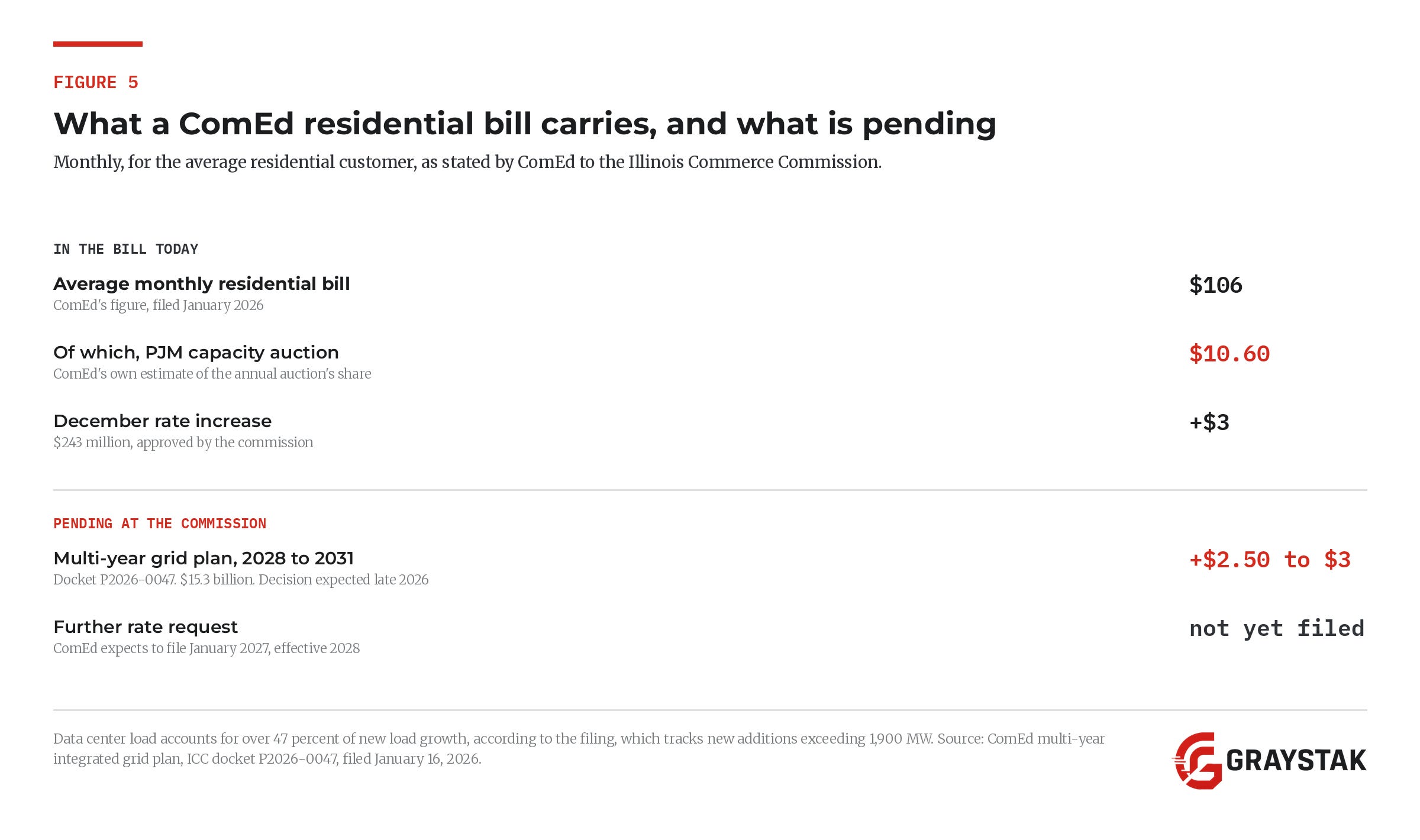
Those totals reach households as a line on a bill. ComEd told the commission its average residential bill is about $106 a month, and has told its customers that the annual PJM capacity auction adds roughly $10.60 of it. A December rate increase of $243 million added a little over $3 a month. The company expects to file a further rate request in January 2027 that would take effect in 2028.
ComEd projects its average residential customer at 1.41 percent of household income in 2028, up from 1.23 percent in 2026, reaching 1.48 percent by the third year of the plan. The company sets those figures against a national average it puts at about 3 percent.
She also named where that work happens. Her office and the consumer advocates across the region appear before state public utility commissions and at the Federal Energy Regulatory Commission. Neither is a legislature.
What counts as grid-wide benefit
The standard that governs allocation surfaced in an exchange between the load and the state.
Sundstrom stated Amazon’s position in terms close to Janas’s. The company will not be responsible for consumer price impacts on electricity, and reaches that by paying full cost of service for the infrastructure it uses. He reported intervening directly or through the industry in at least fifteen state utility commission proceedings on how much large loads should pay. Amazon’s answer is as much as it takes. He identified converging terms across states: long-term contracts, capital up front as evidence a project is real instead of speculative, and exit fees holding remaining customers whole.
He then named two states where he said such structures are beginning to lower costs for other customers. Both exist. Only one of them is documented.
In Indiana, regulators approved the separate generation company behind the arrangement in September 2025 and approved the Amazon contract itself on June 17, 2026. Amazon pays to use existing lines and covers the cost of new plants, lines, and equipment required to serve it. The structure supports up to 2,400 megawatts of Amazon load with 3,000 megawatts of new generation. Estimates of what that saves other customers vary by who is producing them and when. Amazon and NIPSCO cited roughly $1 billion in bill credits over the fifteen-year contract at filing, NiSource put its own model at $1.25 billion in April, and at approval in June the company put customer benefits at about $1.4 billion. A separate Indiana Michigan Power settlement with Amazon, Google, and Microsoft requires large load customers to make long-term financial commitments so the cost of serving them is not passed to existing customers. Mississippi is the other case. Amazon announced two hyperscale facilities in Madison County in January 2024, and Entergy Mississippi serves them under an agreement that is confidential, including the rates Amazon pays. The utility says confidentiality is ordinary for large industrial contracts and points to past agreements with Nissan and Continental Tires. What is unusual is the statute passed in special session that same month. It allows Entergy to build generation for the project without the commission’s prior approval, lets the utility begin recovering construction costs before facilities enter service, and lifts the cap on annual rate increases tied to that spending. The related investments are spread across at least five dockets covering substation and distribution work, the new power stations, and successive formula rate plan filings. Entergy separately credits revenue from Amazon and other large industrial customers with funding a $300 million grid reliability program there, which the utility says comes at no additional cost to residential customers and targets a 50 percent cut in outages over five years.
Berkeley Lab’s own compilation carries the same Indiana figure, listing NIPSCO’s estimate of $1 billion in bill credits over the fifteen-year contract, which it puts at $7 to $9 a month for residential customers beginning in 2032. It appears alongside comparable claims from seven other utilities, including Entergy’s projection of $5 billion over twenty years across Arkansas, Louisiana, and Mississippi.
Two qualifications belong with those facts, and the second is the lab’s. The savings figures are projections by the companies and utilities involved, not realized outcomes. And the analysis Amazon relies on for the broader claim was commissioned by Amazon. The consultancy E3 examined four utility territories, one of which is Dominion Energy in Virginia. Dominion’s state policy lead had spoken on the previous panel. That study found data centers generate enough revenue to cover their costs and often a surplus, projecting $3.4 million in surplus utility revenue in 2025 for an assumed 100-megawatt facility, rising to $6.1 million by 2030.
Berkeley Lab presents the same list of utility claims and then attaches a caution to all of them. These are possible or stated benefits, and there is risk that the new tariff structures will be insufficient to fully protect other customers.
There is a commitment on the record beyond anything said in Chicago. On March 4, seven companies signed a Ratepayer Protection Pledge at the White House: Amazon, Google, Meta, Microsoft, OpenAI, Oracle, and xAI. Announced in the State of the Union ten days earlier, it commits signatories to build, bring, or buy new generation, cover the cost of power delivery infrastructure upgrades, pay negotiated rates whether or not they use the electricity, invest in local hiring, and coordinate with grid operators. A proclamation issued at the signing declared that the commitments effectuate the national policy of the United States, and the pledge was issued as Proclamation 11014 and published in the Federal Register five days later.
It carries no penalties and no enforcement language. Ari Peskoe, who directs Harvard Law School’s Electricity Law Initiative, has argued it does nothing to help consumers, on the grounds that states and public utility commissions control rate structures and the White House and the signatories do not. The pledge has since expanded well past the original seven, and the White House now counts hundreds of signatories including utilities and 23 states.
Three companies made individual commitments in the weeks around it. Microsoft announced an initiative in January. OpenAI followed. On February 11, Anthropic said it would pay for 100 percent of the grid upgrades needed to interconnect its data centers, through increases to its own monthly electricity charges, including the share of those costs that would otherwise pass to consumers. It said it would work with utilities and outside experts to estimate and cover demand-driven price effects, bring new generation online to match its facilities’ consumption, and invest in curtailment systems to reduce draw during periods of grid stress. The company operates facilities in Mitchell County, Texas, Niagara County, New York, and southeastern Louisiana, and said that where it leases capacity instead of operating its own sites it is still examining how to address the effect of its workloads on prices.
These are corporate commitments, not tariffs. Whether any of them binds depends on a rate case.
E3 attaches its own qualifier. Whether that surplus reaches other customers’ bills is up to the utility, and may need a regulator’s approval.
Then he addressed Janas by name. His words were that to the extent large loads are driving new costs in the system, we should pay for that.
He added a qualifier in the same breath. Some of the infrastructure being proposed carries grid-wide benefits, so an arrangement is appropriate where the benefit to other ratepayers is balanced against what is required to accommodate a large load.
Where Amazon puts its effort points at legislatures. He said America’s ability to build energy infrastructure runs through state and local permitting, and cited Ohio legislation the company worked on constraining how long the state siting board may take to act on a complete application, giving nine months as reasonable against a process that has run past two years. He is based in Columbus. He said Amazon reached a 100 percent renewable matching goal seven years ahead of a 2030 target, described leading the investment round in X-energy with a commitment to deploy at least five gigawatts across the company’s footprint, and said Amazon designs chips running at roughly 60 percent higher energy efficiency than market alternatives.
Amazon did not respond to questions about the Ohio legislation, the renewable matching claim, or the chip efficiency figure, all of which are the company’s own accounts of its record.
Where Amazon wants speed it goes to the legislature, on permitting and siting timelines. Where the cost question is decided it appears at commissions, in at least fifteen proceedings by his own count. The company works both, for different things.
The balance he described requires a determination of which costs qualify as grid-wide benefit. That determination occurs in the same proceeding that sets the allocation, under the same commission, on a record built by the parties who appear. Janas stated that consumer advocate offices appear under-resourced.
The largest data center operator in the country and the office that litigates rates against it agreed on the principle, in the same room, on the same afternoon. They diverge on the standard, and the standard is set where the parties appear. Whether the Indiana and Mississippi structures perform as described is answerable from the dockets.
Why legislatures work the facility instead
There is an obvious objection to everything above, and no one in the room raised it. If the outcome is set at the commission, legislatures that spend their sessions on tax exemptions and moratoriums are choosing badly. The choice may be rational.
A public utility commission is not an elected body in most states. Illinois has five commissioners, each appointed by the governor to a five-year term and confirmed by the Senate, with no more than three from the same party. The chairman is designated by the governor. The commission was created by the General Assembly in 1921 to administer the Public Utilities Act, and it holds the authority the legislature gave it.
A rate case runs on its own calendar, in filings, discovery, testimony, and briefs, before administrative law judges, over months. Participation requires counsel and expert witnesses. The parties who appear are the utility, its large customers, the commission staff, and whatever consumer representation the state funds. Amazon appears in at least fifteen of these proceedings by its own count. Janas described consumer advocate offices as going in under-resourced.
Murray laid out the layers from the utility side, answering a question about whether states should take siting authority from local bodies. A power plant needs approvals at all three levels of government. A local land use approval, in a locality that may not be the one being served. A state public utility commission approval. A state environmental agency acting as an agent of the U.S. Environmental Protection Agency for an air or water permit. And if wetlands are involved, the U.S. Army Corps of Engineers. That, he said, is just the top line.
A legislature can move faster than that, and in public. A moratorium is legible to a voter in a way a docket number is not. A tax exemption can be repealed in one session by people who face election. Those are real advantages, and they explain a great deal of what state legislatures did in 2026.
Janas made the point about herself. She told the room it was an honor to speak on the panel because she once served on legislative staff, and did not know then what she did not know. She said she had been fortunate that people from industry and government came to her office to explain what was going on.
Illinois shows the limit of the alternative. Every member of the commission that would implement a data center rate class was appointed by the governor who proposed one. He still could not deliver it, because the instrument he described needs statutory authority the legislature declined to pass. Controlling the commission is not the same as having the law that tells it what to do.
Which is the shape of the problem. The venue that decides the cost is slow, technical, expensive to enter, and staffed by appointees. The venue that is fast, public, and accountable to voters does not reach the cost. Legislatures are not making an error when they work the facility. They are working the tool they have, and the POWER Act’s intervenor compensation fund was an attempt to make the other tool usable.
Michigan is writing the labor conditions into the rate
On June 18, Michigan Senate Democrats introduced a six-bill package on data centers, Senate Bills 1046 through 1051, spearheaded by Sen. Rosemary Bayer. Two of the bills operate at the commission. Senate Bill 1048, from Sen. Kevin Hertel, adds a new section to the state’s 1939 public utilities act, and its own title states the purpose: project labor agreements and prevailing wage and fringe benefit rates, required for certain data center contracts. It would bar the Public Service Commission from approving any contract, discount, or rate between an electric utility and a data center unless the project uses apprentices in programs in good standing with the U.S. Department of Labor, pays the area’s prevailing wage or minimum wage, whichever is greater, and performs work under a project labor or collective bargaining agreement. Senate Bill 1047, from Sen. Mallory McMorrow, would require utilities to create a separate rate class for large-load customers, require those customers to use clean energy, and limit their operations during an energy emergency. The remaining four bills bar public officials from signing data center nondisclosure agreements, require community benefits agreements before construction and operation, and set permitting and public hearing requirements for consumptive water use above 550,000 gallons a day.
Michigan would attach Washington’s labor conditions to the rate and pair them with the rate class the Illinois governor proposed. Whether either passes is a separate question, and both were introduced in June. Together, they attempt at the commission what the rest of the country has been attempting through tax law.
Illinois
The state has fourteen weeks to decide which of these it wants, and every condition above holds there. It sits inside PJM, which serves 67 million people across thirteen states. It hosts at least 222 data centers, more than 160 of them in Chicago, with more than a hundred planned or under construction. Sources differ on whether that ranks the state fourth or fifth nationally. The state’s 2024 report put at least 27 of those facilities as having received incentives with an estimated lifetime value above $983 million. Its reform bill failed. Its incentive program is paused by executive action. And it already operates the regulatory machinery at issue.
The failed legislation was the POWER Act, for Protecting Our Water, Energy, and Ratepayers. Senate Bill 4016, carrying the short title Hyperscale Data Centers, was filed on February 6, 2026, by Sen. Ram Villivalam of Chicago, with House Bill 5513 as the companion, carried by House Majority Leader Robyn Gabel of Evanston. It ran to 638 pages by the count of the Data Center Coalition, whose state policy director said layering it onto existing conditions would close the Illinois market.
Its provisions reached past the facility. The bill amended the Environmental Protection Act, the Energy Efficient Building Act, the Illinois Power Agency Act, and the Public Utilities Act, adding three new sections to the last of those. It required cumulative impact assessments, public notice, and community benefits agreements, and prohibited nondisclosure agreements. It mandated water resource planning, quarterly water usage reporting, water scarcity plans, and water impact permits with public hearings and five-year renewal. It required annual energy and water reporting to the Illinois Commerce Commission. And it created two funds financed by annual fees based on peak demand: a Hyperscale Data Center Public Benefits and Affordability Fund, and a Data Center Community Intervenor Compensation Fund.
It never received a committee vote. The Senate assigned it to Executive on February 24 and routed it to a subcommittee on AI and social media the following day. Committee deadlines were extended four times, from March 27 to April 24 to May 15 to May 22. On May 22, it was re-referred to Assignments under Rule 3-9(a), the procedure by which Illinois bills are parked. Senators kept signing on afterward. Three more co-sponsors were added on May 28 and May 30, bringing the total to twenty-one.
An intervenor compensation fund pays communities to participate in commission proceedings, which is where the allocation is decided and where, by the attorney general’s own account, consumer advocates appear under-resourced. Illinois wrote a bill that reached the venue. It failed.
After it died, the governor directed the Department of Commerce and Economic Opportunity to pause processing new Data Center Investment Program agreements starting July 1, in a release whose first sentence reads: following inaction from the Illinois General Assembly. Existing agreements are honored. Ohio’s governor halted that state’s credits the same week pending an economic impact study.
What is worth noticing is what the same release proposed, and that its framework mirrors many provisions of the bill that had just failed. The framework runs seven pillars, and the first is titled Data Centers Should Pay Their Fair Share. It calls for creating a rate class for data centers and establishing data center electricity rates; assigning the costs data centers impose on the grid to that class, including distribution, generation, and transmission where possible; assigning the costs they impose on water systems; setting efficiency requirements; and ensuring every utility in the state is equipped to fairly manage and allocate the cost of data center demand.
Everything in that pillar happens at the commission. Everything the governor actually executed happens at the facility. He proposed the first and did the second, because the first needed a legislature and the second did not.
The remaining pillars extend past cost, covering interruptible service scaled to self-supplied clean energy, comprehensive water permits, clean air standards for on-site generators, and a transparency pillar that would ban nondisclosure agreements between data centers and local governments.
The release also puts numbers on the stake. It states that data center demand has already raised costs in PJM by $13 billion and could raise costs another $37 billion in Illinois alone in coming years. The second figure traces to a Union of Concerned Scientists analysis finding that data centers could account for up to 72 percent of Illinois electricity demand growth by 2030. The first tracks the market monitor’s calculation, published in its quarterly report, that data center load increased customers’ bills by $13.77 billion across the last two auctions even with the price collar in place.
Janas raised specific objections to two Illinois mechanisms in front of a national audience five months before the session that determines what replaces them. On performance-based metrics, she asked what behavior is being incentivized and whether it is behavior already owed, comparing it to paying a lawyer extra for honesty, and noted the metrics add incentive points to utility profit. On multi-year rate plans, she noted that forecast reliability declines with horizon.
Both chambers have published identical veto calendars: six session days, November 17, 18, and 19, and December 1, 2, and 3. The General Election falls on November 3, so the General Assembly convenes two weeks after members face voters, and some of those voting on the framework will not be returning. Six days determine whether the state’s response rests on the framework or on the pause.
There is already a proceeding. On January 16, ComEd filed its multi-year integrated grid plan for 2028 through 2031 with the Illinois Commerce Commission, docket P2026-0047, at $15.3 billion and more than 800 pages. It proposes three new substations in Chicago and two elsewhere in northern Illinois, with added capacity at more than seventy existing ones. In the chapter covering capacity planning, ComEd told the commission that load growth is localized primarily across 55 substations, and that it is tracking new load additions across the system exceeding 1,900 megawatts, roughly 9 percent of its system peak forecast. Data center load, the filing states, accounts for over 47 percent of that new load growth. The commission has eleven months to review it, placing a decision near the end of this year. If approved in full, ComEd expects residential customers to pay $2.50 to $3 a month more starting in 2028.
The parties are already assembled. The Citizens Utility Board, created by the legislature, called the plan bloated and expensive and has lawyers reviewing it for what it calls wasteful and unnecessary spending. The building owners association intervened for its members. The attorney general’s office will have the opportunity to submit testimony, as will environmental advocates.
Two related proceedings are running at the same time. ComEd filed requests last year at both the Illinois Commerce Commission and the Federal Energy Regulatory Commission that would require large applicants such as data centers to make financial commitments tied to transmission service thresholds, which the company says is designed to keep the cost of accommodating them off other customers. The attorney general’s office filed objections at FERC, writing that the proposed agreements fail to adequately protect other customers.
The instrument Illinois will argue about in November is a rate class that does not exist. The infrastructure that would be assigned to it is already before the commission, in a plan filed seven months ago, in a docket where the utility, the consumer advocate, the attorney general, and the commercial building owners are all parties and the legislature is not. The attorney general’s office has already told a federal regulator that ComEd’s own proposal to keep those costs off other customers does not go far enough.
Whether the attorney general’s office intends to intervene at the Illinois Commerce Commission on large-load tariff design is a question for the office, and one it invited. Janas twice asked legislators to consult consumer advocates on the grounds that the work requires explanation.
The state has also been working a venue outside its own borders. In January the governor joined a bipartisan group of governors across the PJM region in calling on the grid operator to adopt six principles, one of which would allocate the cost of any new capacity to data centers. In April that coalition wrote again, crediting an extension of the capacity market price collar with roughly $18 billion in consumer savings and another $27 billion expected. In a separate letter with New Jersey’s governor, Pritzker added that implementation of those principles must also ensure that clean, cheap energy growth is not sabotaged.
Losing the bill did not end the effort. It moved it. With no statute to work with at home, the governor took the cost question to the regional grid operator, where the capacity price is actually set.
What would falsify this
Six things would break this, and all six are testable inside three years.
If a state repeals its exemption or enacts a moratorium while leaving allocation and utility capital incentives unchanged, and residential rates improve relative to comparable states, the claim is wrong. Washington and New York are running that experiment now.
If commissions disallow imprudent large-load infrastructure at a rate sufficient to return forecast risk to shareholders, the third premise weakens substantially. This is answerable from disallowance records and is not established here.
At least seven states have now enacted an instrument reaching cost allocation, nearly all of them in 2025 or 2026. If residential rate outcomes in those states diverge favorably from states relying on facility instruments, the argument is confirmed. If they do not, it fails. The comparison becomes available within two to three rate cycles.
If the Indiana and Mississippi structures demonstrably lower costs for other customers, the convergence between Amazon’s position and the consumer advocate position is real and the contested term matters less than argued.
If clean firm generation arrives materially earlier than the suppliers’ own filings indicate, the gap shortens and the capital added to the existing system shrinks with it.
If the EPRI result continues to hold through the current period, in constrained regions and not only on a national average, the allocation question is smaller than argued here. The authors themselves identify supply constraints as the condition under which their finding would reverse, which makes PJM the place to test it.
What the room asked for
The two people on opposite sides of the cost fight that afternoon closed their remarks the same way.
Murray told the legislators that the most important agency they never think about is their state public utility commission, and asked them to give it the resources it needs to do its job. Janas asked them to talk to their state consumer advocates, and to fund them, because those offices go in under-resourced.
A utility executive and a state lawyer who litigate against each other in front of the same body spent their closing minutes asking a legislature for appropriations instead of statutes.
Every state law described here operates on allocation, the term the market monitor calls fluid and modifiable. So does the framework the Illinois governor proposed. So do the Michigan bills. None of them assigns a cost to a data center in the way the monitor means it, through a binding contract with a generator and no support from anyone else.
Whether that distinction survives contact with a rate case is the thing to watch. The first test comes in Austin on August 20, when the Public Utility Commission of Texas takes up the grid operator’s request to move a queue the governor has frozen. Springfield follows on November 17. The Texas rule is expected in December, and the ComEd docket closes around the same time.
Method and sourcing
The evidence base is three sessions at the NCSL Legislative Summit on Monday, July 27, 2026, at McCormick Place West in Chicago. They ran consecutively in the same building, on emerging energy technologies at 1:15, data center policy at 2:45, and energy demand and affordability at 4:00. Speakers on each referred to the others. The author attended all three and recorded them for note accuracy, a practice disclosed in writing to NCSL press staff beforehand. Nothing was recorded for rebroadcast, and no audio or video is published. Every statement attributed to a speaker here comes from the sessions themselves or from written comment requests sent afterward. No conversation took place off the record, and no source in this analysis is unnamed. Speaker statements have been checked against statutes, legislative bill reports, agency dockets, executive orders, market monitor reports, and securities filings.
Legislative records are from the Illinois General Assembly bill status system, the Michigan Legislature, and the Utah Code as published by the Utah Legislature. Indiana and Mississippi are drawn from Indiana Utility Regulatory Commission filings and orders, and from Mississippi Public Service Commission dockets and contemporaneous reporting on the 2024 statute. State legislation outside Illinois is cited to primary records: the enrolled text of Texas Senate Bill 6 and Public Utility Commission of Texas filings in Project Nos. 58317 and 58481; the North Carolina General Assembly bill history and roll calls for Senate Bill 730; the Washington session law for Engrossed Substitute House Bill 1846, Chapter 267, Laws of 2022, including the governor’s partial veto message; the New York Senate and Assembly floor vote records for Assembly Bill 11560 and the text of Executive Order 62 as published by the governor’s office; and the Virginia Legislative Information System histories and chaptered texts for House Bill 1393 and Senate Bill 253. Illinois utility figures are drawn from ComEd’s multi-year integrated grid plan for 2028 to 2031, filed January 16, 2026 in Illinois Commerce Commission docket P2026-0047. The load growth figures are from Chapter 4 of that filing, on capacity planning and management investments. Bill impact and process figures are as reported by Capitol News Illinois. Counter-evidence is drawn from Watten, Bistline and Blanford, Have Data Centers Raised Your Electric Bill? Causal Evidence From the United States, arXiv:2606.19777, June 18, 2026; from the Institute for Energy Research, March 2026; from the Information Technology and Innovation Foundation, April 2026; and from Columbia University’s Center on Global Energy Policy, June 2026. PJM capacity market figures are drawn from Monitoring Analytics, 2026 Quarterly State of the Market Report for PJM: January through March, published May 14, 2026, and from the market monitor’s Analysis of the 2027/2028 RPM Base Residual Auction, Part A, published January 5, 2026. Nine parties were sent written questions on July 31 with a response deadline of August 7: the Illinois attorney general’s office, the Department of Commerce and Economic Opportunity, the governor’s office, Sen. Rezin’s office, Amazon, Associated Builders and Contractors, Grid Strategies, Fervo Energy, and Monitoring Analytics. Grid Strategies and Associated Builders and Contractors responded, and their answers are attributed in the text. The others did not respond by the deadline, and are identified as such wherever their answers would bear on a claim. State counts are from NCSL, Data Centers: Legislative Trends, May 2026, and from the Rockefeller Institute of Government, June 2026. Berkeley Lab figures are drawn from Wiser et al., Retail Electricity Price Trends and Drivers: Data Update, 2026 Edition, July update, published July 2026, and from the companion peer-reviewed article by O’Shaughnessy et al. in Joule. Statements are attributed as made from the stage and, where quoted directly, cleared against the recording. Where a speaker’s characterization of a statute differs from the enacted text, both are reported and the difference is shown instead of asserted. That comparison carries a built-in yield, since a spoken summary is looser than a statute in every case. The cases where the description matched are reported at the same length as the cases where it did not. Berg’s account of the Washington conditions holds against the statute, and Cutler’s business-input defense of the Utah exemption survives the text.
Speakers are identified by title and employer, or by office and jurisdiction. Statements about institutional interests are drawn from the public record or from the speakers’ own accounts.
Disclosures
GrayStak holds no position in any company named in this analysis, and neither does the author.
GrayStak Media accepts no sponsored content and no advertising from politically interested parties. Its reporting operates independently of GrayStak’s analytics business, under separate editorial direction. The author attended the Legislative Summit under media credentials, identified as press in every exchange, conducted no off-the-record conversations, and solicited no business at the event.
Anthropic is named twice in this analysis: once as the subject of a revenue projection cited by a legislator from the stage, and once for its own February 2026 commitment on electricity costs, reported here alongside those of Microsoft and OpenAI. GrayStak uses commercially available AI tools, including Anthropic products, in its research and production workflow. GrayStak has no financial interest in Anthropic and no commercial relationship beyond ordinary paid use of its products. This disclosure appears here, at the end of the analysis.
Corrections. GrayStak Media corrects errors of fact in place and on the record. A correction is appended to this analysis with the date, a description of what changed, and the wording that was replaced. The original wording is stated rather than removed. A correction that changes a finding is noted at the top of the piece as well. Requests for correction go to the address at the foot of this analysis and are answered, whether or not a correction results.
Christopher Sweat covers Chicago and Illinois government from the public record, reporting local social and political dynamics for a national and international audience. He spent his career in enterprise technology, from telecom to colocation to AI infrastructure. He is the CEO and Co-Founder of GrayStak.
GrayStak is a media and political risk company covering political and institutional risk across the United States, centered in Washington, D.C., New York, and Chicago. Its real-time Domestic Political Volatility Index measures the velocity and volatility of U.S. domestic politics. Ryan David Lazarus is Editor-in-Chief of GrayStak Media.
Editorial correspondence and corrections: christopher@graystak.com