

The Chicago City Council filled the last open slots on two election ballots Wednesday. When the chamber adjourned at 12:26 p.m., the millionaire tax question had no city ballot left to reach. No alderperson voted against it.
GrayStak covered the day from inside City Hall: the council chamber for the morning session, and the mayor’s press availability on the fifth floor two hours after adjournment. The story runs in that order. The morning closed two ballots and ended the tax’s last floor move on a one-day filing defect. The afternoon put Mayor Brandon Johnson in front of the press corps, where a veteran reporter asked whether he was bashing the council and Johnson answered, “Until somebody come and get me, I’m here.”
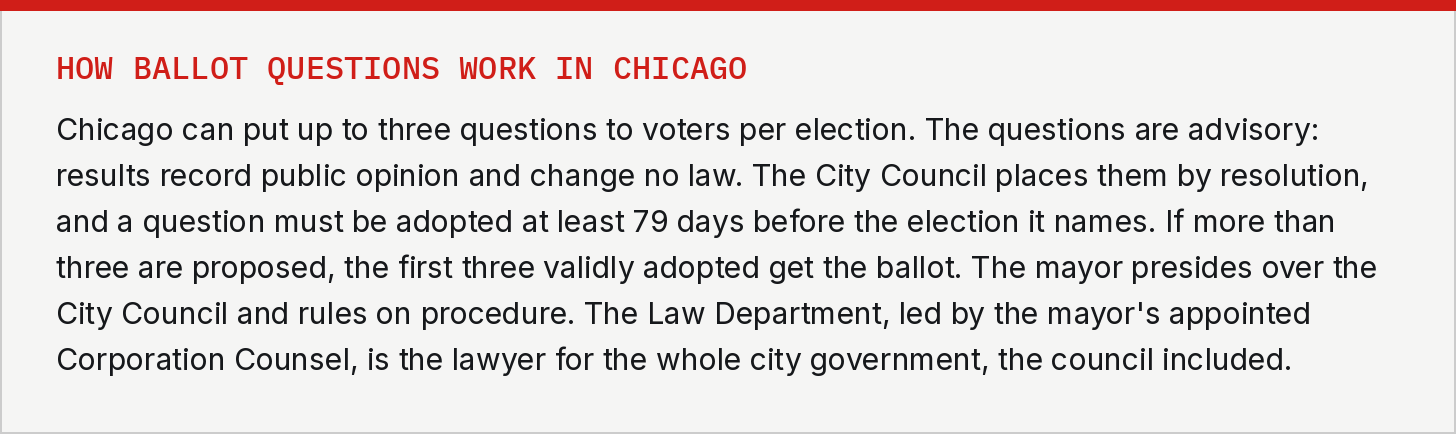
The exclusion was procedural. Illinois law caps public questions at three per government per election, and when more than three are initiated, the first three validly initiated take the ballot. A separate provision requires council resolutions initiating public questions to be adopted at least 79 days before the election they name. Those two provisions, plus a routine adjournment ordinance, combined to shut the tax question out of the November and February elections. [10 ILCS 5/28-1; 10 ILCS 5/28-2(c)]
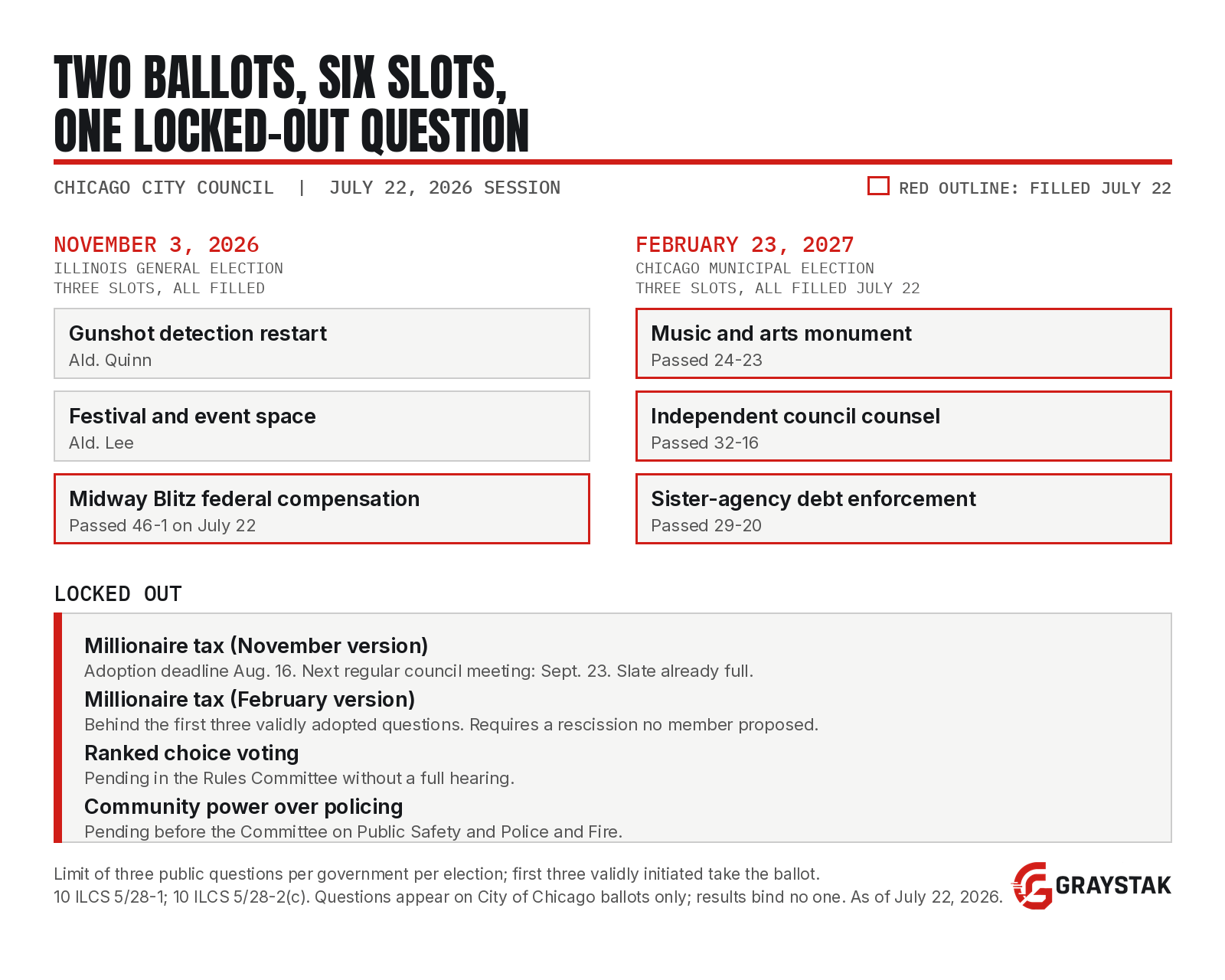
The November 3 ballot filled first. Two questions already held slots: Ald. Marty Quinn’s question on restarting the gunshot detection technology the city stopped using in 2024, and Ald. Nicole Lee’s festival and event space question. The third went Wednesday to the mayor’s priority, a question on whether the city should seek compensation from the federal government for Operation Midway Blitz, last fall’s immigration enforcement operation. It passed 46-1, with Ald. Anthony Napolitano (41st) the sole nay. At his afternoon press availability, Johnson described the question as addressing “reparations for communities that experienced hardship.”
The filled November slate had an immediate consequence. Ald. Samantha Nugent moved to table her own resolution, a November question on whether the city should make its pension contributions in the first quarter of each year “to reduce long-term debt.” Her stated reason from the floor: “since the city is limited to three advisory referenda under state law.” The pension question lost its slot to the immigration question. It died by voice vote without debate.
The February 23, 2027 ballot filled next. Three questions passed in sequence: a monument to Chicago’s contributions to music and the arts, 24-23; an independent legal counsel for the City Council, 32-16; and a funding sanction on sister agencies that fail to enforce employee debt repayment, 29-20. Under the first-three rule, those three now occupy the February ballot. Ald. Michelle Harris moved to reconsider each vote immediately after passage, a standard protective step: once a reconsideration motion fails, council rules bar the vote from being reopened later.
The February limit excludes the millionaire tax question. The council’s Rules Committee, which controls what reaches the floor, killed the original resolution on July 9. Its sponsors refiled it on July 15 as two ordinances, one naming the November election and one naming February (O2026-0027073 and O2026-0027074). Both sit in committee. The November version must be adopted by August 16 to meet the 79-day statutory deadline, and the adjournment ordinance passed Wednesday sets the council’s next regular meeting for September 23. The February version now stands behind three validly initiated questions on a three-question ballot. Reviving it would require the council to rescind one of Wednesday’s resolutions. No member proposed that.
Debate ran longest on the monument question. Ald. Byron Sigcho-Lopez (25th) called it “an insult to our city” to ask voters about a monument while Chicago Public Schools face what he described as a $700 million deficit. He said the governor, “who is another billionaire, does not give help to the Chicago Public Schools,” and told colleagues that “blocking the will of the people will be met at the ballot box in February.”
Ald. Andre Vasquez (40th) spoke next and narrowed the stakes: members who voted against the tax referendum “did not actually block a millionaires tax. They blocked the question asking people if they want to have millionaires get taxed. I’m sure the city would say yes, let’s tax the rich. It’s not actually doing it.” He then raised a different pending item: a ranked-choice voting question sitting in the Rules Committee without a full hearing, and argued for pausing the February votes until the committee items could be debated. Ald. Anthony Quezada (35th) cited another: a community power over policing question he sponsors, pending before the Committee on Public Safety and Police and Fire. He said residents “would love to figure out if we should be buying back the parking meters,” and told colleagues he did not question the merit of the three questions before the body, only “the timing and our ability to have meaningful dialog.” The votes that followed filled the slate and closed it to every question still in committee.
Graphic: GrayStak Media.
A one-day filing defect removed the last tax vehicle
The final millionaire tax move of the session died in miscellaneous business, the end-of-agenda slot for items brought straight to the floor. Harris deferred to Sigcho-Lopez, who had filed the only item. Before he spoke, Ald. Anthony Beale rose on a point of order, a procedural objection the presiding officer must rule on: the Rule 41 notice behind the item was filed Thursday, one business day past the Wednesday deadline.
Rule 41 governs how items reach the floor. All proposed legislation is automatically referred to committee, and discharging an item to the floor requires written notice to the city clerk and all alderpersons by close of business on the fifth business day before the meeting. The immigration question and Nugent’s referendum package reached the floor the same way, on timely notices. Sigcho-Lopez’s notice missed by one day.
Beale moved to lay the item on the table, which would have set it aside for the day without a vote on its merits. Johnson, who presides over the council as mayor under state law, went further, ruling the item out of order entirely, with no need to table. The distinction carried weight. A table motion requires a roll call, and the council had defeated three of them that morning. A ruling requires no vote from anyone, and an item ruled out of order, unlike a tabled one, was never before the body at all. No member moved to appeal the ruling. Sigcho-Lopez told GrayStak after the session that the item concerned the millionaire tax.
His response from the floor accepted the ruling and credited “the ruling of the legal counsel,” which he said showed the counsel’s independence. He then said the episode showed the lack of integrity of those who continue to block the millionaire tax. The chamber rose against him. Over the objections, GrayStak observed Sigcho-Lopez address the body directly: “All of you. All a bunch of clowns.” The chair closed the episode from the rostrum: “It’s good to know that we have all of these parliamentarians here today.”
“All of you. All a bunch of clowns.”
The official who made the ruling is the tax’s leading proponent. After what GrayStak observed as a consult at the rostrum, Johnson ruled his signature policy’s last floor vehicle of the session out of order.
At his press availability, Johnson described where the effort goes next. “I’m going to continue to push along with Speaker Welch to ensure that we have a millionaires tax,” he said, referring to Illinois House Speaker Chris Welch. After Wednesday, the question cannot reach a city ballot before 2028 unless the council rescinds one of its own resolutions.
The counsel question passed over the mayor’s bloc
The independent counsel question drew the day’s clearest split between the mayor’s allies and the rest of the council. The resolution, sponsored by Alds. Brendan Reilly (42nd) and Scott Waguespack (32nd) and introduced May 20, puts this text before February voters:
“Should the Chicago City Council establish and fully fund its own independent legal counsel separate from the City’s Law Department?”
The resolution’s stated grounds are structural. The Corporation Counsel leads the city’s Law Department: appointed by the mayor, the office is the lawyer for all of city government, the council included. The resolution’s whereas clauses, its preamble, note that the Corporation Counsel is appointed by the mayor and “serves as the legal adviser for the whole of City government,” and that advising the executive and legislative branches at once “can present a conflict of interest” or at least its “strong appearance.” The document names no specific dispute.
The floor debate supplied the specifics. Vasquez cited the parking meter deal, telling colleagues the corporation counsel “explicitly isn’t able to talk to us about it” and warning that members would eventually be asked to vote on a parking meter matter without independent advice. Ald. Jason Ervin, the Budget Committee chair who functions as the mayor’s de facto floor leader, answered Vasquez directly: the corporation counsel’s silence on the parking meter deal “is precisely why we have walls in that department,” the same confidentiality “afforded to everyone who seeks counsel from the corporation counsel.” He added that the Legislative Reference Bureau, the council’s in-house drafting office, already serves members and that the council has “representation provided by corporation counsel through the form of special counsel with Jones Day.” In a later turn, Ervin drew a line the rostrum had not: having someone “officially represent us” outside the corporation counsel “would require a change in state statute,” while the council can seek independent advice from anyone it designates today. GrayStak could not locate a public record of a Jones Day arrangement by publication; the statement is Ervin’s, from the floor, and the underlying contract records are requestable. His office did not respond to a request to identify the arrangement.
The legal question surfaced on a point of information from Ald. Lamont Robinson, who asked how an independent counsel would be structured and offered his own reading: “In my thought, we would have to go to the General Assembly.” The answer from the rostrum ratified his premise: “You are right that this provision within city code is established by the state of Illinois.”
The exchange escalated from there. Johnson made the position categorical: “The body cannot establish its own independent legal counsel without the authority being granted by the state of Illinois. That is the law.” When Vasquez confirmed the same criterion would apply to a millionaires tax, Johnson answered, “Thank you for checking,” then asked the chamber: “Does anybody else want to check on what is the authority of the state of Illinois?” By GrayStak’s observation, his voice rose and stayed raised for several minutes. As crosstalk built, GrayStak observed Johnson tell members they were “not going to shout me down.” A voice answered: “Yes, you are.” Johnson then distinguished the two questions: the millionaire tax question “explicitly lays it out,” and this one does not. He closed the stretch by asking, “Are we also now clear?”
“...the opinion of your legal counsel, who used to be our legal counsel.”
Reilly rejected the premise. “The real answer is it depends on how this body were to craft the independent counsel. There are situations where we might need an enabling act by the state of Illinois. There are others that don’t require that. And that again is, of course, the opinion of your legal counsel, who used to be our legal counsel.” He added that the council has debated an independent counsel “for now two administrations. So I don’t know why you’re taking this personally.” Johnson answered from the rostrum that there was “nothing personal about it,” telling Reilly: “If you want to debate my tone, we can do that. But don’t intend for my emotions to be brought into this conversation.”
Ald. Scott Waguespack then asked Johnson to provide “to all of our colleagues” the opinion that had just been given to him. Johnson confirmed its source, “the Corporation Counsel,” and agreed a copy would go to everyone.
In response to GrayStak’s request for comment, the mayor’s office provided, on background, the statutory basis for the position: Section 21-11 of the Revised Cities and Villages Act of 1941, a Chicago-specific state law providing that “the head of the law department of the city shall be the corporation counsel” and that the corporation counsel “shall be and act as the legal adviser of the city council and of the several officers, boards and departments of the city.” [65 ILCS 20/21-11] The office said the material “has been distributed to Council.” The response provided the citation; it did not address whether a written opinion exists. The statute assigns the corporation counsel the adviser role. Whether it precludes the council from establishing separate counsel is the question the floor debate left open.
The statutes complicate the categorical position. The resolution invokes two provisions: Section 28-6 of the Election Code and Section 3.1-40-60 of the Municipal Code, which reads in full: “By a vote of the majority of the members of the city council, the council may authorize an advisory question of public policy to be placed on the ballot at the next regularly scheduled election in the municipality. The city council shall certify the question to the proper election authority, which must submit the question at an election in accordance with the Election Code.” Authority to ask the question is undisputed. The fight concerns what the question omits about implementation, and the floor left it unresolved.
Ervin moved to table the counsel question. The motion failed 15-33. On the passage vote, the 16 nays were the mayor’s closest allies: La Spata, Robinson, Hall, Ramirez, Gutierrez, Moore, M. Rodriguez, Sigcho-Lopez, Fuentes, Burnett, Ervin, Rodriguez-Sanchez, Quezada, Clay, Martin, and Manaa-Hoppenworth. The alderpeople closest to the mayor voted to keep the question off the ballot voters will use to judge him. Ervin moved to table all three February questions in turn. By the third, he told colleagues: “Groundhog’s Day, again... it seems like everybody’s in a different mood than the people of the city of Chicago.”
When the ordinance setting the next meeting date came up at the session’s end, Sigcho-Lopez asked whether “our budget chairman would like to lay this one on the table as well.”
The mayor’s afternoon
Two hours after adjournment and three floors up, Johnson opened his 2:30 press availability without mentioning the session. He spent the first twenty minutes on economic announcements: the LaSalle Corridor revitalization, Chicago Fire FC and the 78, MetLife’s $170 million Water Tower redevelopment, tourism figures he presented as records, and O’Hare’s Concourse D. Reporters raised the session.
Asked whether the millionaire tax fight showed he had lost control of the council, Johnson rejected the frame. “This idea that I’m responsible to control 50 human beings... I don’t find that to be democratic.” The council, he said, is “out of touch with the people of Chicago” and its members “have lost control, quite frankly, of the narrative.” Some had “lost the plot on taxing the rich.” Those members, he said, were “following in direction from an individual” who believes in “closing schools, shuttering mental health clinics, covering up the murder of a boy.” He did not name the individual. Asked afterward, the mayor’s office identified, on background, the boy referenced: Laquan McDonald, the 17-year-old shot by a Chicago police officer in 2014. The office did not identify the individual.
He returned to the theme unprompted. “When the will of the people is ignored by the people who are supposed to speak to the will of the people... that’s a failure in our democracy.”
ABC7’s Craig Wall asked whether continuing to bash a council that has opposed his agenda could prove counterproductive, citing a University of Chicago poll. Johnson laughed and moved toward the next question. Wall pressed: “Is there an answer to the question?” Johnson asked for a definition of bashing. Wall supplied one: everything the mayor had said about the council in the prior fifteen minutes. Johnson answered at length, defending “defending working people” and questioning the polls’ sponsors, “the same people who are commissioning these polls.” He then described how he governs: “If the idea of me being popular determines how I will govern? Well, clearly it isn’t.” He closed: “Until somebody come and get me, I’m here.” A reporter asked whether that meant he was running again. “It sounds like ABC News is endorsing my candidacy.”
“The people of Chicago have already proven that they’ll vote yes on me.”
GrayStak asked whether he would commit to ruling the same way on notice challenges against items he supports as he ruled on the Sigcho-Lopez item. His answer addressed his own diligence. “I would not miss a deadline... we make our deadlines.” He described his rulings as “equitable and just across the board,” adding, “I know that’s a newer concept in this city,” and said Sigcho-Lopez “will get another opportunity” to file the item. He did not make the commitment.
GrayStak also asked whether voters should approve the counsel question, which shares a ballot with the mayor’s race. “There’s nobody on the ballot yet,” he said. “The people of Chicago have already proven that they’ll vote yes on me.” On the question itself, he repeated the morning’s rostrum position: the ballot language omits that the state of Illinois must grant the authority, so “people are voting on an item that doesn’t specifically or explicitly lay out what they’re actually voting on.” The objection he delivered from the podium that afternoon was the position his administration’s counsel gave the council at noon.
The audit behind the debt question
The third February question rests on an Inspector General audit, and the audit complicates the question. Sister agencies are the separately governed bodies the city helps fund: the public schools, the transit authority, the parks, the housing authority, and the community colleges. The resolution, sponsored by Alds. Gilbert Villegas (36th) and Desmon Yancy (5th) with nine co-sponsors, asks voters whether the city should withhold funding from CPS, CHA, the Park District, City Colleges, and the CTA when those agencies “do not enforce employee debt repayment plans.”
OIG released the audit on April 16. It found at least $8,135,892,492 in outstanding debt owed to the city, with balances calculated from July through September 2025 and EMS figures from February 2026. The report calls that total “almost certainly a floor.” Interest alone on administrative hearings debt, at $1.42 billion, exceeds the original fines.
The resolution’s employee figure is assembled from two measures. Its whereas clause states that “tens of millions of dollars are owed by more than 10,000 public employees.” The city’s public dashboard showed 10,174 indebted government employees as of February 2026, owing $8.96 million, a figure that excludes debt in payment plans or under garnishment. Counting that excluded debt, the city has told media outlets that employee indebtedness totals at least $23.5 million. The clause pairs the larger dollar characterization with the smaller measure’s headcount.
The audit also contradicts the question’s premise. The Finance Department’s response states that the Municipal Code “neither requires Sister Agencies to discipline their employees as a result of City debt, nor prevents them from hiring individuals who have City debt.” State and local law bar garnishment where a quarter of an employee’s wages are already garnished for obligations like child support. And the audit’s own remedy is scheduled to arrive first: OIG recommended intergovernmental agreements with the sister agencies on employee debt collection, the department agreed, and the target date is the fourth quarter of 2026, two months before the vote.
The audit’s debt distribution does not match the question’s target list. The five employers with the most employee debt as of February 28, 2026 were CPS ($4.10 million, 5,413 employees), the CTA ($3.19 million, 2,678), the Chicago Police Department ($387,851, 535), the Park District ($259,120, 269), and City Colleges ($207,317, 274). The police department is a city department, beyond the question’s reach. CHA, named in the question, does not appear in the five.
Ald. Walter Burnett warned from the floor that withholding funds could derail Park District and CTA infrastructure tied to Kinzie corridor tax increment financing money, property tax revenue set aside for development in a defined district, with the funds expiring in 2034, and urged colleagues to vote the question down. It passed 29-20.
What happens next
UPDATE, July 23, 2026: The question is reaching Chicago voters anyway. On July 16, six days before the council session, the Cook County Board of Commissioners voted unanimously to place a countywide advisory question on the November 3 ballot (File 26-1964, sponsored by Commissioner Donna Miller, 6th District). The county question asks: "Shall Illinois adopt the Millionaire Amendment for Property Tax Relief and Education, which would enact a 3% income tax surcharge only on millionaires and use 50% of this new revenue to provide property tax relief for residential and commercial taxpayers and 50% to improve state funding for public education?" That is the proposed constitutional amendment at the center of the council fight. Every Chicago voter votes a Cook County ballot. The county's question limit under state law is separate from the city's, and Wednesday's votes have no effect on it. The city-ballot analysis above is unchanged.
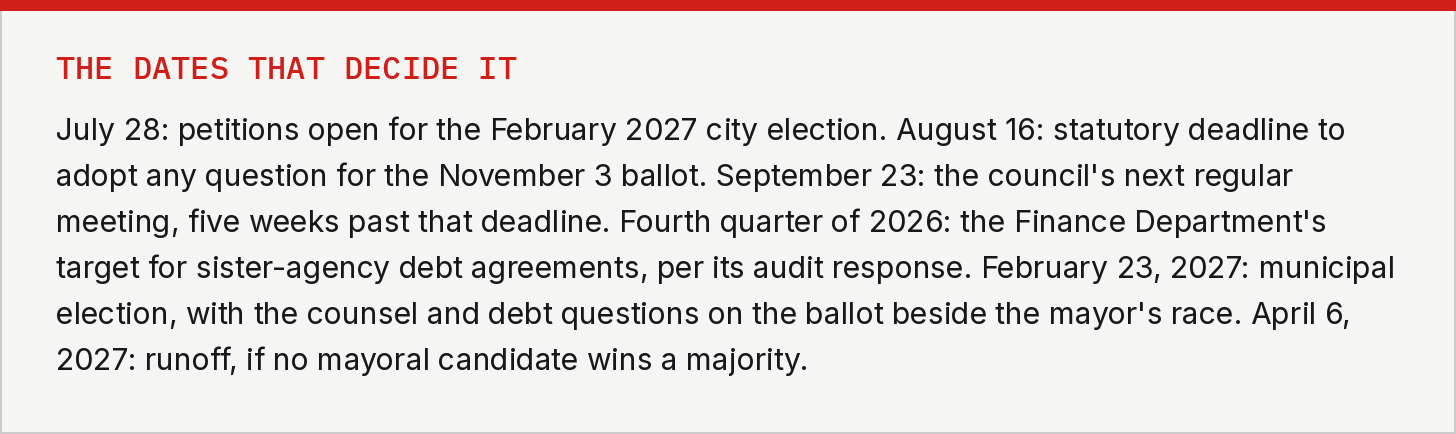
Petitions for the February 23, 2027 municipal election open Tuesday, July 28. Mayoral candidates need 12,500 signatures. The counsel question and the mayor’s race will share that ballot, which, as Johnson noted, has no candidates on it yet.
The November millionaire tax ordinance requires council adoption by August 16. The council’s next regular meeting is September 23. The February version stays locked behind Wednesday’s three questions. Johnson says he will pursue the tax with Speaker Welch in the General Assembly, the state legislature.
The council returns September 23 at 10 a.m.
GrayStak requested comment from the Mayor’s Office, the Law Department, and the offices of Alds. Reilly, Waguespack, Ervin, Beale, Villegas, Yancy, and Sigcho-Lopez on the morning of July 23, 2026, with responses requested by 2 p.m. The Mayor’s Office responded on background; its responses, including the statutory basis provided for the Corporation Counsel position, are reflected above. The Law Department did not respond separately. The aldermanic offices did not respond by the deadline.
GrayStak Media attended the July 22 session and the mayor’s press availability. Floor quotations are verified against the City Clerk’s session recording and GrayStak’s contemporaneous notes; press availability quotations are verified against GrayStak’s audio recordings. The questions attributed to GrayStak at the press availability were asked by the author. Statutory citations reflect GrayStak’s reading of the cited texts and are not legal advice. GrayStak corrects the record promptly: christopher@graystak.com.
Christopher Sweat covers Chicago and Illinois government from the public record, reporting local social and political dynamics for a national and international audience. He also reports on national security policy, intelligence oversight, public finance, and the defense technology sector. He is an analyst working across finance, technology, and politics, and CEO and Co-Founder of GrayStak. GrayStak is a media and political risk company. Our real-time Domestic Political Volatility Index (DPVI) measures the velocity and volatility of U.S. domestic politics. We cover political and institutional risk across the United States, centered in Washington, D.C., New York, and Chicago.